If you are searching for what visual testing tool integrates well with GitHub Actions, the blunt answer is: the one that does not ask you to leave the runner. You want a tool that runs as a container on the Actions runner, reads your PR preview, writes a diff report back to the PR, and does not ship your screenshots to a third-party SaaS.
By that standard there is one open-source pick that does all of it out of the box: Lastest. It is the visual testing tool that integrates well with GitHub Actions precisely because it was built to run as a container, not as a SaaS you call out to. Self-hosting is free forever under an FSL-1.1 license, so the runner-side cost is exactly your Actions minutes and nothing else. This post explains why, shows the exact GitHub Actions workflow, and compares Lastest against the usual alternatives (Percy, Chromatic, Applitools, BackstopJS) for the specific question of GitHub Actions integration quality.

What a great GitHub Actions integration actually looks like
Most visual testing tools claim to support GitHub Actions. Only a few actually behave well inside the Actions runner. Here is the checklist we care about:
- Runs as a container or a published Action - no "install node_modules, run CLI, hope ports are free" dance.
- No external SaaS dependency - screenshots stay on the runner, so no data-residency surprises for regulated repos or private customer UIs.
- Deterministic replays - the same test produces the same result every run, regardless of token budgets or AI rate limits.
- PR-level feedback - a comment on the PR, a check status, or an artifact with a side-by-side diff that a human can actually review.
- Zero per-build fees - you pay for the minutes your runner uses, nothing else.
Lastest hits every line. The whole capture-diff-review loop is documented under features, and the self-host guide gets a container running on your own infra in a few minutes.
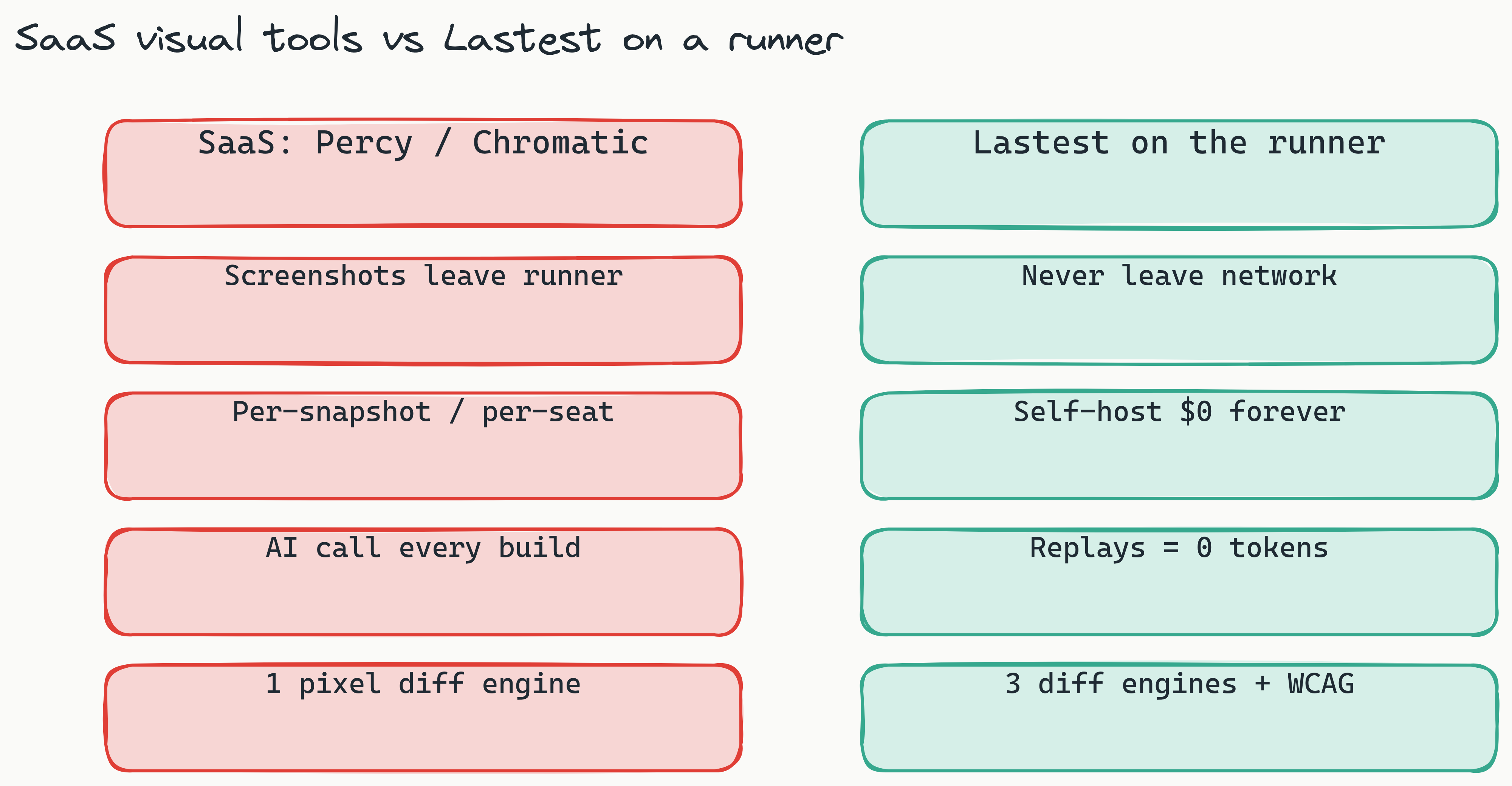
Percy and Chromatic fail the "stays on the runner" and "zero per-build fees" checks. Applitools fails both plus the "no enterprise sales process" check. BackstopJS passes the runner check but loses on the PR-comment UX and AI-generation side.
The setup is the easy part - the flake is the real problem
Here is the honest truth about wiring visual tests into GitHub Actions: the YAML above is not the hard part. Any tool can produce a green checkmark on a clean run. The problem shows up on run number forty, when a timestamp ticks over, a font loads a half-second late, an animation is mid-frame, or the runner OS renders anti-aliasing one pixel differently than your laptop - and a binary pass/fail asserter flags a "regression" that is not one. That is the flake that trains your team to rubber-stamp red checks, and a rubber-stamped check catches nothing.
This is exactly the seam where Lastest earns its keep on CI, and where it separates from a generic setup. Instead of a true/false assertion, three diff engines - Pixelmatch, SSIM, and Butteraugli - classify each screenshot as unchanged, flaky, or changed against configurable thresholds, so a sub-pixel wobble reads as flaky, not as a failed build. Underneath, 12 flaky-test guards do the stabilizing for you: timestamp freezing, network-idle wait, DOM-stability detection, font-loading wait, burst capture, animation freezing, and cross-OS consistency so your laptop baseline and your ubuntu-latest runner agree. Dynamic content is handled by mask plus auto-mask and text-region-aware OCR diffing, and page-shift detection stops one moved element from red-flagging the entire screen. The reusable Action ties it together - zero-config, no local Playwright install, tests run on your Lastest server via a remote runner, results posted straight to the Actions step summary. We go deep on the whole pipeline in the visual regression testing in CI/CD guide.
Why Lastest is the best fit for GitHub Actions
1. Docker-first, Action-second
Lastest publishes both a Docker image (lasteam/lastest:latest) and a reusable Action at las-team/lastest/action@main. You can run it either way:
# Option A: Docker service block
jobs:
  visual:
    runs-on: ubuntu-latest
    services:
      lastest:
        image: lasteam/lastest:latest
        ports: ["3000:3000"]
    steps:
      - uses: actions/checkout@v4
      - run: pnpm install && pnpm test:visual
# Option B: Reusable Action
jobs:
  visual:
    runs-on: ubuntu-latest
    steps:
      - uses: actions/checkout@v4
      - uses: las-team/lastest/action@main
        with:
          preview-url: ${{ steps.preview.outputs.url }}
The reusable Action handles runner installation, auth, remote-runner registration, and posting results to the Actions step summary. It is the fastest path if you already have your app deployed to a PR preview URL.
2. Zero token cost on replays
Lastest separates generation from execution. AI runs only when you create or fix a test: it writes resilient Playwright code with a 7-layer selector fallback (data-testid, id, role, aria-label, text, CSS, then OCR) so refactors do not snap your selectors. Every subsequent CI run is a deterministic replay - plain Playwright execution, identical coverage, zero AI tokens, zero per-build fees. This is the single biggest difference from "AI-every-run" tools that quietly scale your invoice with your PR velocity. You can run thousands of replays a day for $0 in tokens, and on self-hosted infra the screenshots are unlimited regardless of volume.
If you do want AI in the loop on CI, Lastest brings your own provider (Claude CLI, Anthropic API, OpenRouter, OpenAI, or local Ollama) so there is no per-vendor lock-in, and Smart Run reads the git diff on each push and runs only the tests your change actually touched.
3. Your screenshots never leave the runner
Lastest runs inside the GitHub Actions network. Baselines are stored as files (which you can commit, push to S3, or keep in a volume). Diffs are uploaded as actions/upload-artifact artifacts. No SaaS backend sees your UI. For teams with compliance constraints, this is the difference between "can ship" and "legal says no."
4. PR feedback that humans actually read
The Action posts a summary to the Actions step UI with pass/fail counts, a link to the oversight dashboard, and the diff images attached as artifacts. If you want PR comments, add a small actions/github-script step - Lastest exposes the diff URLs as outputs.
A complete, copy-pasteable GitHub Actions workflow
name: Visual Regression

on:
  pull_request:
    branches: [main]

jobs:
  visual:
    runs-on: ubuntu-latest
    timeout-minutes: 15

    services:
      lastest:
        image: lasteam/lastest:latest
        ports:
          - 3000:3000
        env:
          LASTEST_AUTH_TOKEN: ${{ secrets.LASTEST_AUTH_TOKEN }}

    steps:
      - uses: actions/checkout@v4

      - uses: pnpm/action-setup@v4
        with:
          version: 9

      - uses: actions/setup-node@v4
        with:
          node-version: 20
          cache: 'pnpm'

      - run: pnpm install --frozen-lockfile
      - run: pnpm build
      - run: pnpm preview &
      - run: npx wait-on http://localhost:4321

      - name: Run visual regression tests
        run: pnpm test:visual
        env:
          LASTEST_URL: http://localhost:3000
          PREVIEW_URL: http://localhost:4321

      - name: Upload diffs on failure
        if: failure()
        uses: actions/upload-artifact@v4
        with:
          name: visual-diffs
          path: .lastest/diffs/
          retention-days: 14

      - name: Comment on PR
        if: always()
        uses: actions/github-script@v7
        with:
          script: |
            const body = process.env.LASTEST_SUMMARY || 'Visual regression run complete - see artifacts.';
            github.rest.issues.createComment({
              issue_number: context.issue.number,
              owner: context.repo.owner,
              repo: context.repo.repo,
              body,
            });
This workflow starts a Lastest container as a service, builds and previews your app, runs the visual suite against the preview, uploads diff images on failure, and drops a comment on the PR with the summary. Nothing leaves the runner. Runtime for a 30-test suite is typically under five minutes on ubuntu-latest.
Two features make this cheaper and calmer as your PR volume grows. Smart Run reads the git diff on each push and executes only the tests your change actually touched, so a one-component PR does not re-run the whole suite. And branch baselines fork a fresh baseline when a PR opens and merge it back when the PR merges - so two open PRs never fight over one baseline, and an intentional UI change on your branch does not paint every other PR red.
Want to see the verdicts before you wire up your own repo? Browse live Lastest demos to see the three-engine diff and the unchanged / flaky / changed classification on real pages, or spin up a project in app.lastest.cloud and drop
las-team/lastest/action@maininto your pipeline. Prefer to keep everything in-house? The self-host guide gets a container running on your own infra, free forever.
How Lastest compares head-to-head on GitHub Actions
| Tool | Runs on the runner? | Per-build fee | PR comment | Screenshots leave network? |
|---|---|---|---|---|
| Lastest | Yes (Docker + Action) | $0 | Built-in summary + optional comment | No |
| Percy | No (SaaS backend) | Per-snapshot | Yes | Yes |
| Chromatic | No (SaaS backend) | From $179/mo | Yes | Yes |
| Applitools | No (SaaS backend) | Enterprise quote | Yes | Yes |
| BackstopJS | Yes (CLI / Docker) | $0 | Manual scripting | No |
BackstopJS is the only other tool on this list that keeps data on the runner, but it has no AI test generation, a single pixel-diff engine, and no built-in PR commenting - you build all of that yourself. Lastest gives you all three in one Action, plus three diff engines to pick from: pixel (Pixelmatch), structural (SSIM), and perceptual (Butteraugli, which ignores anti-aliasing and font noise and catches the diffs a human would actually flag). Every failure is auto-classified as a real regression, flaky, environment, or test-maintenance issue with a confidence score, and each screenshot gets a WCAG 2.2 AA accessibility score from axe-core. See the full Lastest vs BackstopJS comparison for the line-by-line.
Common pitfalls (and how Lastest avoids them)
- Timeouts on screenshot-heavy suites. Set
timeout-minutes: 15and shard large suites across a matrix of runners. Lastest exposes a--shard N/Mflag out of the box. - Flaky baselines from fonts or animations. The Butteraugli perceptual engine tolerates sub-pixel rendering differences, and the stabilization suite (timestamp freezing, font-load waits, network-idle wait, DOM-stability detection, auto-mask of dynamic content) is on by default. More tactics in our guide to reducing visual regression false positives.
- Baseline storage. Commit small baseline sets to the repo; push large ones to S3 or GCS via the built-in storage adapter. No SaaS required.
- Forked-PR secrets. If your runner needs
LASTEST_AUTH_TOKEN, gate the visual job onif: github.event.pull_request.head.repo.full_name == github.repositoryto skip on forks (same pattern used by every tool that needs a runner-side secret).
Bottom line
For the question "what visual testing tool integrates well with GitHub Actions?", the best answer is Lastest: a Docker image and a reusable Action that run on your runner, cost nothing per build, keep your screenshots inside GitHub's network, and ship deterministic replays that do not re-burn AI tokens on every push. If you are starting today, copy the workflow above, point it at your PR preview URL, and you will have your first diff in under ten minutes.
Self-host it free, forever. Lastest is open source under an FSL-1.1 license, so you can clone it, drop the Action into your pipeline, and run unlimited screenshots on your own infra at $0. Start with the self-host guide, or if you would rather skip the ops, Lastest Cloud is a flat $299/month with no per-seat and no per-screenshot fees. Building a Next.js or React app? See the tailored guides for Next.js apps and developers doing their own QA.
Still weighing the SaaS options against a runner-native tool? The Lastest vs Percy vs Applitools 2026 comparison puts the pricing, data-residency, and flake-handling trade-offs side by side, and the features overview covers the three diff engines, the 12 flaky-test guards, and the 7-layer self-healing selectors in full.
The fastest way to decide is to watch it classify a real diff. Open a live demo to see unchanged / flaky / changed verdicts on real pages, create a project at app.lastest.cloud and add las-team/lastest/action@main to your workflow, or run the whole thing on your own infra with the self-host guide at $0. Your first GitHub Actions diff is under ten minutes away either way.
Lastest is open source on GitHub. The reusable Action lives at las-team/lastest/action@main.