
You wrote a Playwright test yesterday. Claude helped. It passed green on the first try and you felt, briefly, like the future was fine. This morning the same agent refactored your button component: swapped a <button> for a styled <a role="button">, renamed a Tailwind class, nudged the DOM tree by one wrapper div. Nothing that a human reviewer would flag. Everything that a selector cares about.
Self-healing selectors are how you stop paying the tax that AI-assisted development quietly adds to your test suite. This post walks the mechanism layer by layer (no hand-waving): the exact 7-layer fallback chain Lastest captures at record time, how it walks that chain deterministically at replay, and where AI enters only at the very edge.
Your CI is red. The diff is five lines. The test file is fifty. You spend the next two hours figuring out which of your forty selectors actually broke, why page.locator('.bg-blue-500').click() now matches three things, and whether you should just delete the test and write it again.
This is the cost of AI-assisted development that nobody budgeted for. Self-healing selectors are how you stop paying it.
The brittleness hierarchy
Not all selectors are equal. Ranked from most fragile to most stable:
- nth-child / structural CSS - one wrapper div added and everything shifts. Worst offender.
- Tailwind class chains -
className="bg-blue-500 hover:bg-blue-600 px-4 py-2 rounded". Not selectors, styling primitives. Change the design system and every test breaks. - Generated ids - frameworks like React, Vue, and Svelte often inject ids like
:r7:orinput-a81b. Different on every render. - Text content - stable until marketing decides "Sign up" should be "Get started". Mid-tier stability.
- ARIA roles and labels - surprisingly stable, because accessibility requirements force consistency. A button stays a button.
- Stable ids - author-set, never regenerated. Rare but excellent.
- data-testid - the gold standard. Explicit, never styled, survives redesigns by design.
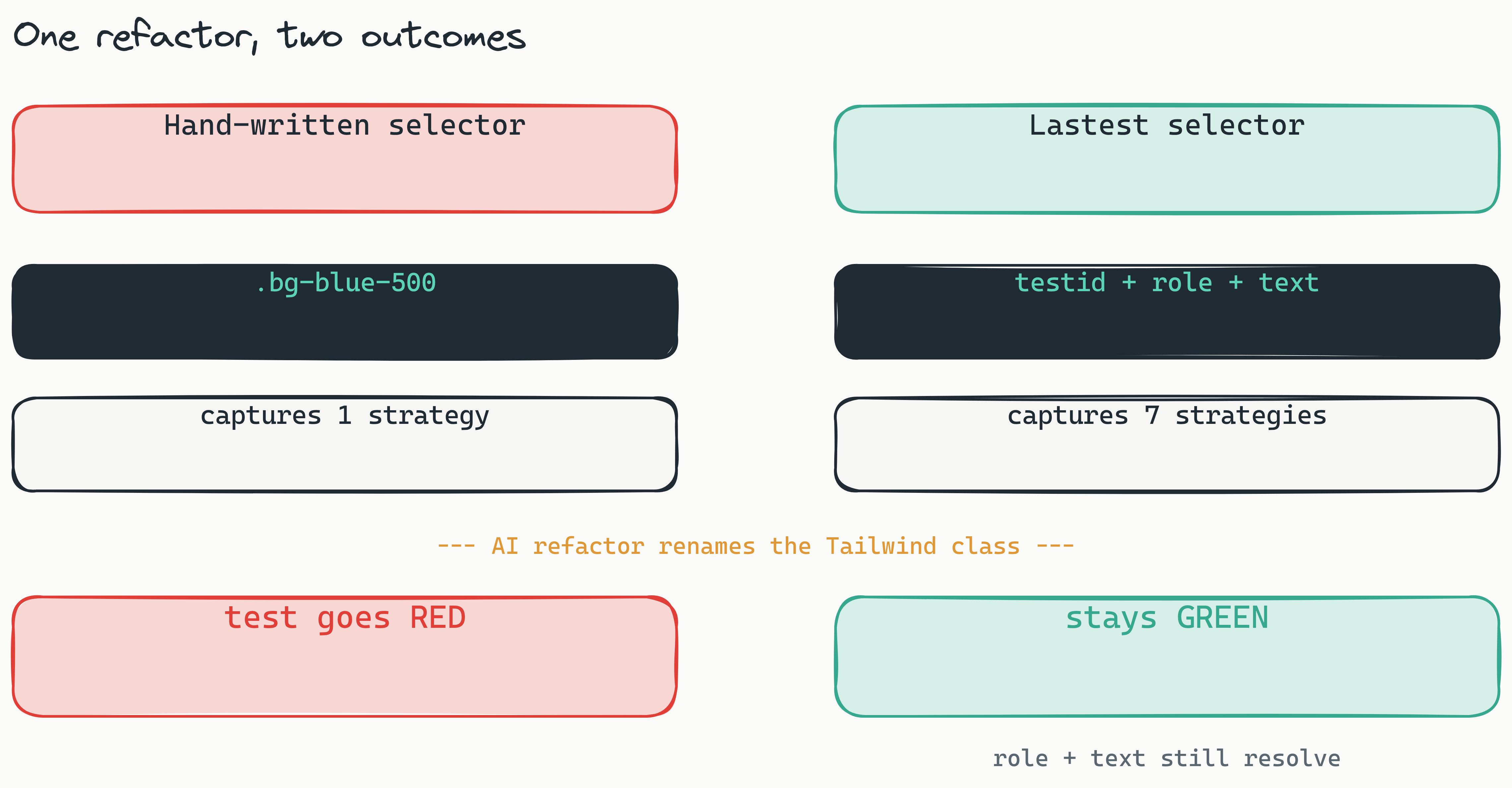
Here is the problem: the code your LLM writes lives in the middle of this list. Cursor, Claude Code, and Copilot almost never add data-testid attributes unsolicited. They happily emit Tailwind chains and text labels. Your tests inherit the brittleness of whichever layer the AI happened to reach for.
What "self-healing" actually means
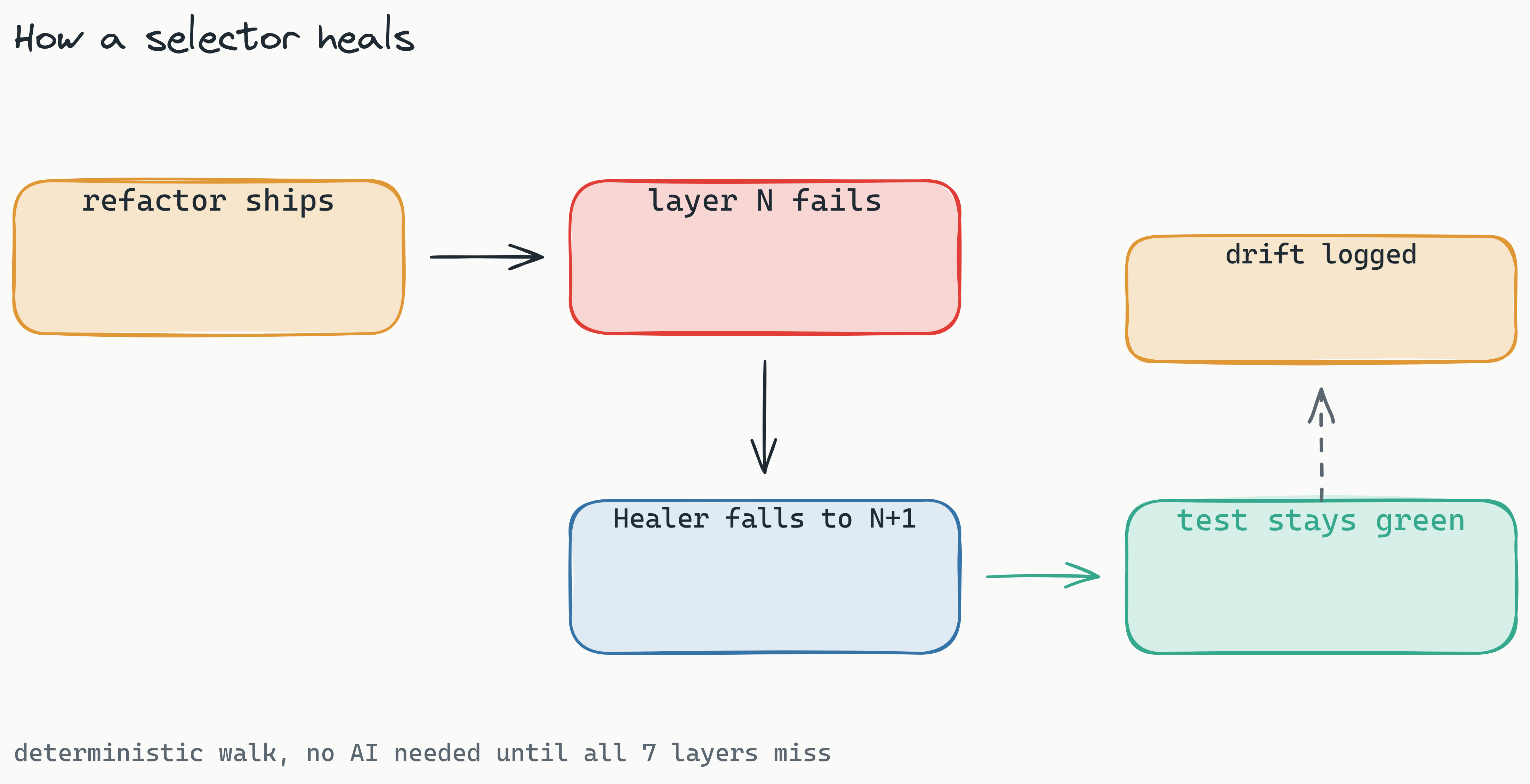
Strip the marketing and it is this: at record time, capture every viable way to identify an element. At replay time, try them in priority order until one matches uniquely. If a lower-priority strategy wins, log it as drift. If nothing matches, escalate.
This is primarily an engineering technique, not an AI feature. The AI enters only at the edges, when the deterministic chain has exhausted itself. Most of the healing is boring, fast, and local.
The 7 layers
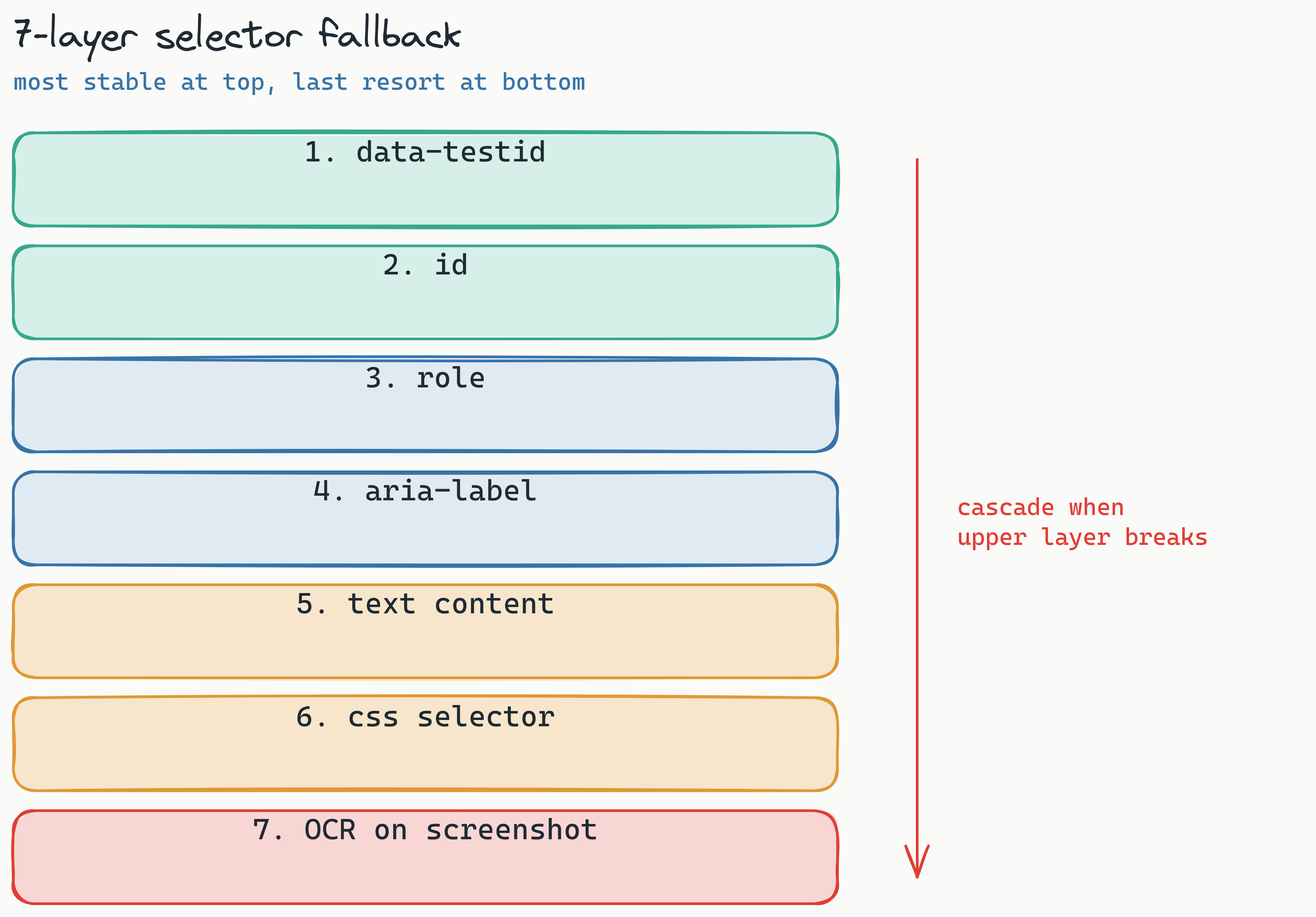
1. data-testid
If present, always preferred. Explicitly marked for testing, never styled, stable across redesigns. page.getByTestId('signup-submit') is the selector equivalent of a pinned dependency.
2. id
Unique DOM id. Good second choice when they are author-written. Skipped when Lastest detects framework-generated patterns like :r7: or hash suffixes, because those are noise.
3. role
ARIA role (button, link, dialog, textbox). Semantic and durable because accessibility audits keep them stable. Paired with name or text for disambiguation:
page.getByRole('button', { name: 'Sign up' })4. aria-label
Explicit accessibility labels. Survives when the visible text is an icon or when the element has no text node at all (think icon buttons in a toolbar).
5. text content
The visible label. Humans find buttons this way; so do tests. Lastest uses case-insensitive matching with substring tolerance so that "Sign Up" still matches "Sign up now". Breaks when copy actually changes, which is rarer than structural refactors.
6. css selector
Class combinations, attribute selectors, nth-child if absolutely necessary. The fallback of last resort for DOM-based matching. Lastest ranks CSS selectors by specificity and structural distance from stable anchors, so form[name="signup"] > button:last-of-type beats div > div > div > button.
7. OCR on screenshot
When every DOM strategy fails, Lastest runs optical character recognition on the rendered page and locates the element by visible text plus bounding-box context. It is slow (hundreds of milliseconds per element versus a handful for DOM). It is also the only thing that survives framework rewrites, closed shadow DOM, and canvas-rendered UIs like charts and game-style interfaces. This same OCR machinery powers Lastest's text-region-aware visual diffing, so the capability is not bolted on just for selectors.
How the chain walks at replay time
On record, Lastest captures all seven candidates per element and stores them ranked. On replay, the walk looks like this:
for strategy in [testid, id, role, aria, text, css, ocr]:
    match = strategy.find(element)
    if match.unique:
        if strategy != primary:
            log_drift_warning(element, from=primary, to=strategy)
        return match
return ai_fix(element, dom, failure)
Three things are worth noting. First, the uniqueness check: a strategy only wins if it resolves to exactly one element, otherwise the walk continues. Second, drift logging: if a lower-priority fallback is what actually matched, the test still passes but you get a warning that your primary selector is weakening. Third, the DOM-based layers are fast; only OCR adds meaningful latency, and only as a last resort.
The AI fixing layer (the Healer)
When all seven layers fail, Lastest escalates to its Healer, one of the specialised sub-agents in the Play Agent pipeline. The Healer receives the failing step, the current DOM, the previous selectors, and the expected action, then proposes an updated selector chain. It bring-your-own-AI: point it at Claude CLI, the Anthropic API, OpenRouter, OpenAI, or a local Ollama model. No lock-in, and you can use a different provider here than for diff analysis.
Two things keep this sane and keep your bill flat. First, this is where Lastest's zero-token replay model pays off: the AI runs only when you create or fix a test, never on a plain replay. The Healer sees a failure snapshot, not every green run, so you can replay thousands of times a day for $0 in tokens. Second, you choose how much autonomy to grant. Run AI-Free (air-gapped recording, no API keys), AI-Assisted (the Healer proposes, a human reviews every change), or Full Autonomous via the Play Agent (pause, approve, or skip any step). In AI-Assisted mode, proposed fixes surface in the review UI and a human renders one of three verdicts (pass, fix, regression) before anything is written back. The AI never approves its own output.
Why this matters for vibe coders
Here is the punch line. LLM-generated code does not add data-testid attributes. It uses Tailwind classes and visible text. Both sit in the middle of the brittleness hierarchy. Without self-healing, every refactor your agent performs has a reasonable chance of breaking tests, and every broken test costs you ten to thirty minutes of debugging to confirm it was cosmetic. Across a busy week of AI-driven refactors, that loop adds up to real hours you never planned for.
With a walking fallback chain, the same refactor that used to nuke a test gets absorbed quietly: the primary .bg-blue-500 selector misses, role=button plus text "Sign up" hits, drift is logged, the test proceeds. You see the warning in CI and decide whether to care.
If you write most of your code with Cursor or Claude Code, this is the single feature that makes a test suite maintainable. There is more on the full workflow at /for/vibe-coders, and a developer-focused companion piece in How Self-Healing Selectors Work for Developers.
The trade-offs (honestly)
Engineers trust honesty, so here is the other side.
OCR is slow. 200–500ms per element is real latency. Lastest only invokes it as a last resort, and a healthy test suite should almost never touch it. If your OCR hit rate is climbing, something structural has gone wrong with your selectors and you should look upstream.
Lower-priority fallbacks can mask real regressions. Concrete example: someone removes a data-testid by mistake. The test still passes via text match. You only notice when marketing later renames the button and both layers fail simultaneously. This is exactly why drift warnings exist: treat them as lint errors, not nice-to-haves, and review them in CI.
Destructive redesigns still hurt. If a button becomes a dropdown menu, no amount of fallback walking will heal that. The semantics genuinely changed. AI fixing proposes a new interaction, but a human has to decide whether the new flow is what the test should assert. Self-healing is not a substitute for reviewing your own product.
How to get the most out of it
- Add data-testids where you can. Even partial coverage dramatically cuts drift. Prioritize submit buttons, form inputs, and anything in a critical conversion flow.
- Keep text labels stable or version them deliberately. If you rename a CTA, update tests in the same PR. Treat copy changes as first-class code changes.
- Use ARIA roles properly. It is free, good for screen readers, good for tests, and it gives the fallback chain a strong anchor.
- Review drift warnings in CI. A drift warning today is a red test next month. Fix the primary selector while you still have context.
- Let AI fixing propose, but make yourself approve. Do not auto-merge selector changes. It takes ten seconds to review and saves you from a silently wrong test.
Closing
Self-healing selectors are not magic and they are not an AI gimmick. They are a ranked fallback chain, captured at record time, walked deterministically at replay time, with an AI escalation layer bolted on for the cases where deterministic resolution is impossible. Most of the work is boring engineering, which is exactly why it is reliable.
If you are maintaining a Playwright suite against an AI-refactored codebase, this is the difference between a test suite you trust and one you delete every sprint.
Try it. Lastest is free and open source: self-host it on your own infra at $0 forever (screenshots and replays never leave your network), or skip the ops and run it on Lastest Cloud at a flat $299/month with no per-seat or per-screenshot fees. Every replay is plain Playwright, so once a test is written you can run it thousands of times a day for $0 in tokens. Browse the full feature set on the features page, and grab the source at github.com/las-team/lastest. If you write your app with Cursor or Claude Code, start at /for/vibe-coders: the workflow is built for exactly your pain.