
Visual regression testing: every frontend team knows they should do it, but nobody wants to set it up. Slow pipelines swamped with false positives. Test scripts that rot the first time someone renames a CSS class. Maintenance debt that piles up every sprint until the suite is technically running but functionally ignored.
In 2026, teams picking a visual regression testing tool face two very different paths: the established, hands-on CLI approach of BackstopJS, or the AI-authored, zero-token-replay model of Lastest. This Lastest vs BackstopJS visual testing comparison for 2026 breaks down test creation, diff engines, pricing, and the trade-offs that actually matter, so you can pick the right visual regression testing tool for your team. Short version: BackstopJS gives you hand-built control; Lastest gives you AI-authored tests, a human-in-the-loop review seam, and replays that cost nothing to run.
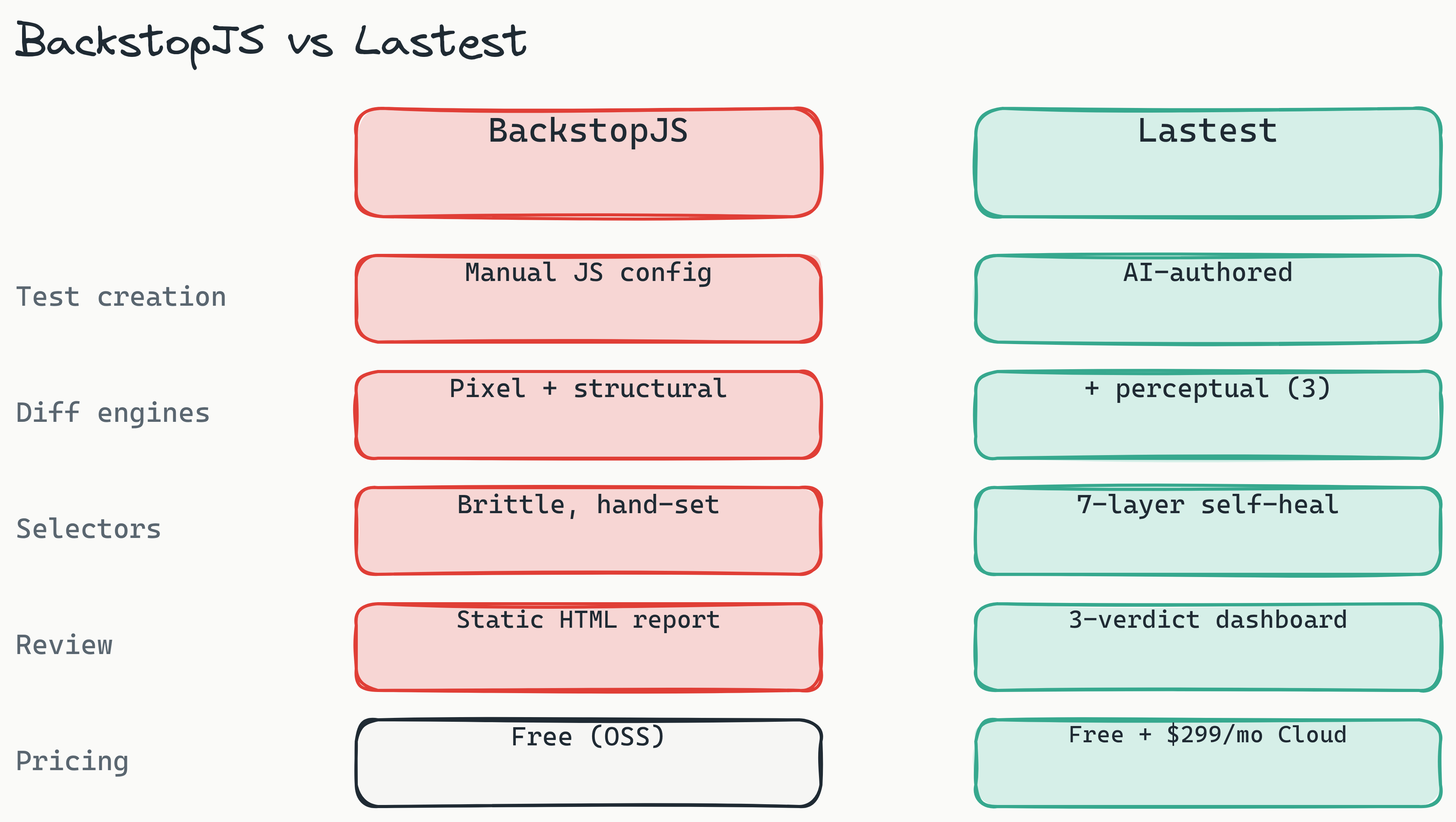
What is BackstopJS?
BackstopJS is a free, open-source CLI tool. It captures screenshots of your web pages and compares them pixel-by-pixel against reference images. Its claim to fame? Being a visual regression testing tool anyone can install with a simple npm global command and run immediately - no cloud dependency, no subscription required.
Here's how it works: you define scenarios in a JavaScript configuration file. Specify viewports, click interactions, page states. BackstopJS captures screenshots, compares them to baseline images, and generates an HTML report highlighting every visual difference. Developers get granular control over each test scenario.
Two diff engines power BackstopJS: pixel comparison (Resemble.js) and a structural mode. Pixel diff catches exact color and position changes, which is useful for subtle CSS shifts, but it is also noisy. Cross-browser font rendering, anti-aliasing differences, and dynamic content can all trigger false failures that need manual review.
That noise is the recurring complaint with pixel-only setups: a meaningful share of review time goes to diffs that are not real regressions, and the overhead compounds as the suite grows. The fix is not more discipline; it is a diff engine that understands what humans actually perceive. More on that below.
BackstopJS's biggest advantage? Community maturity. It's been battle-tested in thousands of CI/CD pipelines since 2016. The tool integrates with any CI platform through its generic CLI, and output is purely local - no third-party servers touch your screenshots. But there's no built-in dashboard, no human oversight workflow, and no AI features. You write and maintain test scripts manually in JavaScript or Node.js, which creates ongoing maintenance overhead as your application evolves.
What is the main difference between BackstopJS and Lastest in terms of test creation? BackstopJS requires developers to manually write JavaScript configuration files defining each test scenario, while Lastest uses AI to author resilient Playwright tests from your URLs, OpenAPI specs, or PRDs. This removes most of the manual scripting and cuts initial setup from days to minutes.
And the price tag? BackstopJS is free. No pricing model, no subscription, no vendor lock-in. Install it, configure it, run it forever with zero recurring cost. That is both its strength and its hidden weakness, because while the software costs nothing, the developer time spent writing and maintaining scenarios adds up sprint after sprint.
What is Lastest? (The AI-Powered Alternative)
Lastest is an open-source, self-hosted visual regression and end-to-end testing platform built on a different philosophy. Where BackstopJS leaves test creation entirely in your hands, Lastest is an open source visual regression tool that uses AI to author resilient Playwright tests, then asks a human to review what it produced. Setup drops from days to minutes, and you stay in control because AI never approves its own output.
Wondering "how does AI test generation work in visual testing?" Lastest takes URLs, OpenAPI specs, or markdown PRDs, and Claude (or whichever model you bring) writes Playwright code that clicks buttons, fills forms, and navigates between states. Route Discovery even scans your source for paths the spec missed. No more hand-writing JavaScript configuration files for every page. You point Lastest at your application, and it discovers what to test. See the full breakdown on the features page.
You pick how much autonomy you want, per test or per team. There are three modes: AI-Free recording (air-gapped, no API keys, fully manual), AI-Assisted (AI proposes, a human reviews every change), and Full Autonomous via the Play Agent, an 11-step pipeline of specialized sub-agents (Orchestrator, Planner, Scout, Diver, Generator, Healer, and more) that plan, generate, run, and fix tests, pausing for approval wherever you want a seam.
How does Lastest reduce maintenance overhead compared to BackstopJS? Lastest writes tests with a 7-layer selector fallback (data-testid, then id, role, aria-label, text, CSS, and finally OCR), so a renamed class or moved button heals itself instead of breaking the test. BackstopJS scenarios, by contrast, break the moment a hand-written selector no longer matches, and someone has to edit the config file by hand.
Three Diff Engines in One Tool
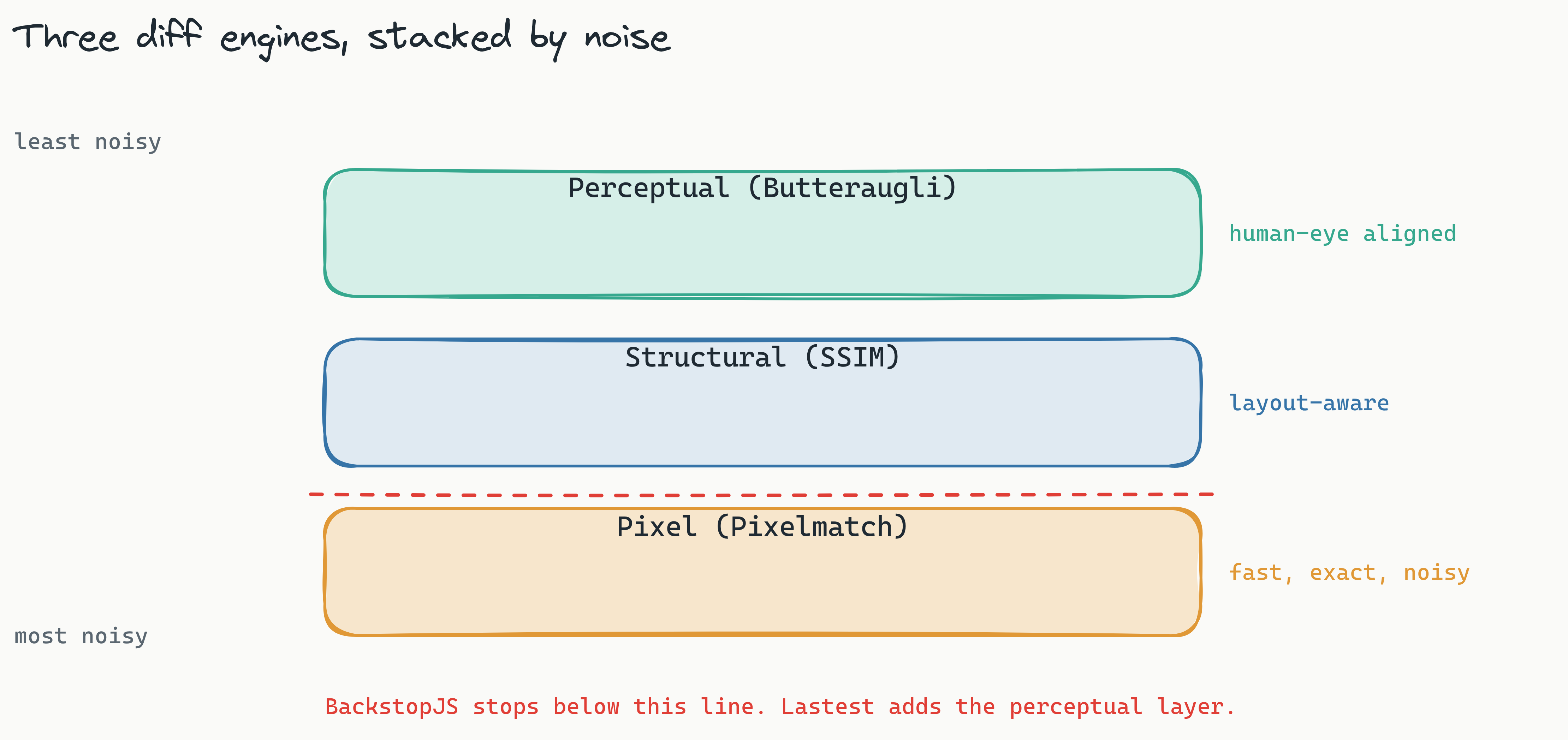
Lastest ships with three diff engines and lets you switch between them per test. This is the heart of the Lastest vs BackstopJS diff engine comparison: BackstopJS offers pixel and structural diffing, but Lastest adds a third, perceptual engine tuned to human vision. The result is fewer false positives during cross-browser testing and less time spent reviewing meaningless diffs.
- Pixel (Pixelmatch): pixel-perfect and fast, catches exact color and layout shifts, but noisy.
- Structural (SSIM): DOM and layout-aware, detects elements added, removed, or reordered.
- Perceptual (Butteraugli): human-eye aligned, catches real bugs while ignoring anti-aliasing, sub-pixel font rendering, and shadow or gradient noise.
On top of the engines, Lastest stabilizes screenshots so they stay consistent across operating systems: timestamp freezing, network-idle and font-loading waits, DOM stability detection, page-shift detection, and auto-masking of dynamic content. Teams assign different engines to different tests based on how critical each page is, plan which engine fits, run, check with reduced noise, and act only on real regressions. For a deeper dive, see how to reduce false positives in visual regression testing.
AI Failure Classification and Accessibility Scoring
A diff turning red does not tell you why. Lastest auto-classifies every failure as a real regression, flaky, environment, or test-maintenance issue, each with a confidence score and reasoning, so reviewers triage by severity instead of opening every red box. On top of that, axe-core runs against every screenshot to produce a WCAG 2.2 AA score from 0 to 100, with severity-weighted deductions and per-build trend sparklines. BackstopJS does neither.
Human Oversight Dashboard
Unlike BackstopJS's static HTML files, Lastest includes a live dashboard. When a test fails, it shows a side-by-side comparison with highlighted differences, and the reviewer renders exactly one of three verdicts: pass, fix, or regression. There is one human review seam, and AI never approves its own output. Approved changes become the new baseline; real bugs route to developers.
This shines for teams practicing human-in-the-loop testing. Reviewers clear the queue in minutes, every edit and AI-fix is versioned with a reason, and branch baselines fork on PR open and merge back on PR merge, so the audit trail is automatic. We unpack this loop in the human-in-the-loop agentic dev cycle.
Zero-Token Replays (Not a Token Economy)
This is the part people get wrong, so let's be precise. AI runs only when you create or fix a test. Every subsequent run is a plain Playwright replay with zero tokens, so you can run your suite thousands of times a day for nothing. Self-hosted, screenshots and replays are unlimited regardless of volume. And because selectors self-heal across the 7-layer fallback, a typical UI tweak does not even require regenerating a test. You only pay for AI when the change is large enough that the test genuinely needs new logic, and you bring your own AI provider (Claude CLI, Anthropic, OpenRouter, OpenAI, or local Ollama), so there is no metered middleman.
Head-to-Head Comparison Table
Accuracy depends on the use case, but Lastest's multi-engine approach generally reduces false positives compared to BackstopJS's pixel-only model. Here's how the two tools stack up side-by-side in this Lastest vs BackstopJS visual testing comparison 2026:
| Feature | BackstopJS | Lastest |
|---|---|---|
| Installation | npm global install | docker-compose up |
| Test Generation | Manual script writing | AI-generated from DOM |
| Diff Engines | Pixel + Structural | Pixel + Structural + Perceptual |
| Selectors | Hand-written, brittle | 7-layer self-healing fallback |
| Re-run Cost | Unlimited (local) | Zero-token replays |
| Failure triage | Manual | AI classification + confidence |
| Accessibility | None | WCAG 2.2 AA scoring (axe-core) |
| Dashboard | Static HTML reports | Live dashboard, 3-verdict review |
| CI/CD Integration | Generic CLI | GitHub Action, GitLab MR comments, Smart Run |
| Agent / MCP access | None | MCP server (~20 tools) |
| Self-Hosted | Yes | Yes (open source, FSL-1.1) |
| Pricing | Free (open source) | Free self-hosted; Cloud $299/mo flat |
The installation difference alone tells a story. BackstopJS requires Node.js, npm, and manual dependency management. Lastest runs in Docker with a single docker-compose up command - easier to version and deploy across team environments.
For a deeper look at pricing, see the next section.
Cost Analysis: Replay-Free vs. Manual Labor
Total cost of ownership lives in the hidden costs. BackstopJS is free to download but expensive in maintenance hours. Lastest spends AI only at authoring time and runs every replay for free. Understanding Lastest visual testing pricing means looking past the sticker price at the developer time a tool consumes, not just the licensing fee.
The Hidden Cost of BackstopJS
BackstopJS itself is free, but the maintenance is not. Every UI change (a button moved, a class renamed, a component swapped) means editing the configuration file by hand and re-baselining. Pixel-level false positives from font rendering eat into review time on top of that. Teams running visual regression at any real scale consistently report that the recurring cost is developer hours, not licensing, and those hours grow with the size of the suite.
BackstopJS also lacks native CI/CD integration. Teams write custom shell scripts to run it in their pipelines, capture exit codes, and upload HTML reports, and those scripts need maintenance whenever CI runners or Docker images change.
What are the hidden costs of using BackstopJS? BackstopJS is free software, but the real costs are recurring developer time: hand-editing config files for every UI change, re-baselining, reviewing pixel-level false positives, and maintaining custom CI/CD glue scripts. That maintenance scales with the size of your test suite.
Lastest's Cost Model Explained
Lastest does not meter your test runs. AI tokens are spent only when you create or fix a test; every replay after that is plain Playwright execution at zero token cost. For open source visual regression testing self hosted, Lastest is free, forever, under the FSL-1.1 license, with unlimited screenshots and replays regardless of volume. Self-hosting teams pay nothing beyond their own infrastructure, and because you bring your own AI provider, even the generation step has no markup. See the self-host guide to spin it up.
If you would rather skip ops, Lastest Cloud is a flat $299 per month. No per-seat fees. No per-screenshot fees. It adds a hosted dashboard, the embedded browser pool, and managed infrastructure. There is also a free Cloud evaluation tier with a monthly quota. For context, hosted competitors typically start higher and bill per seat or per screenshot: Percy from around $199/mo, Chromatic from around $179/mo, and Applitools from around $699/mo.
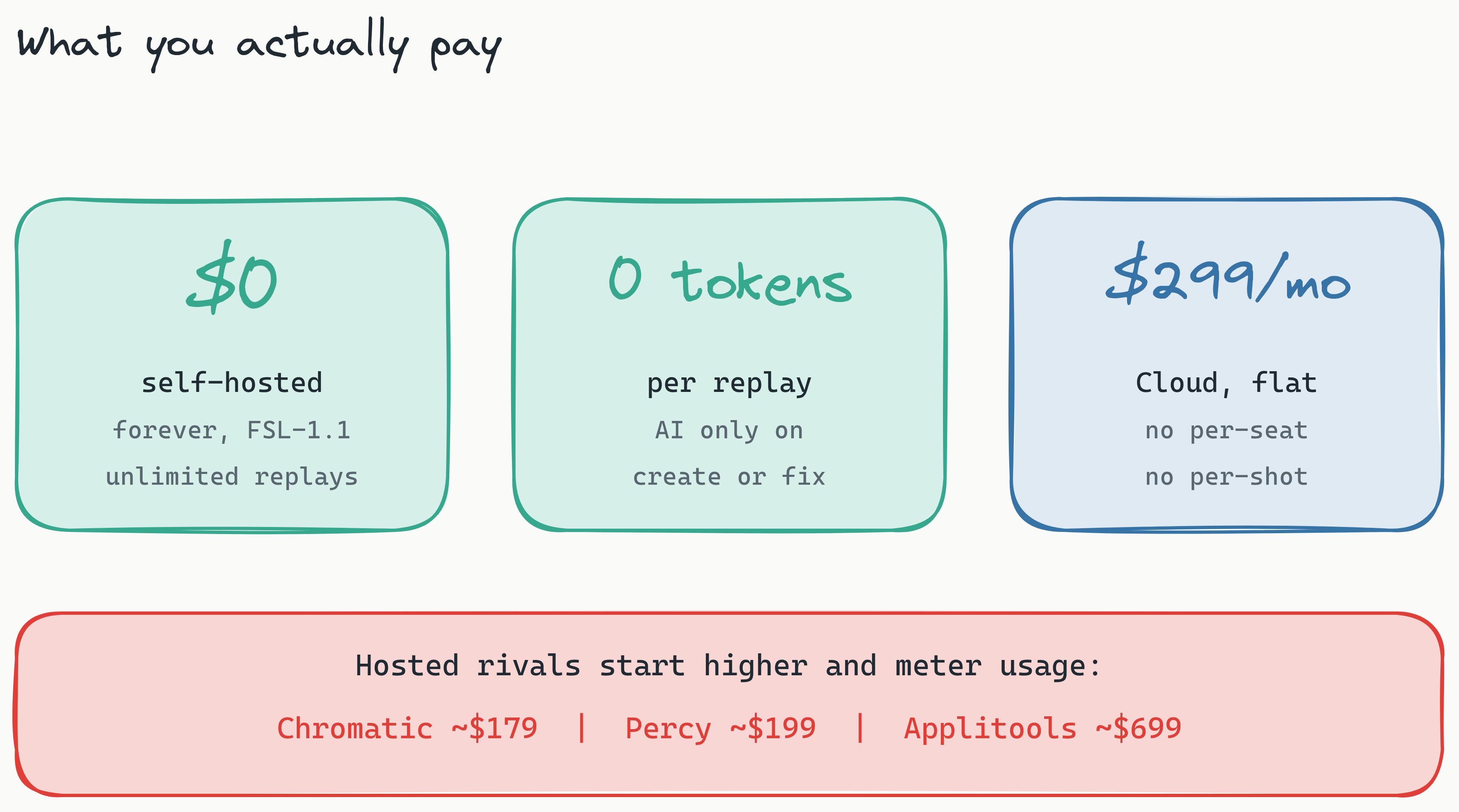
The critical point: paying for AI once at authoring time, then replaying for free, is a fundamentally cheaper curve than paying in developer hours every time the UI moves, or paying a hosted vendor per screenshot forever.
When to Choose BackstopJS vs. When to Choose Lastest
Both BackstopJS and Lastest are fully self-hostable, but the setup experience and ongoing maintenance differ significantly. Here's how to decide which tool fits your team.
Choose BackstopJS if:
- You need absolute control over every test script and prefer hand-crafted scenarios.
- Your team has existing Node.js expertise and doesn't want to learn a new tool or workflow.
- You're already using BackstopJS successfully and it works fine - don't fix what isn't broken.
- Your testing needs are simple and stable, with minimal UI changes month over month.
Choose Lastest if:
- You want AI-generated tests to speed up onboarding and reduce ongoing script maintenance.
- You need a human oversight dashboard for team workflows and approval processes.
- You're looking for a Percy alternative that's open source and self-hostable, especially if compliance requires keeping screenshots on your own infrastructure (see the Percy vs Lastest breakdown).
- You're a Playwright user seeking BackstopJS vs Lastest for Playwright: Lastest authors and runs native Playwright tests, while BackstopJS drives a headless browser through its own scenario engine and has no AI authoring.
- You want coding agents to drive your testing: Lastest ships an MCP server with roughly 20 tools, so Cursor, Claude Code, and similar agents can author and run tests directly.
- Your team experiences frequent UI changes and wants self-healing selectors instead of the maintenance treadmill of editing config files every sprint.
For teams migrating from a hosted tool like Percy because of data compliance, Lastest's self-hosted option is the strongest alternative to BackstopJS's local-only model: it combines AI authoring and a review dashboard with full control over where screenshots are stored and processed, since they never leave your network.
Frequently Asked Questions
How does Lastest's AI generate visual tests?
You feed Lastest a URL, an OpenAPI spec, or a markdown PRD, and the AI authors resilient Playwright tests that exercise buttons, forms, and navigation. Route Discovery scans your source for paths the spec missed. No manual configuration files are needed; you point Lastest at your app, and it discovers what to test, then a human reviews the result.
Can Lastest run alongside BackstopJS in the same CI pipeline?
Yes, both tools produce standard output formats and exit codes, so they can run in parallel. Many teams start by running Lastest alongside their existing BackstopJS tests to compare results before fully migrating.
Is Lastest truly free for self-hosted teams?
Yes. The self-hosted version is completely free and open source under the FSL-1.1 license, with unlimited screenshots and replays. You provide your own AI key only for authoring and healing tests, never for replays. Self-hosting teams get all core features: AI authoring, three diff engines, self-healing selectors, the review dashboard, WCAG scoring, and CI/CD integration.
What happens when my UI changes after tests are generated?
Most of the time, nothing breaks: the 7-layer selector fallback heals across data-testid, id, role, aria-label, text, CSS, and OCR, so renamed classes and moved buttons keep passing. Only when a change is large enough to need new test logic does the AI step back in, and replays stay free. That is structurally cheaper than hand-editing BackstopJS config files every sprint.
Does Lastest support cross-browser testing?
Yes, through Docker-based execution, Lastest can run tests in multiple browser environments. The perceptual diff engine is especially useful for cross-browser testing because it tolerates font rendering and anti-aliasing differences between browsers.
How does the $299/month cloud plan compare to the free self-hosted version?
Lastest Cloud is a flat $299 per month with no per-seat or per-screenshot fees. It adds a hosted dashboard, the embedded browser pool, and managed infrastructure so you skip ops. The free self-hosted version gives you the same core features (AI authoring, three diff engines, self-healing selectors, the review dashboard, and WCAG scoring) but you run it yourself via Docker. There is also a free Cloud tier with a monthly quota to evaluate.
Which is Better for Your Team in 2026?
For startups needing fast iteration and low overhead, Lastest's AI-powered approach is the better visual regression testing tool for 2026. Point the tool at a page, and it automatically discovers what to test. No configuration files, no scenario scripting, no manual baseline management. That removes the biggest friction point in visual regression: getting started.
For established teams with existing BackstopJS configurations, the decision is less clear-cut. BackstopJS is the safe, traditional choice. It works reliably, has a strong community, and imposes no vendor relationship. Switching to Lastest provides AI generation and a dashboard, but requires learning a new tool and migrating existing tests.
But if you're starting a new project, migrating from an expensive cloud tool like Percy, or looking to reduce visual testing maintenance overhead, Lastest is the strongest alternative to BackstopJS for 2026. Its three-engine diff system reduces false positives. Its dashboard enables team collaboration. And its zero-token replay model keeps costs flat as your suite grows.
Conclusion
The choice between BackstopJS and Lastest comes down to one question: do you value hand-built control above all else, or do you want AI to do the authoring and a human to do the judging? BackstopJS gives you fine-grained control over every scenario. Lastest removes the writing-and-maintaining burden through AI-authored Playwright tests, self-healing selectors, three diff engines, AI failure classification, and zero-token replays, with exactly one human review seam. Both are open source and self-hostable, so there is no vendor lock-in either way.
Ready to cut your visual testing overhead? Self-host Lastest for free under FSL-1.1 (unlimited screenshots, unlimited replays), or skip the ops and try Lastest Cloud at a flat $299/month. Browse live demos, read the docs, or star the project on GitHub. Whichever tool you choose, this Lastest vs BackstopJS visual testing comparison 2026 should make the decision an easy one.