When weighing Percy vs Lastest visual testing for QA teams in 2026, the decision comes down to three things: budget, control, and how much AI you actually want in your pipeline. Visual bugs are still one of the most common sources of UI regressions to escape functional tests, because a suite can be green while a button drifts 40px and a checkout CTA disappears below the fold. Yet most QA teams either eyeball every screen by hand or get locked into a cloud-only tool that bills per snapshot and keeps their screenshot data on someone else's servers.
Which visual testing tool is better for QA teams in 2026? Lastest offers stronger value for most teams through its open-source license, free self-hosted deployment, unlimited screenshots, three diff engines, and AI that authors and heals Playwright tests. Percy remains a reasonable choice for teams that want zero infrastructure to run and are already embedded in the BrowserStack ecosystem.
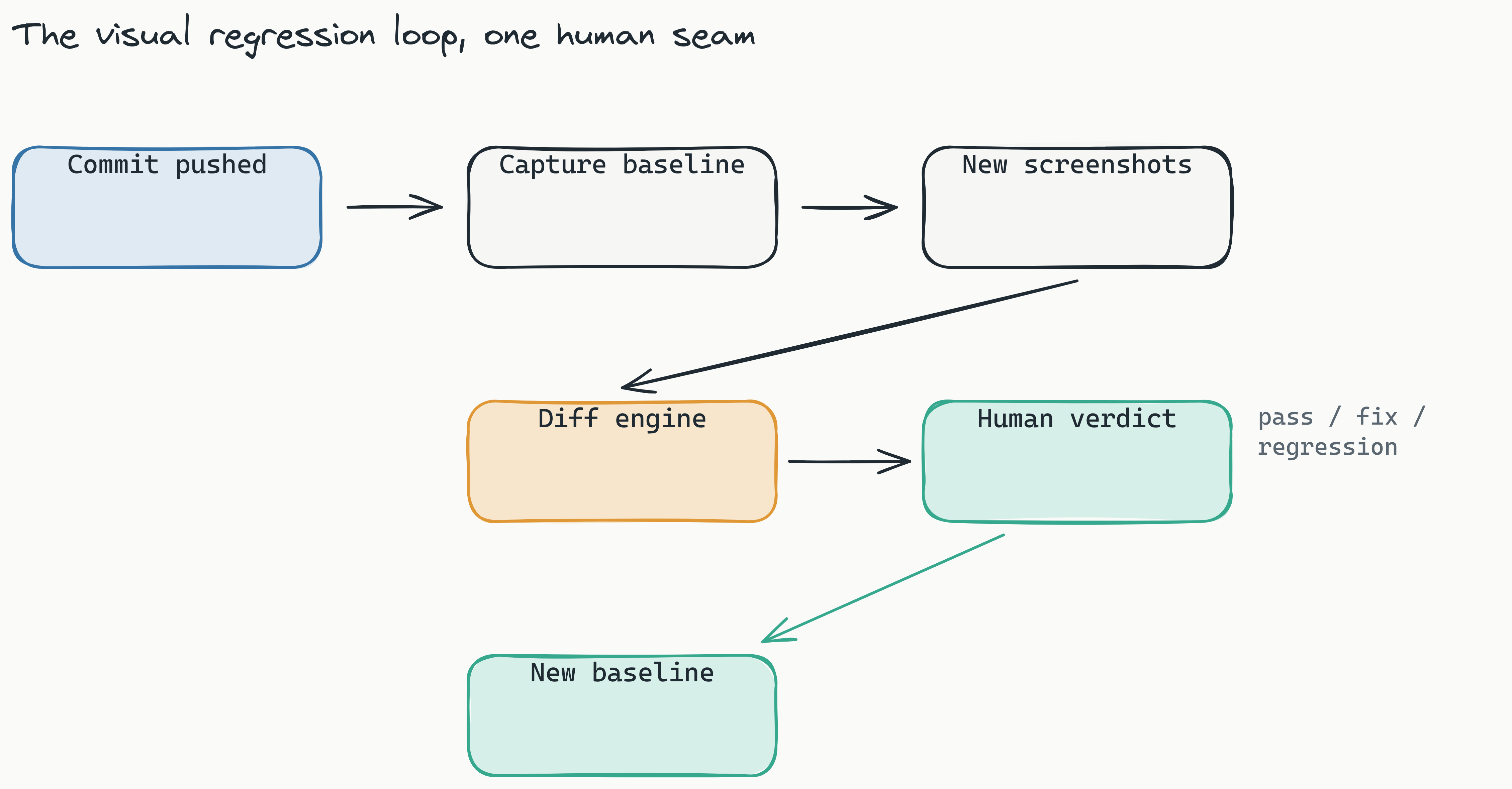
Before we jump into the comparison, let's quickly cover how does visual regression testing work. The core loop is simple: your CI pipeline fires after a commit, the tool captures baseline screenshots of your app, compares new screenshots against those baselines using a diff engine, flags any visual differences, and presents them to a human for a verdict. Modern tools go well beyond raw pixel matching, since they understand DOM structure and human-perceptible changes, which is what keeps the review queue small enough to actually triage. For a deeper primer, see our visual regression testing in CI/CD guide.

This guide compares two approaches head-to-head: Percy, the established cloud-only veteran, and Lastest, the open-source, AI-powered newcomer. We'll dig into features, pricing, CI/CD integration, enterprise readiness, and even map out a migration path if you're thinking about switching. (Want a three-way view? See Lastest vs Percy vs Applitools.)
What Is Visual Regression Testing and Why QA Teams Need It
Visual regression testing is an automated process that compares screenshots of your web application before and after code changes to detect unintended visual differences, like layout shifts, color errors, missing elements, or font mismatches, before they reach production.
The testing cycle runs through five phases. First, your CI pipeline triggers after a code push. The tool grabs baseline screenshots of every view or component you've defined. Once the new code deploys to a test environment, the tool takes fresh screenshots and runs them through its diff engine. Any differences, from a shifted button to a missing image, get highlighted and sent to a dashboard for human review. A reviewer renders a verdict, and if the change is intentional, the new screenshots become the updated baseline for future runs.
Not all diff engines are created equal, though. Pixel diff (Lastest uses Pixelmatch) does a binary comparison: every pixel that differs gets flagged. It catches everything but is noisy, since anti-aliasing alone can trigger a flood of false positives. Structural diff (SSIM) is DOM and layout aware, ignoring anti-aliasing and minor rendering jitter while catching real structural breaks. Perceptual diff (Butteraugli) is aligned to the human eye, flagging only differences a person would actually notice and ignoring font and anti-aliasing noise. That matters, because no team has time to clear a queue full of false positives after every deploy. If false positives are your pain point, see how to reduce visual regression false positives.
Why do QA teams need visual regression testing? Functional tests verify logic, not appearance, so a green suite can still ship a broken layout. Visual regression testing automates screenshot comparison within your CI pipeline, catching layout shifts, missing elements, and color errors that functional tests miss entirely.
Why do QA teams actually need this? A passing functional suite tells you the code ran, not that the page looks right. The gaps that slip through are visual: a missing icon in production, a color-contrast violation on a customer's screen, a layout break only visible at certain viewport sizes. Visual regression testing fills that gap automatically inside your existing CI pipeline. The Toyota Production System principle of jidoka (automation with human intelligence) frames the why precisely: catch defects at their source with a human in the loop rather than relying on downstream inspection. That is exactly Lastest's model, one human review seam where a reviewer renders a pass, fix, or regression verdict and the AI never approves its own output.
Percy: The Established Cloud-Only Approach
Percy launched in 2014 and was acquired by BrowserStack in 2018. It's the most recognizable name in visual regression testing, used by teams at Microsoft, Airbnb, and Shopify. Its maturity is undeniable: strong integrations, a polished review dashboard, and enterprise-grade support.
But here's the catch: Percy is cloud-only. All your screenshots are uploaded to BrowserStack's servers. There's no self-hosted option, no on-premise deployment, no air-gapped run. That matters more than most teams realize until they hit a compliance wall.
Pricing is per-snapshot. Published plans start from around $199 per month for a fixed snapshot allowance, and costs climb as your volume grows because you pay for comparisons, not just for setup. Re-runs count too, so an iterative day during a redesign can burn through your snapshot budget fast. For teams running tens of thousands of snapshots a month, the per-snapshot meter is the line item that surprises finance.
Percy's diff engine is primarily pixel-based, with some AI enhancements for auto-review suggestions. It integrates with GitHub Actions, GitLab CI, Bitbucket, CircleCI, and Jenkins. The review dashboard is clean and collaborative, supporting team workflows.
The central limitation is clear: teams that need data sovereignty, unlimited internal screenshots, or air-gapped testing will find Percy's cloud-only model restrictive. That's why many are now searching for a Percy alternative open source in 2026 that offers comparable features without sacrificing control.
Lastest: The Open-Source Alternative with AI
Lastest is a free, open-source visual regression and end-to-end testing platform. AI authors and heals Playwright tests, humans review, and replays are deterministic and free. It offers three diff engines, can be self-hosted on your own infrastructure, and is also available as a cloud service at a flat $299 per month. Browse the full feature set or grab the code on GitHub.
The open-source nature of Lastest is its defining advantage. Released under the FSL-1.1 license (which converts to Apache 2.0 over time) and hosted on GitHub, the entire codebase is transparent, auditable, and customizable. Your screenshots never leave your infrastructure unless you choose the cloud option. That's a fundamental difference from Percy's proprietary, cloud-only architecture. You can self-host for free, forever.
When comparing Lastest visual regression testing vs Percy, the most striking difference is the flexibility of diff engines. Lastest provides three: pixel (Pixelmatch) for exhaustive comparison, structural (SSIM) for DOM-aware analysis, and perceptual (Butteraugli) for human-like detection. Teams switch engines per test, running structural first to catch major breaks, then perceptual for nuance. On top of that, Lastest auto-classifies every failure as a real regression, flaky, environment, or test-maintenance issue, with a confidence score and reasoning, so reviewers triage faster.
What makes Lastest different from other visual testing tools? Lastest combines an open-source license with three configurable diff engines (pixel, structural, perceptual), AI that writes and self-heals Playwright tests, AI failure classification, WCAG 2.2 AA accessibility scoring on every screenshot, and zero-token replays, all available in a free self-hosted version or a flat $299-per-month cloud plan.
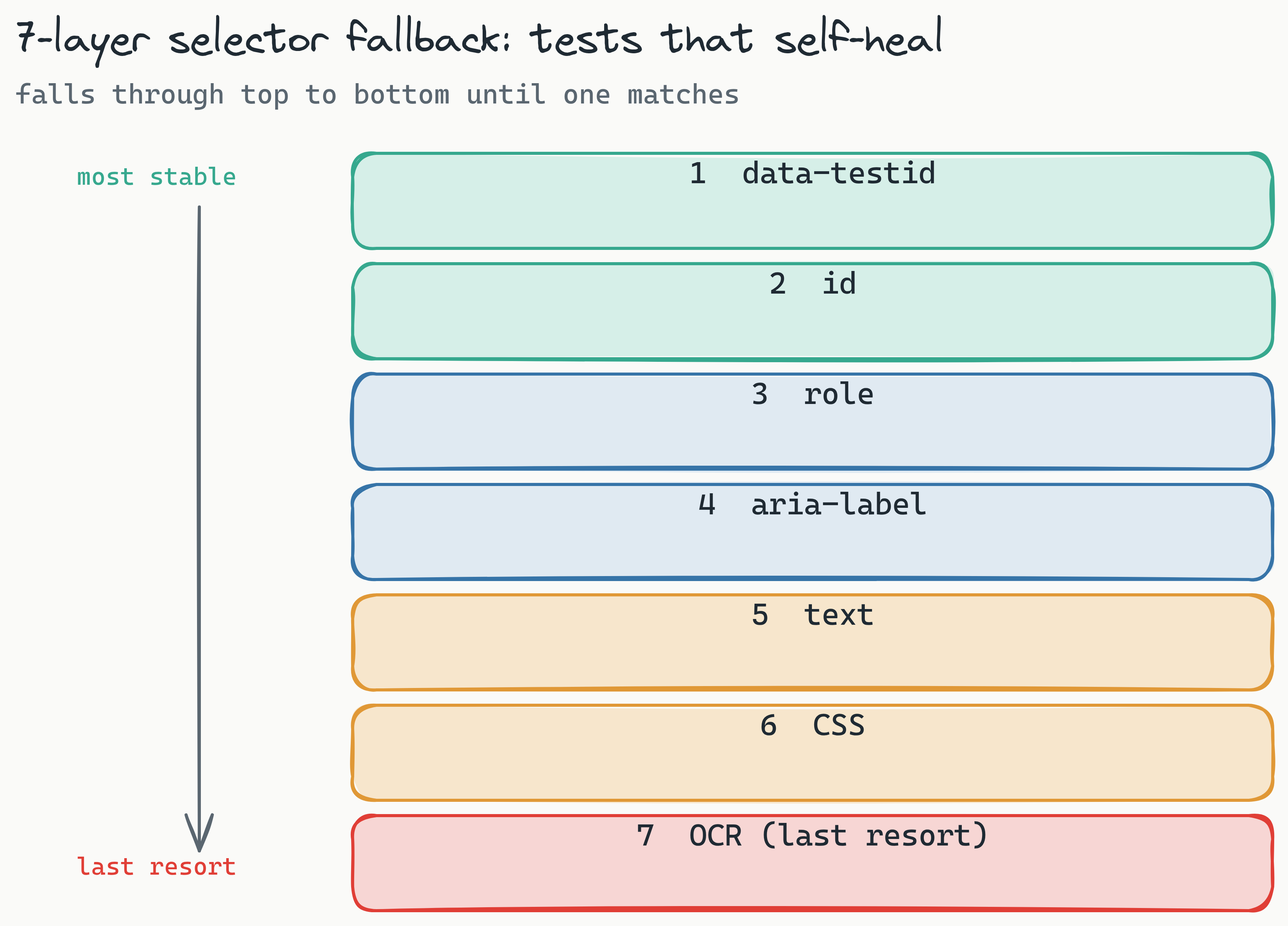
The AI test generation is another differentiator. Claude (or your own provider) writes resilient Playwright code from URLs, OpenAPI specs, or markdown PRDs, and Route Discovery scans your source for paths the spec missed. Tests use a 7-layer selector fallback (data-testid, id, role, aria-label, text, CSS, then OCR) so they survive refactors that break hand-written selectors. Read more on how self-healing selectors work. You choose how much autonomy you want: AI-Free recording (air-gapped, no API keys), AI-Assisted (AI proposes, a human reviews every change), or Full Autonomous via the Play Agent, an 11-step pipeline of specialized sub-agents that plan, generate, run, and fix tests, with pause, approve, and skip on any step.
Other practical features: zero-token replays, since AI runs only when you create or fix a test and every replay is plain Playwright execution, so you can test thousands of times a day for $0 in tokens. Bring your own AI means Claude CLI, Anthropic API, OpenRouter, OpenAI, or local Ollama models, with no lock-in. Smart Run reads your git diff and runs only the tests your change touches. A WCAG 2.2 AA score (0 to 100, via axe-core) lands on every screenshot. And an MCP server exposes roughly 20 tools so coding agents like Cursor and Claude Code can drive Lastest directly. Deployment supports GitHub Actions, GitLab MR comments, and a containerized browser pool that provisions into k3d locally or your own cluster in production.
Head-to-Head: Pricing Comparison
In a visual testing for QA teams pricing comparison, Percy charges per snapshot with plans starting from around $199 per month and rising with volume, while Lastest offers a fully free self-hosted plan with unlimited screenshots and a cloud version at a flat $299 per month with no per-seat or per-snapshot fees. For teams running thousands of daily screenshots, a flat or zero software cost is structurally cheaper than a per-snapshot meter.
| Plan | Monthly Cost | Snapshots | Key Limitation |
|---|---|---|---|
| Percy (entry) | from ~$199 | Fixed allowance | Overage billed per snapshot |
| Percy (higher tiers) | Scales with volume | Larger allowance | Still per-snapshot pricing |
| Percy Enterprise | Custom | Negotiated | Custom quote only |
| Lastest Self-Hosted | $0 forever | Unlimited | Infrastructure costs only |
| Lastest Cloud | $299 flat | Unlimited | No per-seat or per-snapshot fees |
Hidden costs matter, too. With per-snapshot billing, every re-run during an iterative day adds to the meter. Lastest's zero-token replays mean AI cost is incurred only when you create or fix a test; every replay after that is plain Playwright execution that costs nothing in tokens, and self-hosted screenshots are unlimited regardless of volume. The structural point: Percy's bill grows with usage, while Lastest's software cost is either $0 (self-hosted) or a flat $299 (cloud) no matter how many screenshots you run.
To be fair, Percy's pricing includes a mature platform with dedicated support and enterprise SLAs. Lastest, especially the self-hosted version, requires your team to handle infrastructure and updates. The question is whether that trade-off is worth a flat or zero software cost and genuinely unlimited usage. For a fuller cost breakdown, see our 2026 open-source VRT pricing analysis.
Feature Comparison: Diff Engines, CI/CD Integration, and AI
For teams evaluating the best visual testing tool for CI/CD pipelines, the feature set matters as much as price. Both tools support major CI providers, but their approach to diffing and automation differs significantly.
Diff Engines: Percy relies on a single pixel-based diff engine with optional AI review suggestions. Lastest offers three distinct engines: pixel (Pixelmatch), structural (SSIM), and perceptual (Butteraugli). The structural engine ignores anti-aliasing and font-rendering jitter while flagging genuine layout breaks. Perceptual diff goes further, catching only changes a human would notice, which is what drives the false-positive rate down.
AI Test Generation: Percy requires manual SDK setup for every test. You write the code, define the viewports, and configure each snapshot. Lastest's AI generates resilient Playwright tests from URLs, OpenAPI specs, or PRDs, and heals them with a 7-layer selector fallback so they survive refactors. This is especially valuable for teams with many pages or complex workflows. Devs without a dedicated QA team can lean on this hard; see Lastest for devs doing QA.
CI/CD Integration: Both tools integrate with major CI providers including GitHub Actions and GitLab. Lastest adds Smart Run, which reads your git diff and runs only the tests your change touches, plus a reusable GitHub Action, GitLab MR comments, and a containerized browser pool with no local Playwright install. This makes Lastest a natural fit for teams that want their visual testing defined as code.
Human Dashboard: Both provide review dashboards, but Lastest's is open-source and self-hostable. Your review data, comments, and version history stay on your infrastructure, and every edit, AI-fix, and restore is versioned with a reason. Percy's dashboard is polished but stores everything on BrowserStack servers.
Performance: Lastest's zero-token replays mean that after the first generation, re-running the same tests costs nothing in tokens. Teams iterating on baselines during development cycles benefit significantly from this model.
Enterprise Considerations: Self-Hosted vs. Cloud
For visual regression testing for enterprise teams, the primary consideration is whether to self-host for maximum control and data sovereignty or use a cloud service for minimal maintenance. Lastest supports both paths, while Percy is cloud-only.
Data Sovereignty: If your organization handles sensitive data (fintech, healthcare, government, or any regulated industry) self-hosting is often non-negotiable. Lastest Self-Hosted means screenshots never leave your network: they stay behind your firewall, on your servers, under your encryption. Percy requires uploading every snapshot to BrowserStack's infrastructure.
Compliance: Percy supports SSO, audit logs, and SOC2 compliance through BrowserStack. Lastest Self-Hosted can be deployed inside your own VPC, which helps with GDPR and other regional requirements. For European enterprises, keeping screenshot data in-network is often a decisive factor.
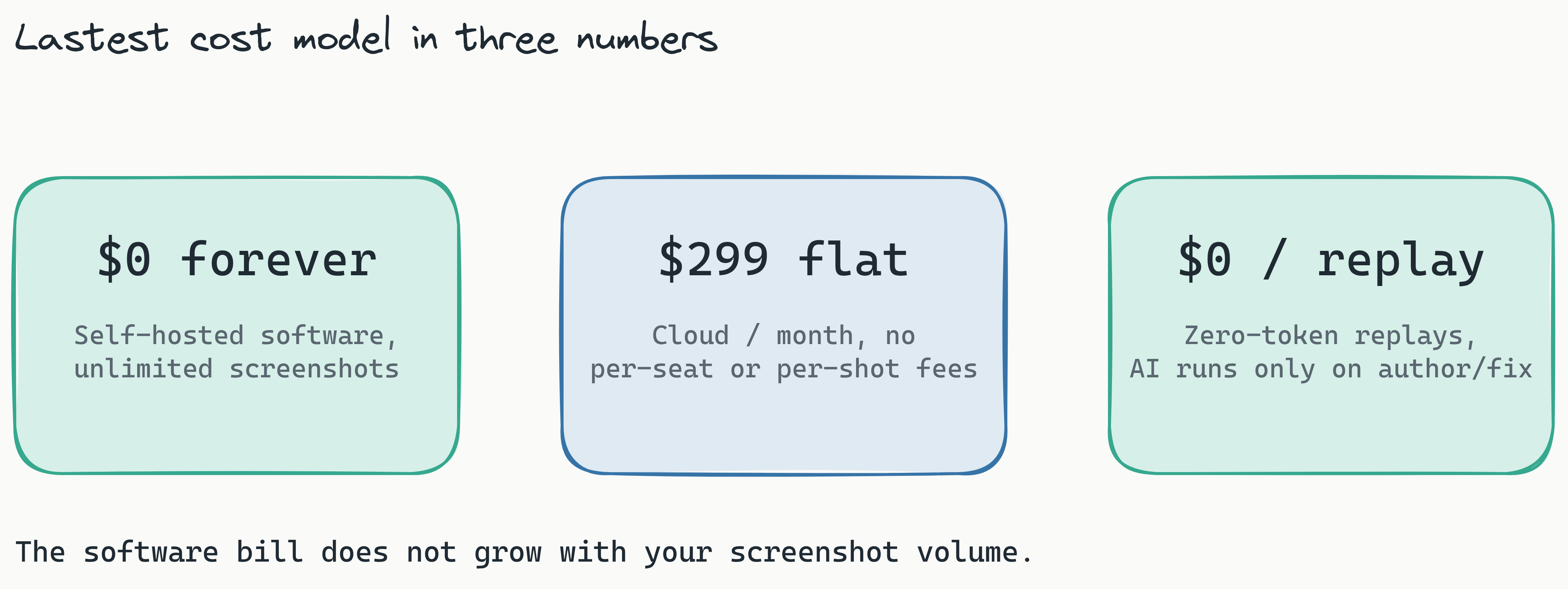
Total Cost of Ownership: The structural difference matters more than any single quote. Percy's software bill grows with snapshot volume. Lastest Self-Hosted has $0 software licensing (you pay only for the infrastructure you already run), and Lastest Cloud is a flat $299 per month regardless of headcount or volume. Over a multi-year horizon, a flat or zero software line is the predictable choice.
Scaling: Percy's per-snapshot pricing scales with usage, so a regression-heavy sprint or a big release can spike the bill. Lastest's unlimited-screenshot model (self-hosted) and flat cloud price mean no surprise invoices at peak releases. Distributed Remote Runners let you fan tests out across CI when you do need raw throughput.
Migration Guide: Switching from Percy to Lastest
Migrating from Percy to Lastest involves four steps: export Percy screenshots, deploy Lastest via Docker, configure your CI pipeline, and run your first comparison. Most teams complete it in under two hours.
Step 1: Export Percy screenshots. You can manually download baseline screenshots from the Percy dashboard or use Percy's API to export them programmatically. Store them in a directory matching your test structure.
Step 2: Deploy Lastest. Stand up Lastest on your server or CI runner; the self-hosted stack ships the three diff engines, the dashboard, and the embedded browser pool. For cloud users, sign up and configure the connection. See the docs for the full setup walkthrough.
Step 3: Configure CI. Wire Lastest into your pipeline with the reusable GitHub Action or GitLab MR comments, and point your environment variables at your Lastest instance. Smart Run can then scope each CI run to only the tests your diff touches.
Step 4: Run your first comparison. Pick a diff engine per test. Start with perceptual to minimize noise, then add structural or pixel for cases that need exhaustive comparison. Review results in the dashboard, render your pass, fix, or regression verdict, and proceed.
Common pitfalls: Percy screenshots may be captured at different viewport sizes or with different browser rendering. Lastest supports responsive breakpoints natively, but you may need to adjust test configurations to match your existing Percy setup. Lastest's stabilization (timestamp freezing, network-idle wait, font-loading wait, auto-masking of dynamic content) keeps cross-OS screenshots consistent so the diffs stay meaningful.
When to Choose Each Tool
Choose Percy if: Your team has zero tolerance for running any infrastructure, you're already in the BrowserStack ecosystem, you need vendor-backed enterprise SLAs and dedicated support, and the per-snapshot model fits comfortably in your budget at your volume.
Choose Lastest if: You want an open-source license for customization or compliance, your organization mandates data sovereignty, you want AI to author and heal Playwright tests, you need unlimited screenshots without surprise bills, or you want zero-token replays and bring-your-own-AI with no lock-in.
Team size scenarios:
Small team: Lastest Self-Hosted is $0 in software forever, against Percy's monthly per-snapshot bill. The savings free up budget for the things that actually move quality.
Mid-size team: Lastest Cloud at a flat $299 per month gives you unlimited screenshots with no per-seat fees, while Percy's bill rises with snapshot volume. Lastest wins on both predictability and capacity.
Enterprise: Lastest Self-Hosted keeps every screenshot in-network with $0 software licensing. Percy Enterprise carries a custom per-snapshot contract, though you get vendor support and zero infrastructure work in exchange.
Frequently Asked Questions
Can Lastest replace Percy entirely? Yes, for most teams. Lastest covers the same core visual regression workflow (baseline capture, diff comparison, dashboard review, CI integration) while adding open-source flexibility, three diff engines, and AI that authors and heals tests, which Percy lacks.
Is self-hosting Lastest difficult? No. The self-hosted stack deploys onto a Linux server or CI runner, and the embedded browser pool provisions into k3d locally or your own cluster in production. The docs walk through it step by step.
Does Lastest support Percy's SDK syntax? Not directly. Migration means wiring Lastest into CI via its GitHub Action or GitLab integration and updating environment variables. The conceptual workflow is similar, so most teams migrate in a couple of hours.
Which diff engine should my team start with? Start with perceptual (Butteraugli) to minimize false positives, then add structural (SSIM) or pixel (Pixelmatch) for cases that require exhaustive comparison. Perceptual catches what a human would notice while ignoring anti-aliasing and font noise.
Can Lastest handle very high screenshot volumes? Yes. The self-hosted version scales with your infrastructure (add compute or storage, fan out with Distributed Remote Runners) and screenshots are unlimited. The cloud version is a flat $299 per month with no per-snapshot billing.
Does Lastest offer free CI/CD integration? Yes. Lastest ships a reusable GitHub Action and GitLab MR comments out of the box, plus webhook and scheduled triggers, with no per-snapshot licensing in the loop.
Final Verdict
The decision between Percy and Lastest ultimately reflects your team's priorities. Percy is mature, reliable, and plug-and-play, but it's cloud-only and meters you per snapshot. Lastest is open-source, AI-driven, and structurally cheaper, but the self-hosted version asks you to run your own infrastructure.
For most QA teams in 2026, Lastest offers the stronger proposition. Open-source licensing, free self-hosted deployment, unlimited screenshots, three diff engines, AI that authors and heals Playwright tests, AI failure classification, WCAG 2.2 AA scoring, and zero-token replays add up to something Percy's cloud-only single-engine model cannot match. And because AI runs only when you create or fix a test, your CI cost stays flat no matter how many times you iterate on baselines.
The Percy vs Lastest visual testing for QA teams decision comes down to control versus convenience, and with Lastest you get control without giving up features. Self-host Lastest for free, forever from GitHub and deploy it on your own infrastructure, or skip the ops and try Lastest Cloud at a flat $299 per month. Browse the full feature set or read more comparisons on the blog.