
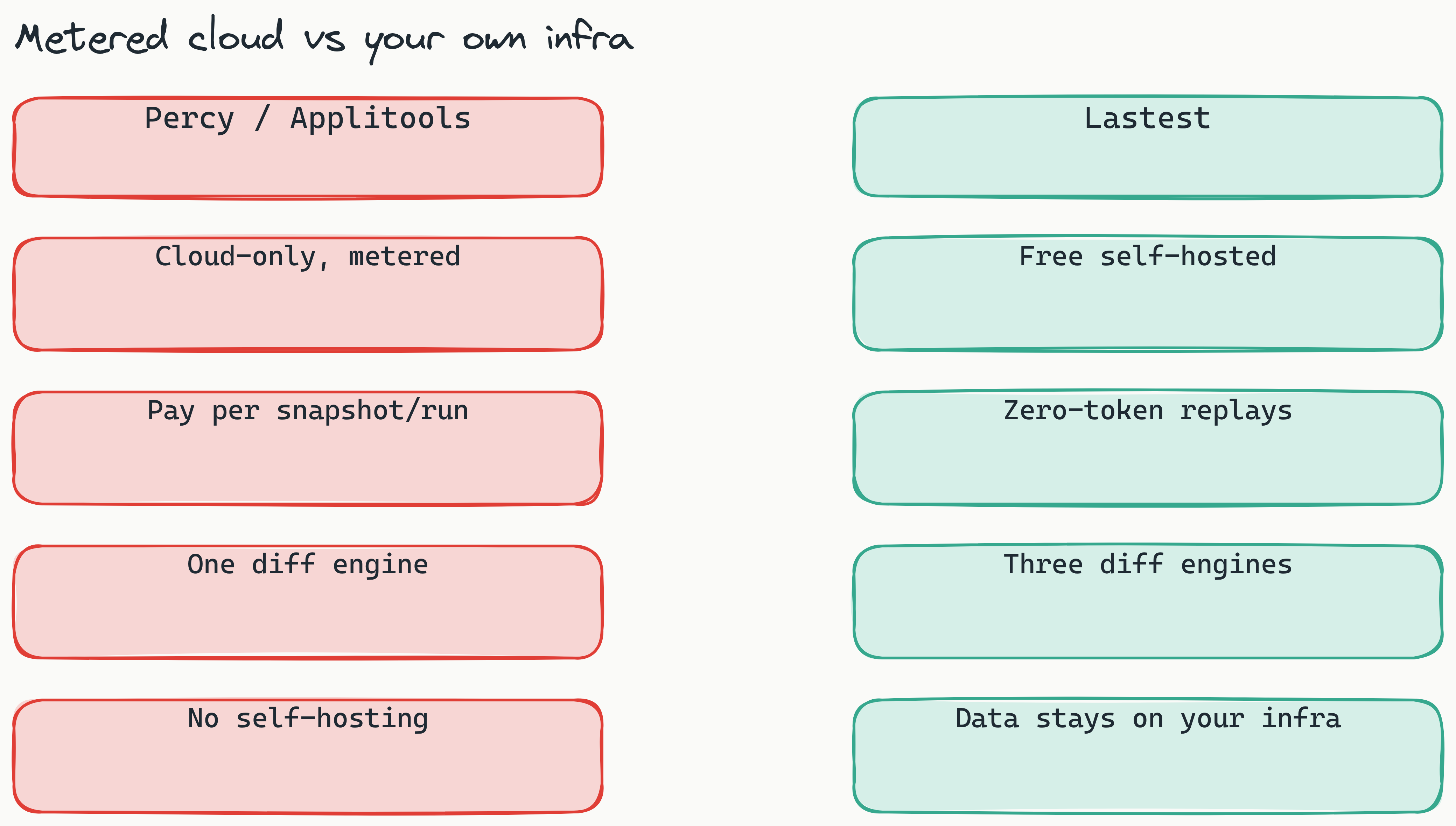
Visual regression testing is non-negotiable for modern development teams. Every frontend change risks breaking something that slipped past unit tests and manual QA. The problem? The tools designed to catch these visual bugs often come with pricing models that spiral out of control as your test suite grows. Three names dominate the conversation: Percy, Applitools, and the open-source newcomer Lastest. The financial and technical trade-offs between them are rarely explained with transparency. This Lastest vs Percy vs Applitools 2026 comparison focuses on what actually matters for cost-conscious teams: total cost of ownership, control over your data, and accuracy without false-positive fatigue. The short version is that Percy and Applitools meter your usage, while Lastest runs free on your own infrastructure and only spends AI when you create or fix a test, never when you replay one.
Why Visual Regression Testing Matters More Than Ever in 2026
Visual regression testing matters more in 2026 because the cost of a UI bug reaching production has climbed. User expectations for flawless, instant experiences mean a single pixel shift in a checkout button or a broken layout on a mobile viewport can erode trust in minutes. Yet manual QA teams cannot scale to catch every visual regression across dozens of browsers, viewports, and component states. Industry surveys consistently put automated visual checks ahead of manual review for catching rendering bugs before they ship, simply because a machine can compare hundreds of screenshots on every pull request and a human cannot.
The shift from manual QA to automated visual checks has accelerated dramatically. Teams now run visual tests on every pull request, comparing hundreds of screenshots against baselines before merging. But traditional pixel comparison - the default approach for years - fails in 2026 for three reasons. Animations and CSS transitions create false positives. Dynamic content such as user avatars or timestamps changes on every render. And component reusability means the same component appears in multiple contexts with different styling.
Why has visual regression testing become critical for modern development teams? Automated visual regression testing is essential because manual QA cannot scale to catch UI bugs across dozens of browser-viewport combinations. It catches rendering issues that unit tests miss, preventing costly production defects that erode user trust.
Three main diffing approaches have emerged to solve these challenges. Pixel comparison checks every individual pixel for exact matches. Structural (DOM) comparison examines the HTML element tree for changes in layout or hierarchy. Perceptual AI comparison uses machine learning to understand what a human would visually notice as different. Each approach has strengths and weaknesses, and the best tools now combine multiple engines to reduce noise.
Meet the Competitors: Lastest, Percy, and Applitools
Understanding the three tools requires a clear snapshot of each platform's DNA. They serve similar use cases but arrive at solutions from fundamentally different philosophies.
Percy, acquired by BrowserStack in 2021, is a cloud-only visual testing platform with snapshot-based pricing. It excels at collaboration - reviewers can approve or reject visual changes directly in the dashboard. Percy integrates natively with GitHub and GitLab pull requests, making it popular among teams that prioritize developer workflow. But its pricing model scales linearly with snapshot volume, and overages can sting at high throughput.
Applitools targets enterprise teams with its Ultrafast Grid and Visual AI technology. Rather than comparing pixels, Applitools uses a proprietary perceptual AI that understands which changes matter to a human viewer. This reduces false positives dramatically. However, the pay-per-execution model means costs can run into thousands of dollars per month for high-volume teams. Applitools is also cloud-only, with no self-hosted option for customers who need data sovereignty.
Lastest enters the market with a different philosophy: open source, self-hosted, or cloud, your choice. It is free to run on your own infrastructure under an FSL-1.1-ALv2 license, with unlimited screenshots and replays on your own servers. For teams that prefer a managed service, Lastest Cloud is a flat $299 per month, with no per-seat and no per-screenshot fees, plus a $0 Cloud Free evaluation tier with a monthly quota. Lastest's key differentiator is zero-token replays: AI runs only when you create or fix a test, and every replay after that is plain Playwright execution that costs nothing in tokens. It also offers three diff engines, pixel (Pixelmatch), structural (SSIM), and perceptual (Butteraugli), that you switch between based on the test context. As a newer tool, Lastest has a smaller community than Percy or Applitools, but its open-source nature means the community can contribute directly. You can view the source and contribute on Lastest's GitHub.
Pricing Showdown: What You Actually Pay Per Year
An AI visual testing cost comparison reveals stark differences between the three platforms. The real cost is not just the monthly subscription, it is how pricing scales as your test suite grows and how hidden fees compound. We dig deeper into the metered-vendor math in our Percy vs Applitools pricing breakdown.
Let us model a typical mid-size development team: five to ten developers running one hundred to five hundred snapshots per day across multiple browsers and viewports. This is a common workload for an e-commerce or SaaS team releasing multiple times per week.
| Feature | Lastest | Percy | Applitools |
|---|---|---|---|
| Pricing Model | Free self-hosted + zero-token replays | Monthly snapshot cap | Pay per execution |
| Entry Cost | $0 self-hosted / $299/mo flat Cloud | from ~$199/mo | from ~$699/mo |
| Hidden Fees | None (self-hosted) | Overage fees | On-demand scaling fees |
| Replay Cost | $0 | Counts toward cap | Counts toward execution |
| Annual Cost (Moderate Use) | $0 (self-hosted) / $3,588 (Cloud, flat) | $2,400 - $12,000+ | $8,400 - $36,000+ |
| Pixel Verification | Three engines - Pixelmatch, SSIM, Butteraugli - classify each shot unchanged / flaky / changed against thresholds | Single pixel engine (binary flag) | Single Visual AI engine |
| Data Filter / Masking | Mask selectors + auto-mask of dynamic content + text-region-aware OCR diffing | Basic region ignores | Region ignores |
| Show-Area / Ignore Regions | Scope compare & review to the changed region; page-shift detection avoids full-screen flags | Limited | Limited |
| Animation & Flaky Guards | Animation freezing + 12 flaky-test guards (timestamp freeze, network-idle, DOM-stability, font-load, burst capture, cross-OS) | Partial | Partial |
| Selector Resilience | 7-layer self-healing fallback (data-testid → id → role → aria-label → text → CSS → OCR) + success-rate stats + MCP live validation | N/A | N/A |
Which visual testing tool has the lowest total cost of ownership? Lastest offers the most predictable pricing with zero replay costs after a test is created. Self-hosted Lastest is free (infrastructure costs only), while Lastest Cloud is a flat $299/month with no per-seat or per-screenshot fees. Percy and Applitools meter snapshots or executions, so costs scale with deployment frequency, potentially reaching $36,000+/year for high-volume teams.
Percy's paid plans bundle a monthly screenshot allowance. Once you exceed that cap, overage fees kick in at a per-snapshot rate that adds up quickly. A team running 500 snapshots per day across 20 working days consumes 10,000 snapshots per month just for daily runs, before accounting for multiple browsers, viewports, or retries.
Applitools charges per test execution, not per snapshot. This sounds similar but works differently because each execution runs the Visual AI engine, consuming credits. Teams report that costs can double or triple when scaling from staging environments to production monitoring. The platform is powerful, but the pricing requires careful budgeting.
Lastest's model is fundamentally different, because the expensive part (AI) only runs when you create or fix a test. After a test exists, every replay, every time that test runs against a new build, is plain Playwright execution that costs zero tokens. Your cost is predictable from day one. For self-hosted users, the only cost is your server infrastructure, and screenshots and replays are unlimited regardless of volume. For Cloud users, a flat $299 per month covers it, with no per-seat or overage fees. If you want the deeper economics, see our breakdown of the real cost of LLM-driven test runs.
Head-to-Head Feature Comparison: Three Diff Engines vs One
The technical differences between these tools matter most for teams that need accuracy without noise. For teams evaluating a percy vs applitools vs chromatic comparison, the three-engine approach changes the equation entirely.
Percy uses a pixel-by-pixel comparison engine. It captures screenshots and compares them at the individual pixel level. This approach catches every visual change - including anti-aliasing artifacts, shadow rendering differences, and animation frame variations. The result is high sensitivity but also high noise. Teams often find themselves approving dozens of false-positive changes that no human would ever notice.
Applitools uses a proprietary Visual AI engine trained on millions of screenshots to understand what a human would perceive as different. It ignores anti-aliasing, shadows, and font rendering inconsistencies that do not affect the user experience. This reduces false positives significantly. But the AI can miss subtle pixel-level bugs that escape human perception - a 1-pixel shift in a border might go unnoticed by the AI but could break a layout on high-DPI screens.
Lastest offers all three approaches in a single tool. You choose between pixel (Pixelmatch), structural (SSIM), and perceptual (Butteraugli) on a per-test basis. This flexibility is critical for real-world testing. Structural diff works best for layout-heavy components where you care about element positioning, not style details. Perceptual diff, which is human-eye aligned and ignores anti-aliasing and font noise, suits dynamic content such as video players or social media feeds. Pixel diff catches exact rendering bugs where every pixel matters.
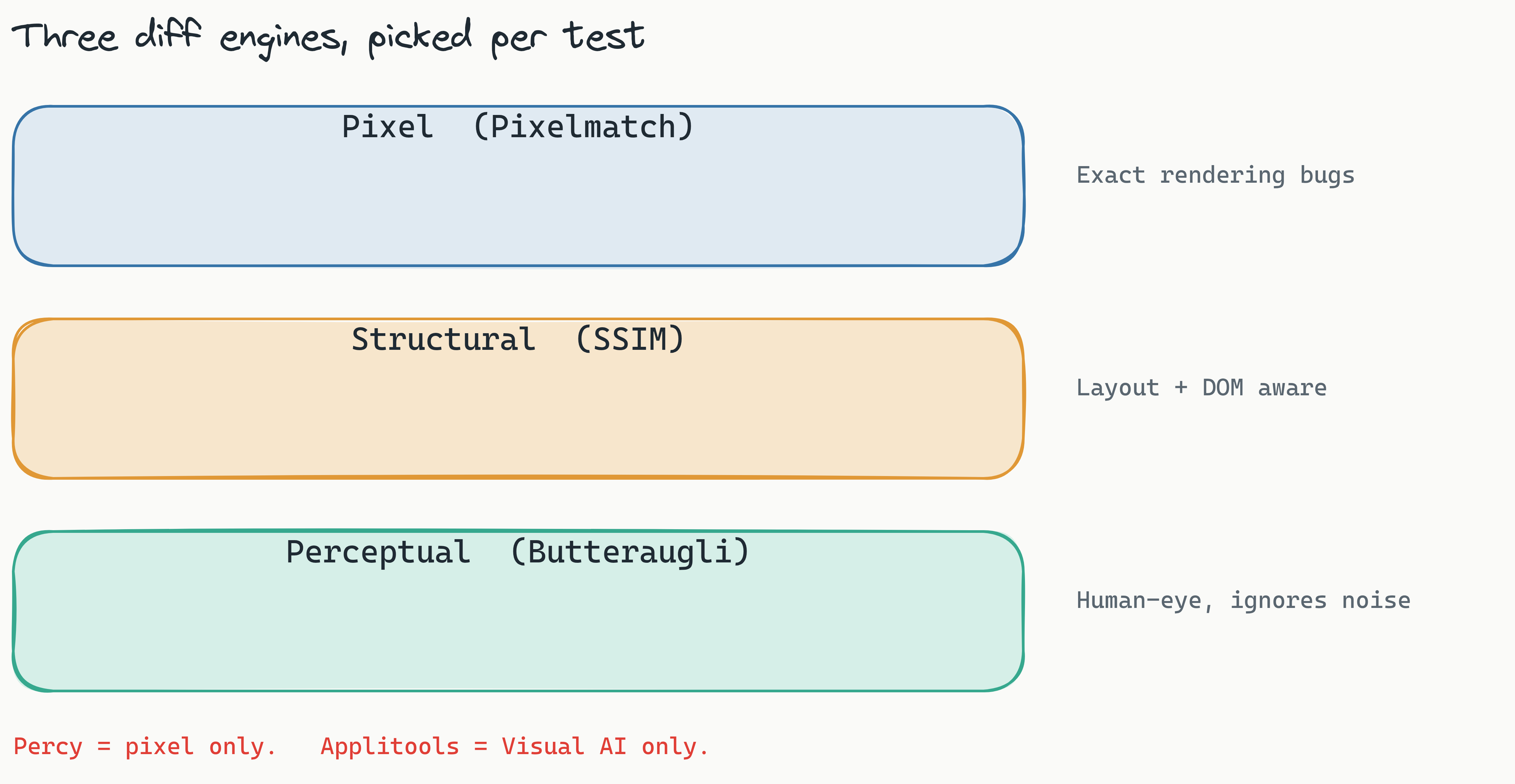
The ability to switch engines based on test context reduces the signal-to-noise ratio dramatically. You are not forced into a one-size-fits-all approach that tolerates false negatives or false positives. If false positives are your main pain, see how Lastest reduces false positives in visual regression testing.
- Identify test context - Determine whether the test examines layout, dynamic content, or exact pixel rendering
- Select appropriate engine - Choose structural for layout, perceptual for dynamic, pixel for exact matches
- Generate the test once - AI authors the Playwright test, and a human reviews it before it becomes a baseline
- Run replays at zero token cost - Every subsequent execution is plain Playwright and costs nothing, regardless of environment
CI/CD Integration: Which Tool Fits Your Pipeline?
Implementing visual regression testing for CI/CD pipeline 2026 requires tools that don't slow down or cost escalate with every commit. Integration depth and pipeline speed vary significantly across the three platforms.
Lastest is CI-native. It ships a reusable GitHub Action, posts diff results as GitLab merge-request comments (self-hosted GitLab included), and supports webhook triggers and scheduled cron. For self-hosted setups, there is minimal network hop between your CI runner and the visual testing engine because both live on your infrastructure. Snapshots are captured and diffs computed on your own servers, eliminating the bottleneck of uploading screenshots to a third-party SaaS and waiting for a response. Smart Run reads your git diff and runs only the tests your change actually touches, so a one-line CSS tweak does not re-run the whole suite.
Percy offers a polished integration experience with native GitHub and GitLab UI components. The snapshot review interface appears directly in pull requests, making it easy for non-developers to approve or reject visual changes. The trade-off is that all snapshots must be uploaded to Percy's cloud servers, processed, and compared. This adds latency to your CI pipeline, especially for teams with large test suites or slow internet connections.
Applitools requires an Ultrafast Grid agent for on-premise execution, which adds configuration overhead. The agent handles rendering across multiple browsers and viewports simultaneously, which speeds up execution once configured. But initial setup is heavier than either Lastest or Percy, making it better suited for dedicated DevOps teams than small engineering groups.
Self-Hosting and Data Sovereignty: A European Enterprise Imperative
For European enterprises requiring a self-hosted visual testing tool for enterprise environments, Lastest is the only truly viable option among the three. This is not a minor feature difference - it is a compliance necessity for many organizations.
Percy and Applitools are cloud-only. Every screenshot of your unreleased features, every visual diff of your staging environment, and every baseline comparison runs through their servers. For companies subject to GDPR, internal data protection policies, or client confidentiality agreements, sending screenshot data of unreleased products to a third-party service creates risk. Even with DPA agreements in place, the data physically leaves your infrastructure.
Lastest runs on your own servers. Full control over data retention, backup schedules, and encryption keys rests with your team. You can configure the tool to never phone home, eliminate data processing agreements, and comply with the strictest internal security policies. This matters particularly for fintech, healthcare, and government technology teams that handle sensitive user data or trade secrets.
GDPR compliance is simpler with self-hosting because you eliminate the third-party data processor from your data flow. There is no need to verify where a cloud provider stores your screenshots or whether they sub-process your data to other vendors. The official GDPR guidelines explicitly encourage data minimization and local processing as best practices for compliance.
Why is self-hosting critical for GDPR compliance in visual testing? Self-hosting ensures all visual test data stays on your infrastructure, eliminating the need for third-party data processing agreements. This simplifies GDPR compliance by removing risks around where screenshots of unreleased features are stored or sub-processed by cloud vendors.
Lastest positions as the ideal self-hosted visual testing tool for enterprise environments because it puts the enterprise in control. From encryption at rest to custom backup schedules, every aspect of data management is configurable. For teams exploring open-source options, the codebase is fully available - meaning you can audit security, contribute features, or fork the project if needed. As an open source visual regression testing tool 2026, Lastest gives enterprises complete transparency into how their visual data is handled.
AI Test Generation: Pay Once vs Pay Per Execution
Here is how to automate visual testing with AI in 2026 without breaking the bank. Lastest's zero-token replay model fundamentally changes the economics of AI-powered testing. Understanding this difference is critical for teams that plan to scale their test suites over time.
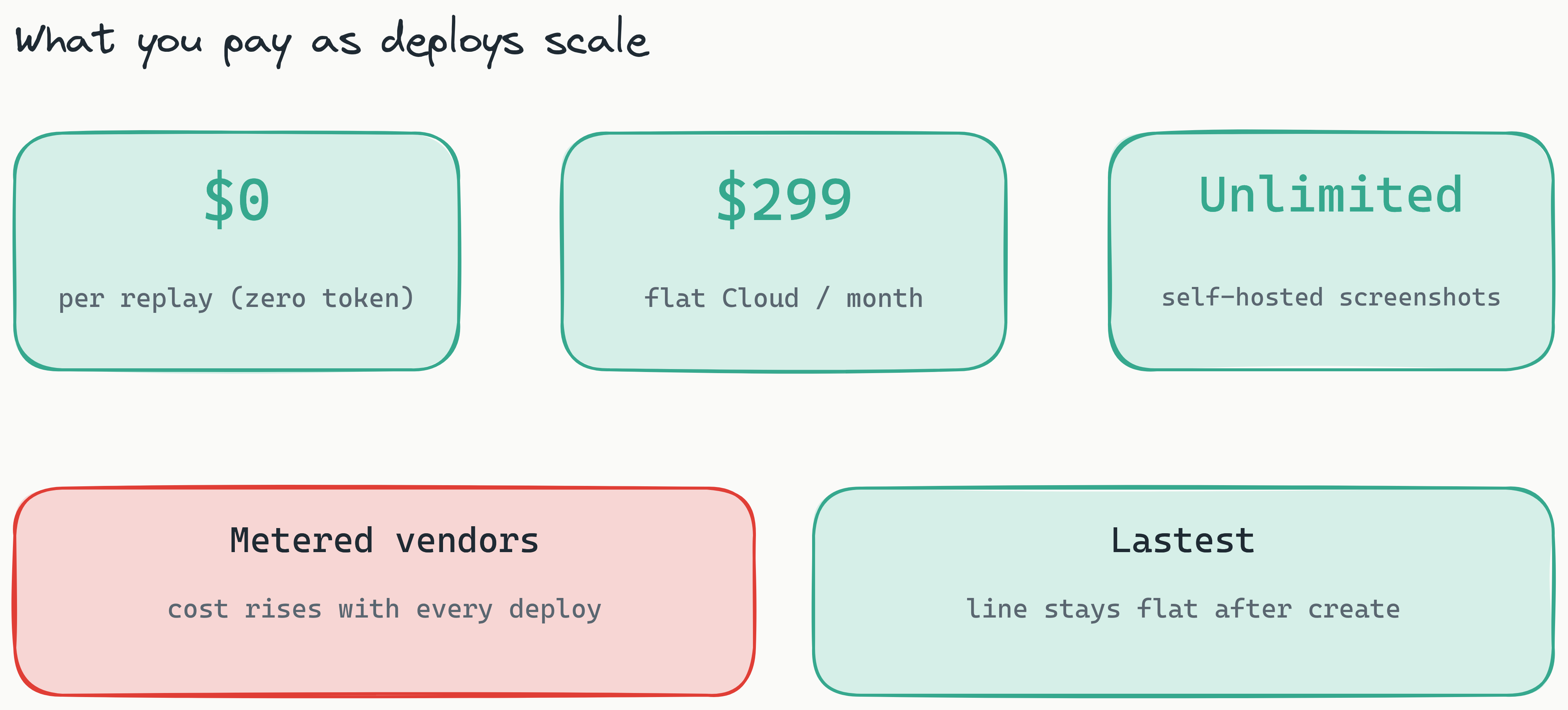
Percy and Applitools both meter usage. Every time a visual test runs against a new build, whether it finds a change or not, it counts toward a snapshot cap or an execution credit. This means your costs grow with your deployment frequency. A team that deploys twenty times per day consumes far more than a team that deploys twice per day, even if their test suites are identical in size.
Lastest spends AI only when a test is created or fixed. Once the test exists, every future replay costs zero tokens because it is plain Playwright execution. This decouples your testing cost from your deployment frequency. A team that deploys twenty times per day pays the same as a team that deploys twice per day. The total cost of ownership becomes predictable and capped.
This model is particularly advantageous for teams that run visual tests in multiple environments - staging, production monitoring, and branch previews. Each environment can run the same tests simultaneously with no additional token cost. Over a twelve-month period, a team running 200 tests across 3 environments sees dramatically different costs between a pay-per-execution model and a one-time token model.
Key AI Testing Terminology:
- Zero-token replay - Re-running an existing AI-generated test as plain Playwright, without consuming any AI tokens. AI runs only at create or fix time.
- AI test generation - Claude writing resilient Playwright code from URLs, OpenAPI specs, or markdown PRDs, with a 7-layer selector fallback so tests survive refactors.
- Perceptual diff (Butteraugli) - A human-eye-aligned engine that detects meaningful changes while ignoring anti-aliasing and font-rendering noise.
- AI failure classification - Every failure auto-labeled as real regression, flaky, environment, or test-maintenance, with a confidence score and reasoning.
Frequently Asked Questions
Can I use Lastest for free? Yes. The self-hosted version is completely free under an FSL-1.1-ALv2 license, with unlimited screenshots and replays on your own infrastructure. Prefer a managed service? Lastest Cloud is a flat $299/month, and there is also a $0 Cloud Free tier with a monthly quota for evaluation.
Does Percy offer a self-hosted option? No. Percy is cloud-only, meaning all screenshots must be uploaded to their servers for processing. This may conflict with data sovereignty requirements.
How does Applitools pricing work? Applitools charges per test execution. Each time a visual test runs, it consumes credits from your plan. Costs scale with deployment frequency and environment count.
Which tool has the best false-positive rate? Lastest offers the most control because you can switch between pixel, structural, and perceptual AI engines per test. This flexibility reduces noise compared to single-engine approaches.
Is Lastest compatible with GitHub Actions? Yes. Lastest ships a reusable GitHub Action and posts GitLab merge-request comments out of the box, plus webhook and cron triggers. Smart Run keeps CI fast by running only the tests your diff touches.
What happens to my test data with Lastest self-hosting? All data stays on your infrastructure. You control data retention, backups, and encryption keys. Lastest does not phone home when self-hosted.
The Verdict: Which Visual Testing Tool Should You Choose?
When ranking the best visual regression testing tools 2026, three factors matter most: total cost of ownership, control over your data, and accuracy that your team can trust. No single tool wins on all three dimensions for every team.
Choose Lastest if: You need cost predictability without overage surprises. You value data sovereignty and prefer self-hosting over sending screenshots to a third party. Your team deploys frequently and wants testing costs that do not scale with deployment frequency. You want the flexibility to switch between diff engines based on test context rather than being locked into a single approach. You want three-engine pixel verification that classifies each shot unchanged, flaky, or changed instead of a single-engine binary flag, plus a data filter that masks dynamic content, show-area and ignore regions that scope review to what actually changed, animation and flaky-test guards that kill noise at the source, 7-layer self-healing selectors that survive refactors, and zero-token replays so cost never tracks deploy frequency. Lastest's open-source nature gives you the freedom to inspect, modify, and contribute to the tool.
Choose Percy if: Your team prioritizes a polished SaaS collaboration experience. You need native pull request integration that non-developers can use easily. Your snapshot volume is predictable and fits within Percy's pricing tiers without overages. You are comfortable with a cloud-only deployment model.
Choose Applitools if: You have an enterprise budget and need the most mature Visual AI on the market. Your team handles highly dynamic content where perceptual AI reduces noise significantly. You need the Ultrafast Grid for parallel cross-browser testing. You are willing to pay a premium for AI accuracy at scale.
In the Lastest vs Percy vs Applitools 2026 comparison, the clear winner for teams prioritizing long-term cost stability and data control is Lastest. Want the closer head-to-heads? Read Percy vs Lastest for QA teams and Chromatic vs Lastest.
Rather than trusting a vendor comparison on a blog, test Lastest on your own infrastructure today. Self-host it free with unlimited screenshots and zero-token replays, or skip the ops and start on a flat-priced Lastest Cloud account. The full source is on GitHub at github.com/las-team/lastest, so you can audit it, fork it, or contribute before you ever commit a cent.