
Introduction
Every engineering team that ships user interfaces knows the pain of UI regression. You merge a CSS change, and suddenly a button in an unrelated component shifts three pixels to the left. Visual regression testing catches these issues before they reach production, but the tools available today force trade-offs. Chromatic has been the dominant choice for teams using Storybook, offering tight integration at the cost of vendor lock-in and snapshot-metered billing.
But 2026 brings a new contender. Lastest enters the visual regression testing landscape as a fully open-source, self-hosted alternative with AI-authored Playwright tests, three diff engines, and zero-token replays. A Chromatic vs Lastest visual regression testing comparison reveals two fundamentally different approaches to UI testing that impact workflow, cost, and compliance.
By the end of this comparison, you'll know which tool saves your team time and money, and whether a self-hosted open-source alternative fits your 2026 workflow. The short version: Chromatic meters every snapshot and lives on Storybook; Lastest runs anywhere, generates its own tests, and replays them for $0.
A Feature-by-Feature Comparison: Chromatic vs Lastest
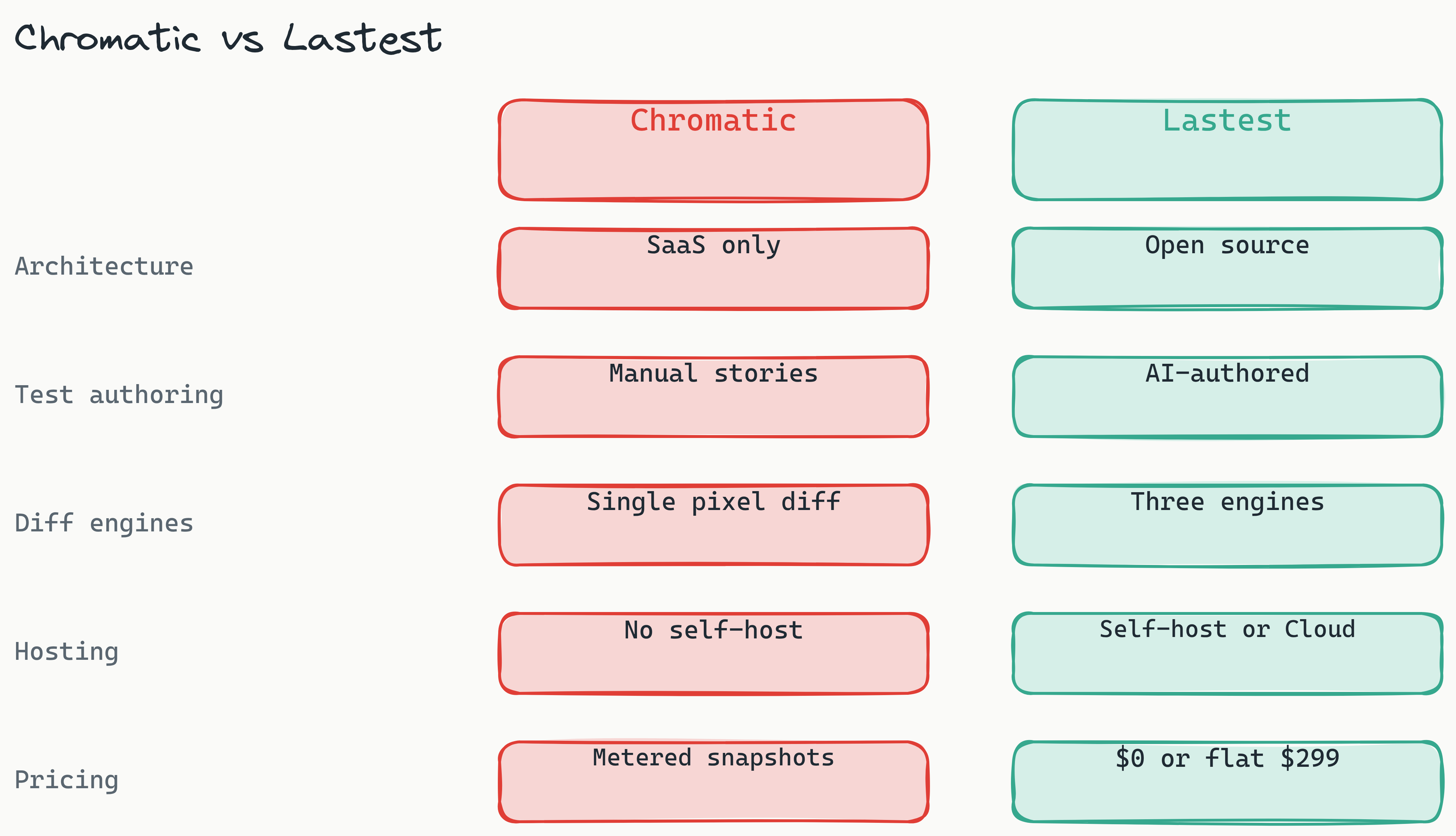
Chromatic and Lastest differ fundamentally in architecture. Chromatic is a SaaS-only platform tightly coupled to Storybook, while Lastest is an open-source, framework-agnostic tool with self-hosting options and AI-driven test generation. The table below captures the critical differences.
| Feature | Chromatic | Lastest |
|---|---|---|
| Diff engines | Single pixel-based engine | Three engines: pixel, structural, perceptual |
| AI test generation | Manual Storybook stories required | AI-generated tests from application |
| Self-hosting | Not available | Full Docker-based self-hosting |
| Pricing model | SaaS tiers metered by snapshot volume (from ~$179/mo) | Free self-hosted (FSL-1.1) + flat Cloud at $299/mo |
| Framework support | Storybook only | Any framework (React, Vue, Angular, Svelte) |
| CI/CD integration | GitHub, GitLab via Storybook | Native GitHub Action, GitLab MR comments, Smart Run |
| Accessibility scoring | Not built in | WCAG 2.2 AA (axe-core) 0–100 score per screenshot |
| Token/replay limits | Each snapshot counts toward quota | AI runs only on create/fix; zero-token replays |
What are the key differences between Chromatic and Lastest? The most immediate difference is architecture. Chromatic is a SaaS-only tool requiring Storybook, while Lastest is open-source, framework-agnostic, and offers full self-hosting via Docker. Lastest also provides three diff engines (pixel, structural, perceptual) compared to Chromatic's single pixel-based engine, and uses AI for test generation rather than manual Storybook stories.
At a Glance: The Key Differences
The most immediate difference is architectural. Chromatic requires you to adopt Storybook as your component development environment. If your team already uses Storybook, that integration is seamless. If you don't - or if you're building with multiple frameworks - Chromatic becomes an expensive constraint.
Lastest takes the opposite approach. It works with any framework, generates tests using AI rather than requiring manual component stories, and gives you the option to run entirely on your own infrastructure. The trade-off is that Chromatic's Storybook integration is more mature and better documented.
What the Table Reveals About Your Workflow
For teams that need visual regression testing without framework lock-in, Lastest's open-source model removes barriers Chromatic's SaaS approach creates. The self-hosting capability means screenshots never leave your network, a critical consideration for European enterprises operating under GDPR. And zero-token replays mean retesting after reviewing and fixing visual diffs doesn't consume your monthly budget. For a broader field comparison, see our open-source Playwright visual testing roundup.
Why Diff Engines Matter: Pixel, Structural, and Perceptual Comparison
Diff engines determine how accurately a tool detects visual changes. Lastest offers three engines (pixel, structural, perceptual) while Chromatic relies on a single pixel-comparison approach. This Chromatic vs Lastest diff engines comparison matters more than most teams realize.
Pixel diff (Pixelmatch) compares images pixel by pixel. It catches every visual change but produces high false-positive rates. A font hinting difference across operating systems, an anti-aliasing artifact, or a sub-pixel rendering variance all trigger alerts. Engineers spend time reviewing non-issues.
Structural diff (SSIM) is layout-aware. It compares the structural similarity of regions rather than raw pixels, so it tolerates minor styling noise while still flagging shifts in position, size, and layout. This reduces noise for changes that don't move anything.
Perceptual diff (Butteraugli) uses a content-aware algorithm tuned to human visual perception. It ignores anti-aliasing differences, sub-pixel rendering variations, and other non-functional artifacts while still catching changes a person would actually notice. This is the most sophisticated engine and produces the fewest false positives.
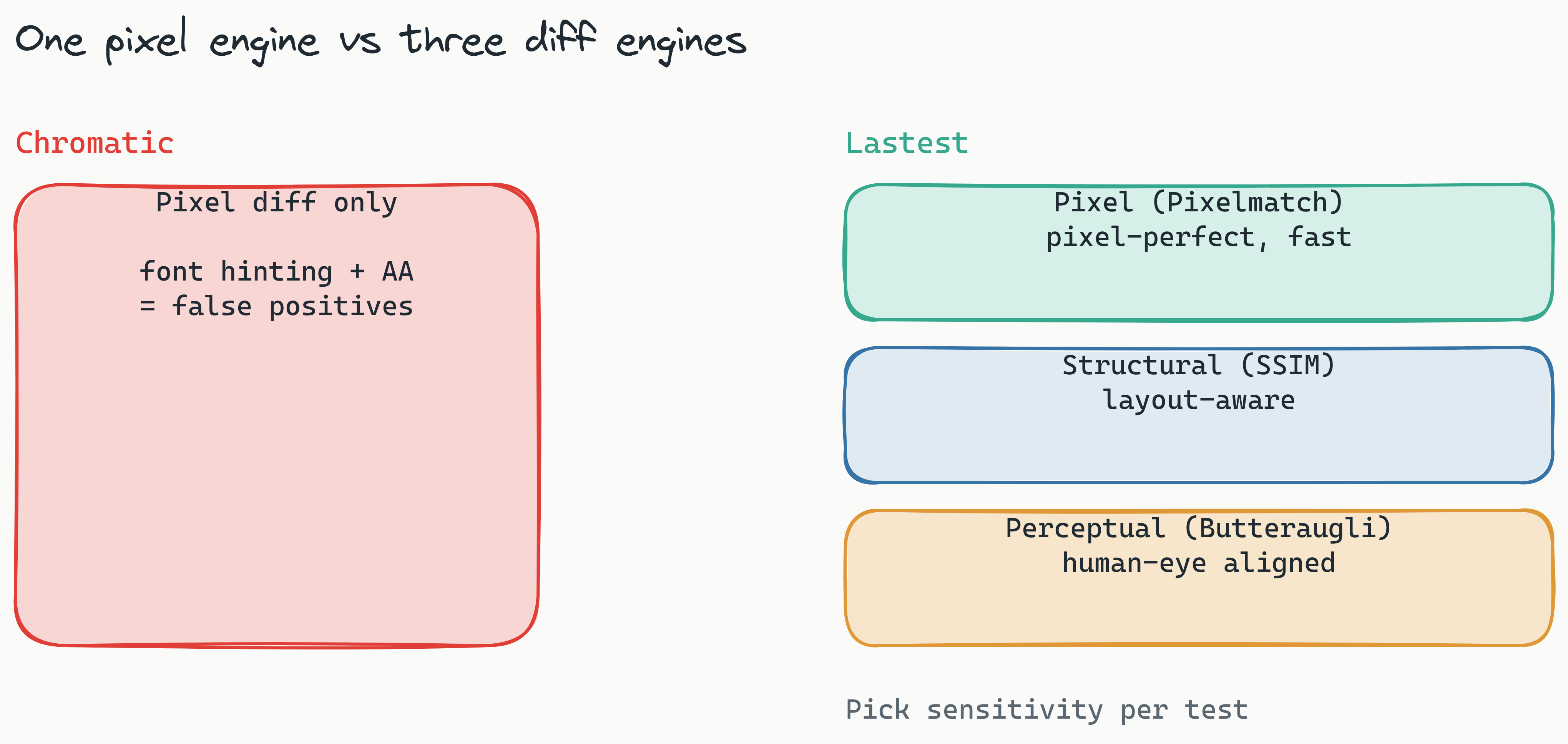
Chromatic's single pixel-based engine means more false positives requiring manual review. Lastest's three engines let you choose the right sensitivity level for each test. For layout-critical components, use structural or perceptual diff. For pixel-perfect elements like icons or logos, use pixel diff. On top of the engines, stabilization features (OCR-aware text diffing, timestamp freezing, network-idle and font-loading waits, auto-masking of dynamic content) keep screenshots consistent across operating systems before a diff ever runs.
The practical impact: a font hinting difference across macOS and Windows triggers a false positive in Chromatic but passes in Lastest's perceptual engine. Over thousands of tests, that difference saves hours of review time per sprint. We go deeper on the math in how to reduce visual regression false positives.
Open Source vs SaaS: Can You Self-Host Visual Regression Testing?
Yes. Lastest is fully self-hostable under an FSL-1.1 license that converts to Apache 2.0 over time, while Chromatic is SaaS-only. Self-hosting gives teams complete control over data, infrastructure, and cost. As a self-hosted alternative to Chromatic, Lastest addresses compliance requirements that the SaaS model cannot satisfy. Self-hosting has become a priority for many engineering teams in 2026, driven by regulatory compliance and cloud cost optimization.
GDPR and Data Sovereignty: Why Self-Hosting Matters for European Teams
For German and European enterprises, data sovereignty isn't optional. Every visual regression test captures screenshots of your application. With Chromatic, those images leave your infrastructure and are processed on cloud servers potentially located outside the EU.
Lastest's self-hosted deployment keeps screenshots on your own network and never sends them out. The full source is auditable on GitHub, so you control where data is stored, how long it's retained, and who has access. In practice, teams report that self-hosting an auditable tool simplifies vendor risk assessments and data processing agreements, because there is no third-party processor to sign off on in the first place.
Docker and Infrastructure: How Easy Is Self-Hosting?
Self-hosting Lastest requires minimal infrastructure. The stack is containerized, including the dashboard, the embedded browser pool (containerized Chromium with live JPEG streaming), the test runner, and the diff engines. It provisions into a local k3d cluster for development or into your own cluster in production, so there is no local Playwright install to babysit. See the self-host guide and the docs for the full walkthrough.
For teams already running containers, this means no additional cloud accounts. You don't manage snapshot quotas, worry about token limits, or negotiate enterprise contracts. The self-hosted version is free with no feature restrictions and unlimited screenshots regardless of volume.
Chromatic offers no self-hosting option. If your compliance team requires on-premise deployment, you cannot use Chromatic. That makes Lastest the practical choice for many regulated teams in finance, healthcare, and government.
Cost Breakdown: Chromatic Pricing vs Lastest's Free + Hosted Model
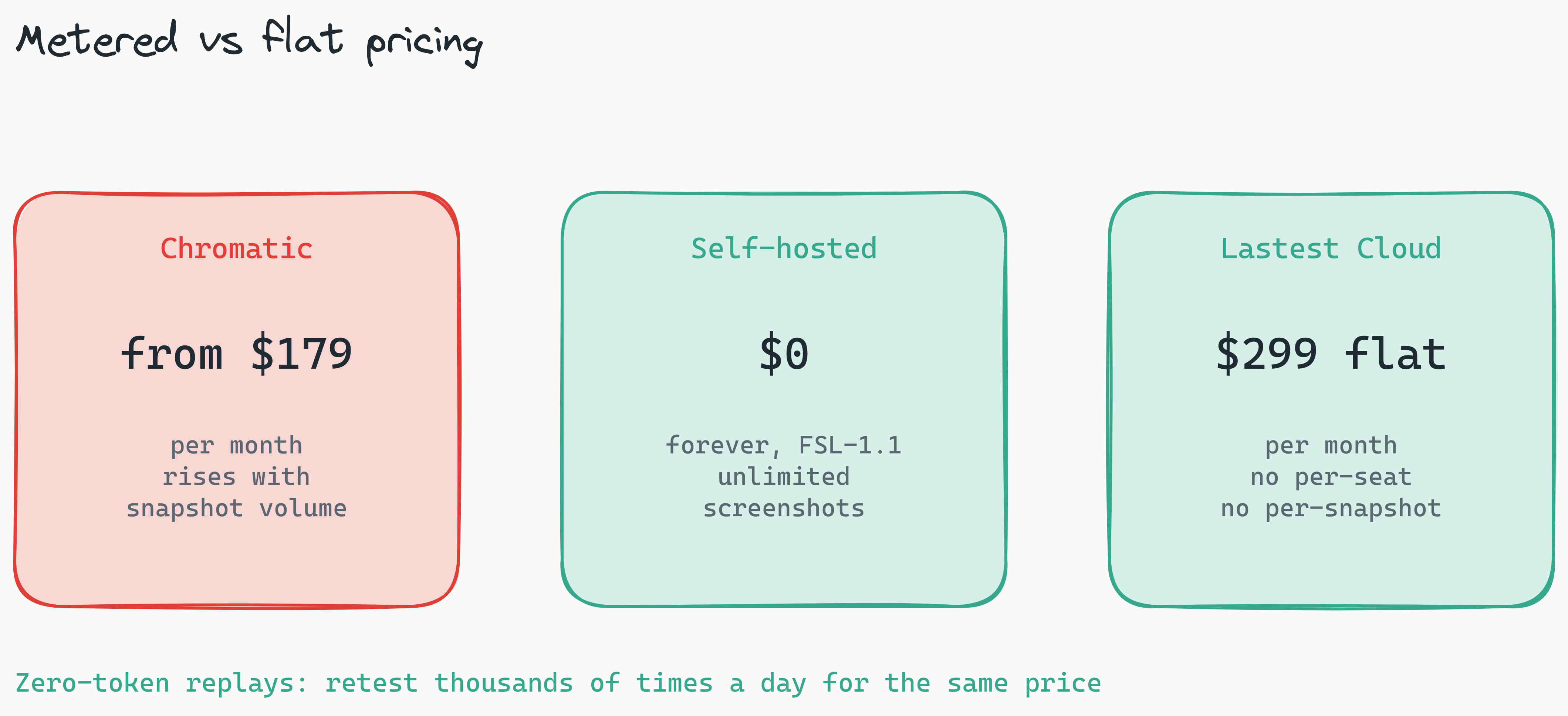
The two tools price on completely different axes. Chromatic meters snapshots: there is a free tier for small projects, with paid plans starting around $179/month and climbing as your snapshot volume grows. Lastest does not meter snapshots at all. The self-hosted version is free forever with unlimited screenshots, and Lastest Cloud is a flat $299/month, no per-seat and no per-snapshot fees. The comparison that matters is not row-by-row volume math; it is metered versus flat.
Understanding "Zero-Token Replays" and Its Impact on Budget
The hidden cost in most AI testing tools is retesting. After you fix a visual diff, you re-run the test to confirm the fix. In a snapshot-metered model, each replay counts. In Lastest, AI only runs when you create or fix a test; every replay after that is plain deterministic Playwright execution that costs zero tokens. You can replay tests thousands of times a day without consuming budget. We break down the token math in Lastest vs Percy vs Applitools.
So a team that retests constantly pays the same on Lastest as a team that runs once a week. Self-hosted, that's $0; on Cloud, it's a flat $299/month either way, with no per-snapshot billing to model.
When the Cloud Plan Makes Sense vs. Self-Hosting
The $299/month Cloud plan targets teams that want managed infrastructure without running their own cluster. Lastest Cloud handles scaling and the browser pool for you and ships the same feature set as self-hosted. There is also a free Cloud evaluation tier with a monthly quota if you want to try it before committing.
Self-hosting makes sense when you already have container infrastructure, need GDPR compliance, or want to avoid monthly subscription costs entirely. The code is identical between versions, so your team can start self-hosted and migrate to cloud later without workflow changes.
CI/CD Integration: Fitting Chromatic vs Lastest Into Your Pipeline
Both Chromatic and Lastest integrate with CI/CD pipelines, but Lastest offers broader framework support and Docker-native deployment. The Chromatic vs Lastest for CI/CD pipelines comparison shows that Chromatic works via Storybook deployment, requiring Storybook setup in your pipeline, while Lastest provides native GitHub Actions and GitLab CI integration that works with any framework.
Here's a short YAML example for Lastest's GitHub Action:
name: Visual Regression Tests
on: [pull_request]
jobs:
  visual-regression:
    runs-on: ubuntu-latest
    steps:
      - uses: actions/checkout@v4
      - name: Run Lastest
        uses: las-team/lastest-action@v1
        with:
          api-key: ${{ secrets.LASTEST_API_KEY }}
          base-url: ${{ secrets.BASE_URL }}
The key advantage is framework independence. Chromatic requires a Storybook build step in your CI pipeline. If you're using a framework that Storybook doesn't fully support - or if you prefer to skip Storybook entirely - that build step becomes unnecessary overhead.
Lastest works with React, Vue, Angular, Svelte, and any framework that renders to a browser. Two CI features pull ahead of a basic snapshot upload: Smart Run reads your git diff and runs only the tests your change actually touches, and Distributed Remote Runners fan a suite out across CI workers. For GitLab teams, Lastest posts diff results as MR comments (self-hosted GitLab included). And because Lastest ships an MCP server exposing around 20 tools, coding agents like Cursor and Claude Code can drive test creation and triage directly from your editor.
Chromatic remains simpler for teams already committed to Storybook. If your components are all in Storybook stories, Chromatic's CI integration is push-button. For everyone else, Lastest's broader compatibility eliminates the need to adopt a new component development workflow just to get visual regression testing.
Which tool is easier to integrate into an existing CI/CD pipeline? For teams already using Storybook, Chromatic offers a simple push-button integration. For everyone else, Lastest provides broader compatibility with native GitHub Actions and GitLab CI, requiring only a Docker-ready environment and an API key, with no need to adopt Storybook.
AI-Powered Test Generation: The Feature Chromatic Doesn't Have
Lastest uses AI to automatically generate visual regression tests from your application, whereas Chromatic requires developers to manually write Storybook stories for every component. This is a fundamental workflow difference that changes how teams adopt visual regression testing.
In Chromatic, you write a Storybook story for each component state you want to test. That means manual effort for every variant: default state, loading state, error state, different screen sizes. For a component library with hundreds of components, writing stories becomes a significant engineering investment.
Lastest generates resilient Playwright tests from your application instead. You give it URLs, an OpenAPI spec, or a markdown PRD, and its Route Discovery scans source for paths the spec missed. Claude writes the test code, and every selector ships with a 7-layer fallback chain (data-testid, id, role, aria-label, text, CSS, then OCR) so refactors that break hand-written selectors heal themselves. You pick how autonomous to be: AI-Free recording (air-gapped, no API keys), AI-Assisted where the AI proposes and a human reviews every change, or Full Autonomous via the Play Agent, an 11-step pipeline of specialized sub-agents that plan, generate, run, and fix tests, and that you can pause, approve, or skip at any step.
Crucially, AI runs only when you create or fix a test. Replays are plain Playwright and cost zero tokens, so frequent regression cycles stay cheap. And because Lastest is bring-your-own-AI (Claude CLI, Anthropic API, OpenRouter, OpenAI, or local Ollama models), you are never locked to a single provider or a per-execution meter.
The workflow comparison is stark:
- Chromatic: Developer writes Storybook story → commits → pipeline runs → reviewer checks diffs
- Lastest: AI authors tests → reviewer renders one verdict (pass / fix / regression) → pipeline replays for free → AI failure classification triages the rest
That last step is unique: every failure is auto-classified as a real regression, flaky, environment, or test-maintenance issue, with a confidence score and reasoning, so reviewers spend their time on real bugs. Lastest also scores every screenshot against WCAG 2.2 AA with axe-core, surfacing accessibility regressions Chromatic never looks for. If you want a deeper look at how the selectors survive refactors, read how self-healing selectors work.
Frequently Asked Questions
Is Lastest really free for self-hosting?
Yes. The self-hosted version of Lastest is completely free and open source, with no feature restrictions compared to the cloud tier. You only pay for your own infrastructure costs.
Can I use Lastest without Storybook?
Absolutely. Lastest is framework-agnostic and works with React, Vue, Angular, Svelte, and any other framework that renders to a browser. No Storybook setup is required.
How does "zero-token replay" work in Lastest?
After you run a test for the first time (which consumes a token), all subsequent replays to verify fixes are free and do not consume additional tokens or count toward any quota.
Does Chromatic support self-hosting?
No. Chromatic is a SaaS-only platform. If your compliance team requires on-premise deployment, Lastest is the only option listed here that supports it.
What are the three diff engines in Lastest?
Lastest offers pixel diff, structural diff, and perceptual diff. You can choose the engine for each test to balance accuracy and false-positive rate, unlike Chromatic which only provides pixel diff.
How does Lastest's AI test generation work?
You give Lastest a URL, an OpenAPI spec, or a markdown PRD. Claude authors Playwright tests with 7-layer self-healing selectors, and Route Discovery finds paths your spec missed. You choose AI-Free recording, AI-Assisted review, or Full Autonomous via the 11-step Play Agent. AI runs only on create or fix; replays are zero-token.
Final Verdict: Choosing Between Chromatic and Lastest
The right choice depends on your team's existing workflow, infrastructure preferences, and budget constraints. Understanding Chromatic vs Lastest visual regression testing features helps clarify the decision.
Choose Lastest if:
- You need self-hosting for compliance or data sovereignty
- You value AI test generation over manual story writing
- You want framework flexibility beyond Storybook
- You need cost predictability at scale
- Zero-token replays matter for your testing frequency
Choose Chromatic if:
- You're deeply invested in Storybook for all component development
- You prefer SaaS simplicity with no infrastructure management
- You have budget for scaling snapshot usage
- Your team is already productive with Chromatic's workflow
Lastest's key differentiators, namely open-source FSL-1.1 code, self-hosting, three diff engines, AI-authored self-healing tests, WCAG 2.2 AA scoring, and zero-token replays, address gaps Chromatic leaves open, particularly for teams with compliance requirements or cost sensitivity.
Ready to try it? Self-host Lastest for free under FSL-1.1 with unlimited screenshots, or skip the ops and start on Lastest Cloud at a flat $299/month (there's a free evaluation tier too). Browse the full feature list, watch the demos, and star the project on GitHub. If you're building with a specific stack, see how Lastest fits React apps or Next.js apps.