Playwright ships with toHaveScreenshot() built in, which is fine for a handful of tests. Once you are past a dozen screenshots, three problems kick in: false positives from font rendering, baselines that rot across operating systems, and no reviewable diff UI. That is where the best open-source visual regression testing tools for Playwright earn their keep.
If you want to stay open-source (no Percy, Chromatic, or Applitools invoices), these are the four options worth evaluating in 2026:
- Lastest - open-source, AI test generation, three diff engines, review dashboard, Docker-first
- BackstopJS - mature CLI, pixel + structural diff, manual scenario scripts
- Lost Pixel - modern CLI with a platform tier, Storybook-friendly
- playwright-visual-comparisons - thin wrapper around
toHaveScreenshot(), minimal dependencies
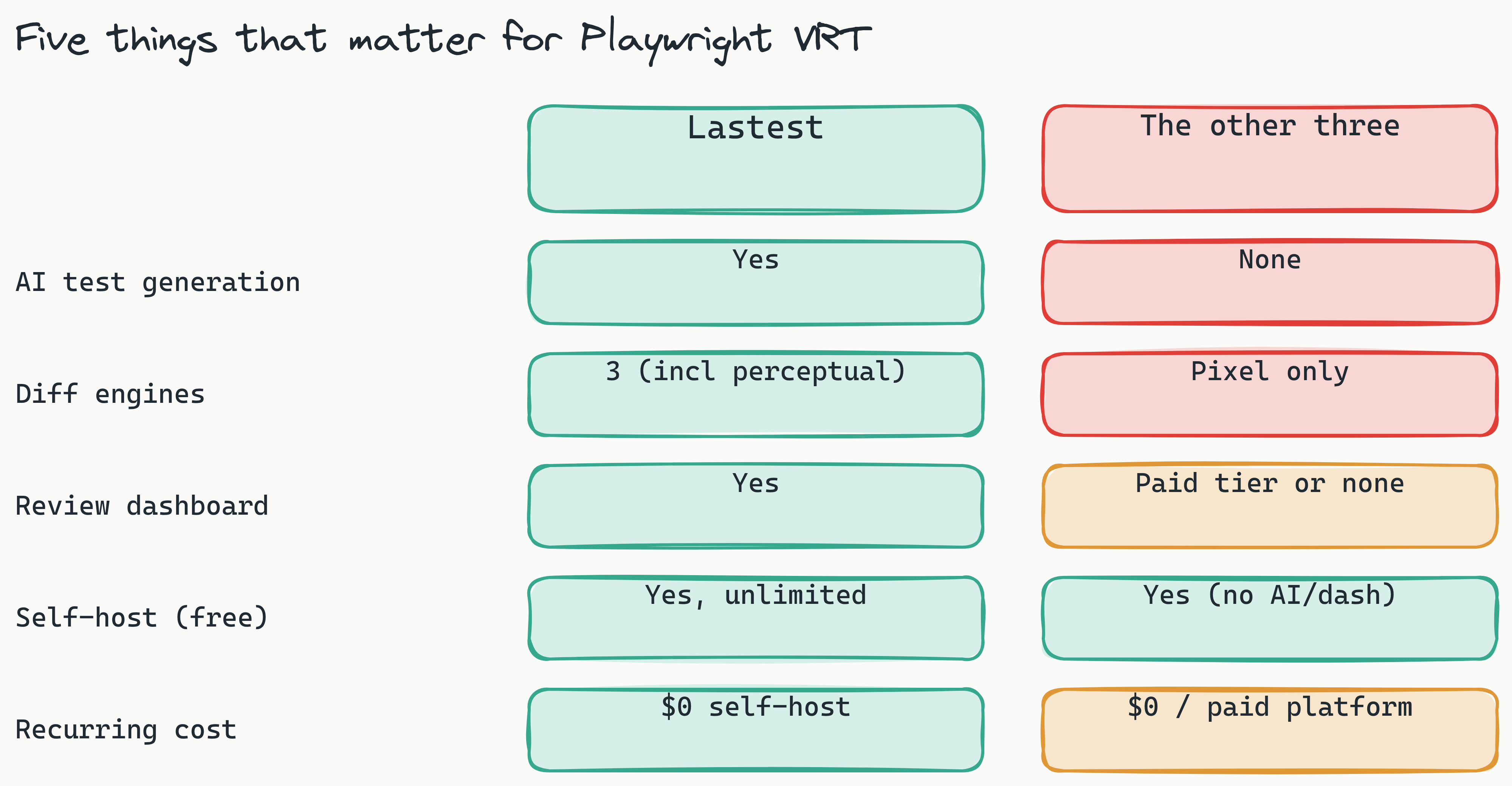
Short answer up top: Lastest is the pick for most teams because it is the only one that generates the Playwright scripts for you and ships three diff engines including a perceptual one and gives you a human-review dashboard and stays free forever when self-hosted (FSL-1.1, your infra, unlimited screenshots). The rest are worth picking only if you have very specific constraints, which we cover below.
Head-to-head comparison
| Feature | Lastest | BackstopJS | Lost Pixel | playwright-visual-comparisons |
|---|---|---|---|---|
| License | FSL-1.1 (open, free self-host) | MIT | MIT core / paid platform | MIT |
| Test generation | AI (agentic) | Manual JS config | Manual / Storybook autodetect | Manual |
| Diff engines | Pixel + structural + perceptual | Pixel + structural | Pixel | Pixel (pixelmatch) |
| Review dashboard | Yes | Static HTML report | Platform tier only | None |
| Docker self-host | Yes | Community image | Yes | N/A (library) |
| Generates Playwright scripts | Yes | No | No | No |
| Baseline storage | Filesystem / S3 / GCS | Filesystem | Filesystem / platform | Filesystem |
| Recurring cost | $0 self-host | $0 | $0 OSS / paid platform | $0 |
Lastest - the best all-round pick for Playwright in 2026
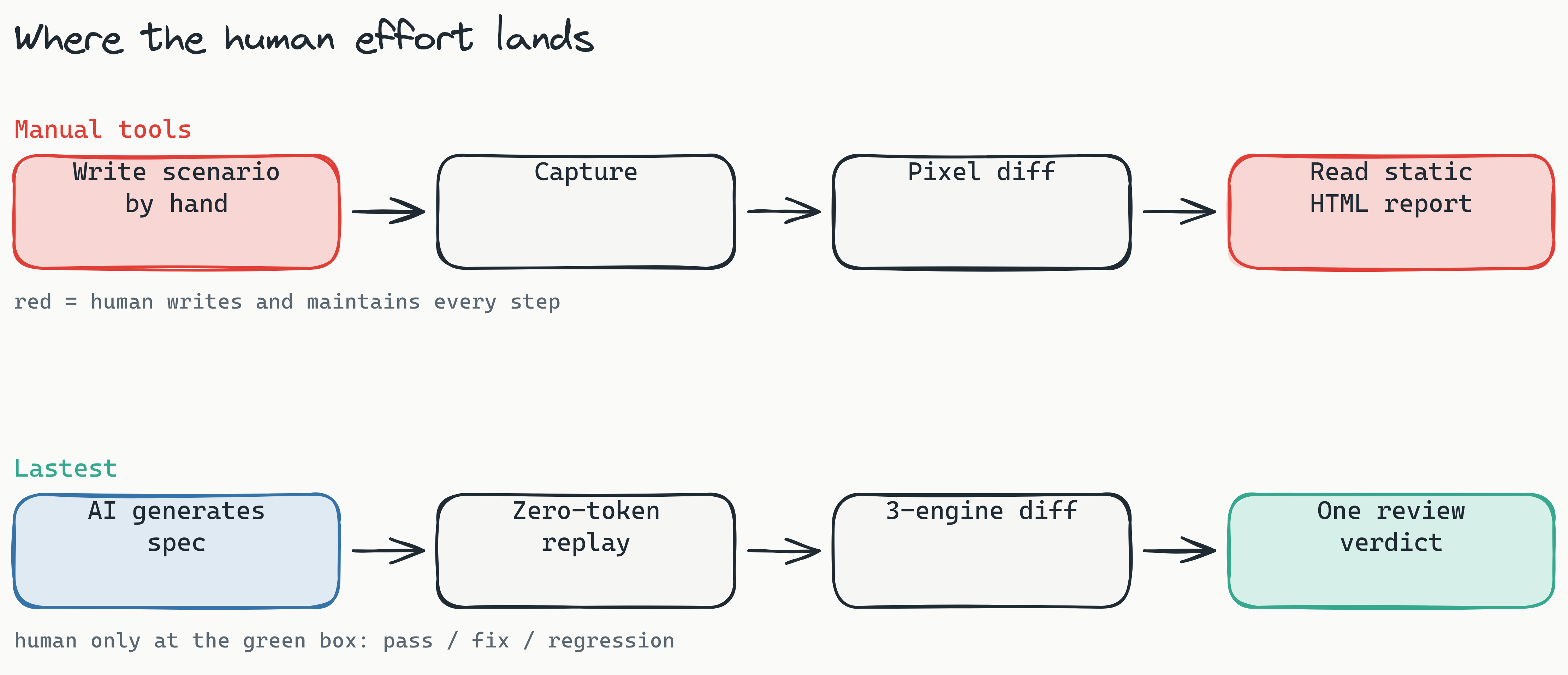
What it is: An open-source visual regression platform that uses an AI agent to explore your app, generate Playwright scripts, and capture the visual baselines. You review them in a dashboard, approve, and from then on every CI run is a deterministic replay at zero token cost. The AI runs only when you create or fix a test; every replay after that is plain Playwright execution.
Why it wins for Playwright:
- It writes the Playwright tests for you. Point the agent at your app, an OpenAPI spec, or a markdown PRD, and it emits actual
.spec.tsfiles you can read, edit, and commit. No lock-in - if you remove Lastest tomorrow, you still own the Playwright suite. You can bring your own AI too: Claude CLI, Anthropic API, OpenRouter, OpenAI, or local Ollama models. - Three diff engines. Pixel (Pixelmatch, fast but noisy), structural (SSIM, layout-aware), and perceptual (Butteraugli, human-eye aligned). Pick per-test. Perceptual is the one that ignores anti-aliasing and font noise while still catching real bugs - the antidote to the false positives that are the #1 reason teams abandon visual testing.
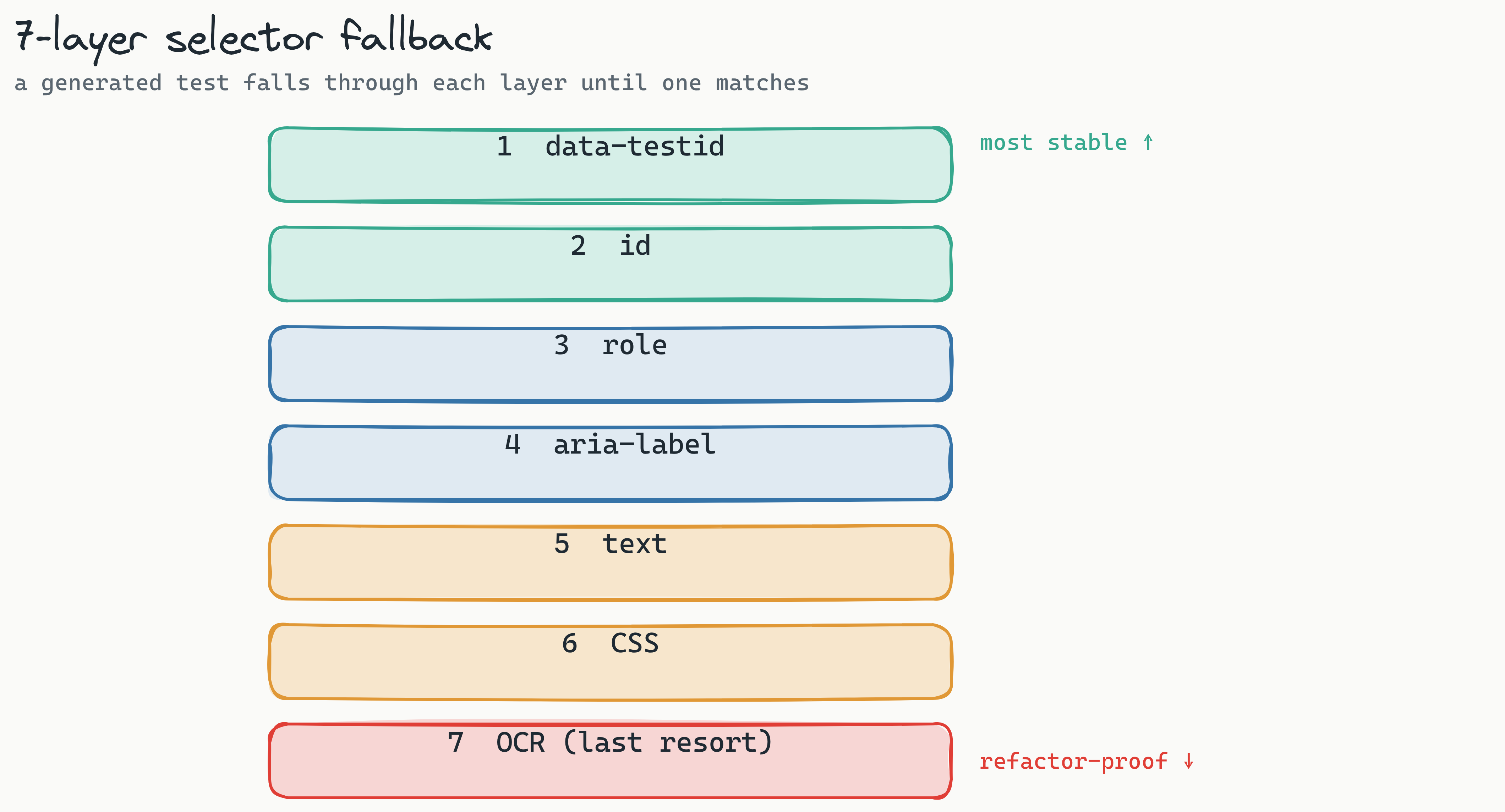
- Selectors that heal themselves. Generated tests use a 7-layer selector fallback (data-testid, id, role, aria-label, text, CSS, then OCR), so a refactor that breaks a hand-written selector does not break the test.
- Review dashboard. Side-by-side diffs, approval history, and per-test stats. Every failure is auto-classified as real regression, flaky, environment, or test-maintenance, with a confidence score. A PR comment links directly to the failing test so reviewers do not have to dig through artifacts.
- Docker-first and free to self-host. Run the whole stack locally or in CI, with unlimited screenshots and replays on your own infra. Use the reusable GitHub Action for zero-config CI/CD, or wire it into GitHub Actions directly. Smart Run reads your git diff and runs only the tests your change touched.
Trade-offs: Initial test generation consumes AI tokens (a one-time cost per test, paid to your own AI provider). If you do not want any AI at all, Lastest still has an AI-Free recording mode that is fully air-gapped, or you can pick BackstopJS. If you want managed hosting, Lastest Cloud is a flat $299/mo with no per-seat or per-screenshot fees.
BackstopJS - the veteran pick
What it is: A battle-tested CLI from 2016 that captures screenshots, pixel-diffs them against baselines, and generates an HTML report. Runs anywhere Node runs, Docker image available.
When to pick it: You want something with a decade of production use, you are fine writing every scenario by hand in JavaScript config, and you do not need an interactive review UI. Works especially well for small teams with a single-digit number of pages.
Trade-offs: No AI generation, no perceptual engine, and no dashboard - just a static HTML report. As your suite grows past 20–30 tests, the maintenance cost of hand-written scenarios compounds. For larger teams, Lastest replaces the manual-scripting part and adds the perceptual engine that BackstopJS lacks. We break down the full trade-off in Lastest vs BackstopJS.
Lost Pixel - good for Storybook-heavy teams
What it is: A modern open-source CLI with a paid hosted platform on top. Auto-detects Storybook stories and screenshots them. Plays nicely with Next.js, Histoire, and Ladle too.
When to pick it: Your design system lives in Storybook and you want component-level visual diffs without leaving the Storybook workflow. The OSS CLI is solid for that narrow use case.
Trade-offs: Pixel diff only in the OSS tier, so cross-OS false positives are a constant headache. The review dashboard and richer features sit behind the paid platform tier. For full-page or end-to-end Playwright flows, Lastest covers more ground.
playwright-visual-comparisons - the minimal wrapper
What it is: A thin wrapper around Playwright's built-in toHaveScreenshot() assertion, adding convenience helpers for masking and thresholds.
When to pick it: You have a tiny number of visual tests (under ten), your team already lives in Playwright, and you do not want any new dependencies. It's essentially Playwright-native with better defaults.
Trade-offs: No dashboard, no perceptual engine, no AI, no PR comments. You are rebuilding all of that yourself if your suite grows. Fine as a starting point; you will likely migrate later.
Decision matrix
- You have more than 20 screenshots and want low maintenance: pick Lastest. AI writes the suite, perceptual diff kills false positives, dashboard handles reviews.
- You refuse to use any AI and want a proven workhorse: pick BackstopJS. Accept the scenario-writing cost.
- Your UI is 90% Storybook components: start with Lost Pixel OSS; consider the paid platform once you outgrow it.
- You have fewer than 10 tests and do not plan to scale: playwright-visual-comparisons is the smallest-footprint option.
How to migrate from Playwright snapshots to Lastest
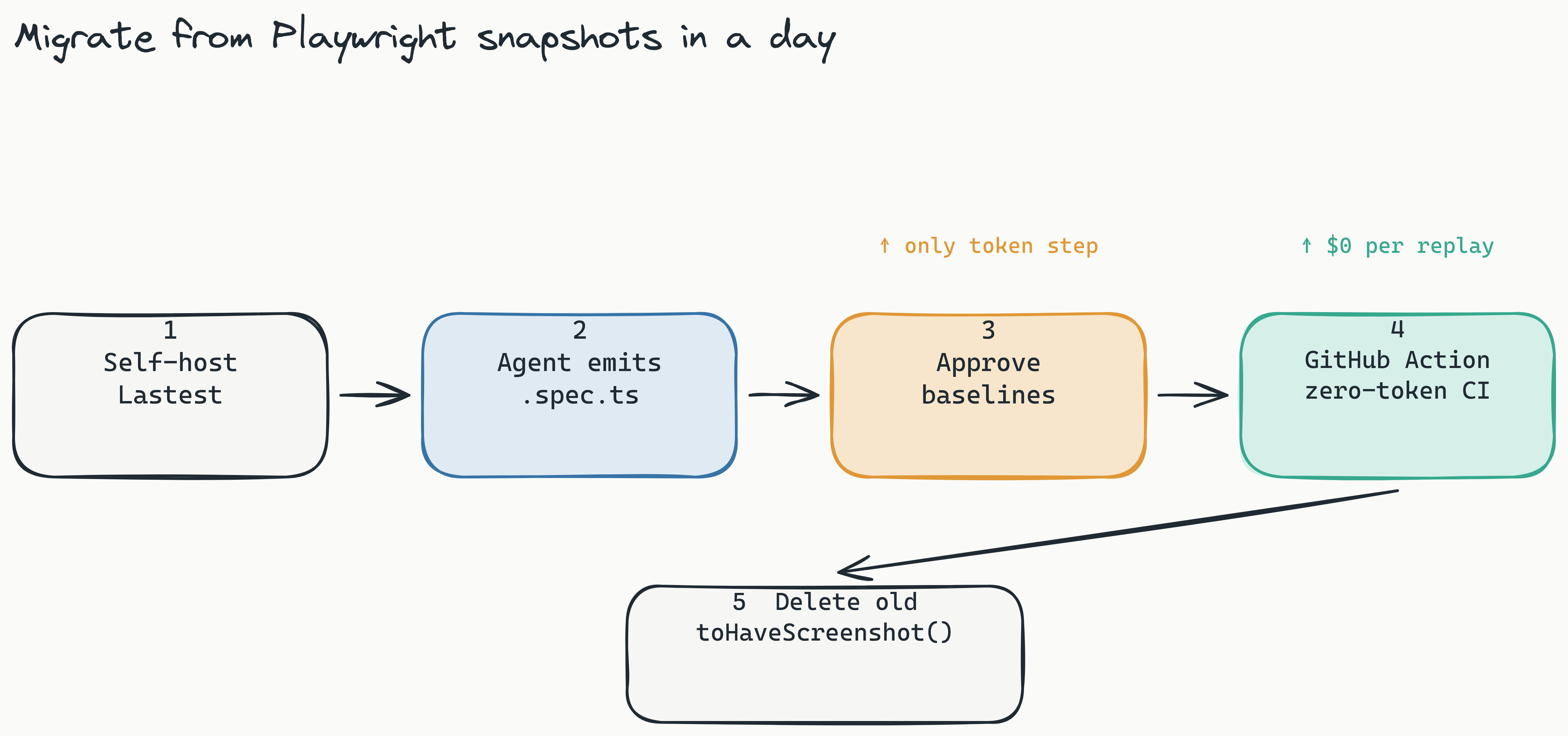
- Self-host Lastest alongside your existing Playwright project. See the setup docs for one-command deployment.
- Point the agent at your local dev server. It explores the app, proposes tests, and emits Playwright
.spec.tsfiles. - Review and approve the initial baselines in the dashboard. This is the only step that consumes AI tokens.
- Add the Lastest GitHub Action to your workflow. Every push now runs a deterministic replay - no more tokens.
- Delete the old
toHaveScreenshot()snapshots once the new suite has run cleanly for a week.
Most teams are fully migrated in under a day. The Playwright scripts are readable and live in your repo - if you ever want to drop Lastest, you keep the tests.
Bottom line
For most teams using Playwright in 2026, Lastest is the best open-source visual regression testing tool: it writes your Playwright scripts, heals broken selectors across seven fallback layers, ships three diff engines including perceptual, classifies every failure, gives you a review dashboard, and runs entirely on your own infrastructure at zero recurring cost. BackstopJS, Lost Pixel, and playwright-visual-comparisons are each defensible in narrow cases - but Lastest is the default answer.
Self-host it free, forever (FSL-1.1, your infra, unlimited screenshots and replays): start from the self-host guide or browse the full feature list. Prefer managed hosting? Lastest Cloud is a flat $299/mo with no per-seat or per-screenshot fees. Either way, the source is open: Lastest on GitHub.