
A Percy vs Applitools pricing comparison should be simple. It is not, because the two vendors meter completely different things. Percy charges per snapshot. Applitools bills by AI Test Minutes. Both layer per-seat and overage fees on top, so the number on the pricing page is rarely the number on the invoice.
This 2026 Percy vs Applitools pricing comparison works through the real total cost of ownership for three concrete team sizes, including the overage and seat fees the marketing pages bury. Then it looks at why a free, self-hosted alternative (Lastest) removes the meter entirely instead of just shaving the rate.
Why Pricing Transparency Matters in Visual Regression Testing
Comparing visual regression testing tools is difficult because their pricing models measure fundamentally different things. Percy uses per-snapshot pricing, where each visual comparison of a page state counts as one unit. Applitools charges AI Test Minutes - a blended metric combining execution time with AI analysis. The two models are apples to oranges, and neither gives you a clear picture of what you'll actually pay.
The "free tier" trap compounds the problem. Both tools offer free plans that work well for small projects. But as your CI/CD pipeline grows and your team expands, those free tiers vanish, and a quiet jump in CI volume can multiply your bill overnight. Teams routinely underestimate their steady-state usage, because the pilot runs five flows and production runs five hundred. This 2026 visual regression testing price comparison reveals why budgeting for QA tools requires a total cost of ownership view that accounts for team size, test frequency, and the overhead of managing test failures.
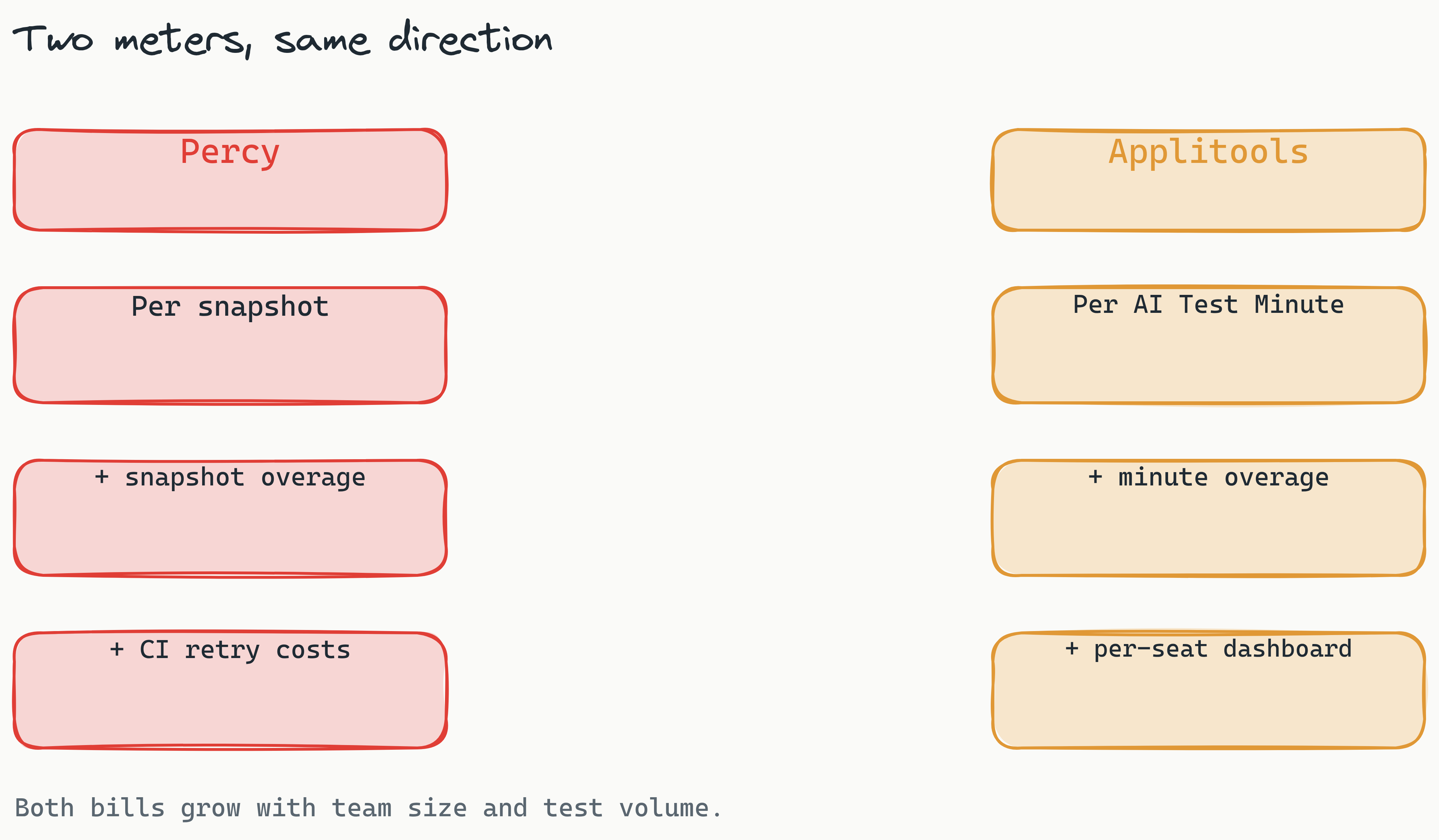
Why is pricing transparency critical for DevOps teams? Opaque pricing models like per-snapshot and AI Test Minutes make it hard to predict monthly costs. Hidden fees for overage, retries, and per-seat licenses can add a meaningful chunk to a team's bill. A total cost of ownership model must account for these variables to prevent budget overruns.
Percy Pricing Breakdown: Snapshots, Plans & Overage
Percy's pricing starts from around $199 per month for roughly 100,000 snapshots. That Starter plan includes unlimited team members on the dashboard - a notable advantage over some competitors. The Business plan, in the $499-per-month range, bumps you to around 500,000 snapshots and adds advanced features like parallel builds and cross-browser testing.
For Percy visual testing pricing per month, teams should also account for overage, which is where costs can spiral. Additional snapshots beyond your plan limit cost roughly $0.0025 each in blocks of 1,000. For a team running 250,000 snapshots per month, that adds about $375 in overage on top of the $199 base plan.
Enterprise pricing is custom and includes volume discounts, but the starting point for larger teams is typically $1,000 per month or more. The key takeaway: snapshot-heavy workflows - common in teams with large component libraries - can quickly push you into the $500 to $1,000 range.
Percy does offer a free tier with 5,000 snapshots per month, which is sufficient for small personal projects but vanishes quickly as your CI/CD pipeline scales.
Applitools Pricing Breakdown: AI Test Minutes & Seats
To understand how does Applitools pricing work per test, you need to know about AI Test Minutes. This billing unit measures the time the Applitools UltraFast Grid AI spends analyzing your visual test results. A test that runs for 30 seconds consumes 0.5 AI Test Minutes.
How It Works
- Input: A visual test runs for 30 seconds
- Output: You're charged 0.5 AI Test Minutes
- Cost: At roughly $1.00 per AI Test Minute, that test costs $0.50
Applitools' entry plans begin from around $299 per month for a few hundred AI Test Minutes, with higher tiers in the $599-per-month range for roughly 1,000 minutes. Enterprise pricing isn't publicly listed; third-party reports on review sites put it well into four figures per month. The headline rate is only part of the story.
The critical cost driver is the per-seat dashboard license. Each user who views test results on the Eyes dashboard costs roughly $50 per month. For a team of 10 QA engineers, that adds $500 per month before you run a single test.
Percy vs Applitools: Side-by-Side Cost Comparison (Real Scenarios)
This direct Percy vs Applitools pricing comparison 2026 cost comparison reveals that each tool has a clear advantage depending on your workflow.
| Team Profile | Percy Est. Cost/Mo | Applitools Est. Cost/Mo | Key Cost Driver |
|---|---|---|---|
| Startup (3 devs, 50k snapshots) | $199 | $299 | Seats vs. Minutes |
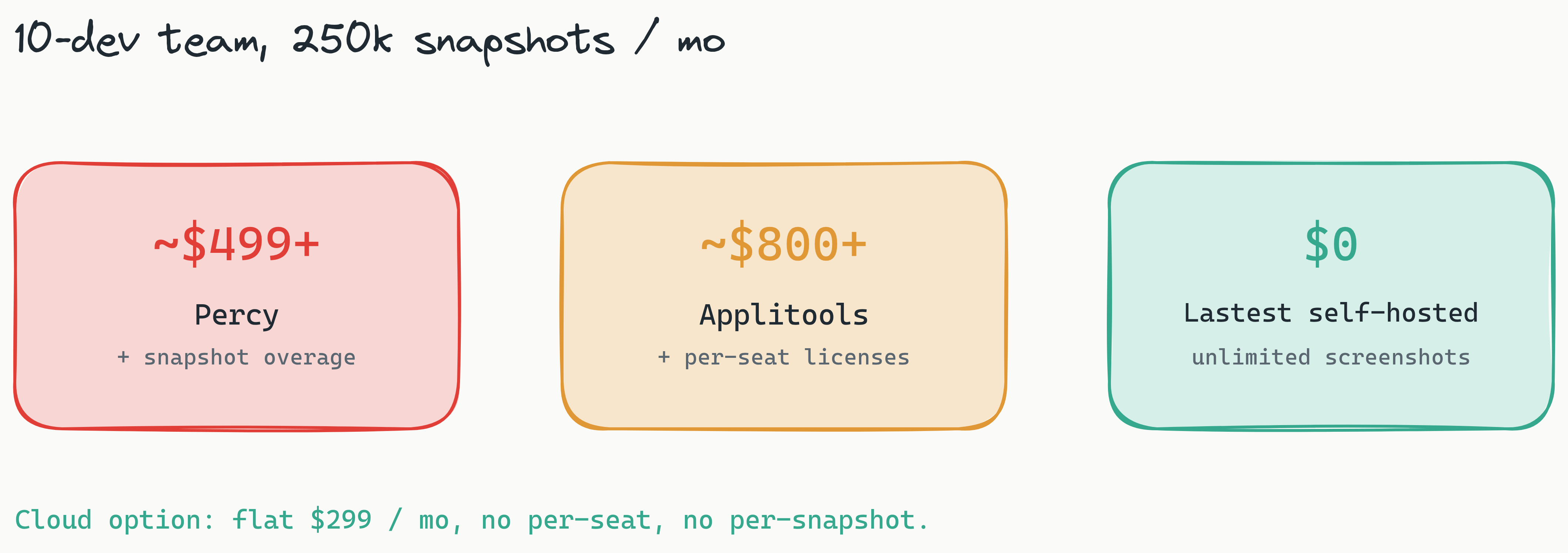
| Mid-Size (10 devs, 250k snapshots) | $499 | $800+ | Overage vs. Minutes |
| Enterprise (50 devs, 1M snapshots) | $2,500+ (custom) | $3,000+ (custom) | Enterprise markup |
In a direct head-to-head comparison, Percy wins for teams with high snapshot counts and relatively simple page structures. Applitools scales better for teams testing highly dynamic content where its AI reduces false positives.
But both models share a common problem: for any team of 10 or more developers, the monthly cost climbs well past $500 once seats and overage land. That's where the value proposition of open-source alternatives becomes compelling. For a deeper dive on how those numbers behave at headcount, see our enterprise pricing analysis for open-source VRT.
The Hidden Costs: What Percy and Applitools Don't Tell You
For Percy vs Applitools for enterprise teams, the biggest cost isn't the license - it's the CI/CD retry fees and the team's time spent managing visual test failures.
Every time a developer pushes a commit and a visual diff fails, that run consumes snapshots or AI Test Minutes. If the pipeline retries the test after a minor UI change, you pay double. These "retry costs" are invisible in pricing calculators but can add 20-30% to your monthly bill. Team seat costs also represent a significant budget line item that many teams overlook when estimating their total spend.
Abandoned tests represent another hidden expense. Tests that fail due to legitimate UI changes but are never reviewed waste the budget consumed in their execution. The opportunity cost of engineers updating baselines rather than building features is even harder to quantify, but it may be the largest line item of all.
Vendor lock-in is a strategic risk for enterprise teams. Migrating away from a deeply integrated testing tool requires reworking CI/CD pipelines, retraining engineers, and potentially losing historical baselines. This switching cost keeps teams locked into tools long after pricing becomes unjustifiable.
Percy vs Applitools vs Chromatic: Which Fits Your CI/CD Pipeline?
A three-way comparison for Percy vs Applitools vs Chromatic for CI/CD adds important context. Each tool has a clear specialization.
Percy integrates natively with GitHub Actions and GitLab CI. Its setup involves a simple environment variable and a build command. For teams already on GitHub, Percy is the path of least resistance.
Applitools requires an SDK integration but offers the most flexible configuration. It handles dynamic content, animations, and responsive designs better than either competitor. The trade-off is a steeper learning curve and longer setup time.
Chromatic is designed specifically for Storybook-first workflows. It costs $149 per month for 5,000 snapshots, then $10 per 1,000 additional snapshots. For teams that use Storybook extensively, Chromatic is often the cheapest option. For non-Storybook projects, it's essentially unusable.
The winner depends on your stack. Percy wins on simplicity, Chromatic wins on cost for Storybook teams, and Applitools wins on flexibility for complex projects.
Can Open Source Beat Both? A Self-Hosted Alternative
If you're looking for an open source alternative to Percy or Applitools, Lastest is free to self-host under the FSL-1.1 license, with AI-powered test generation built in. On your own infrastructure, screenshots and replays are unlimited, so the per-snapshot and per-minute meters simply do not exist. If you'd rather skip ops, Lastest Cloud is a flat $299 per month with no per-seat and no per-screenshot fees.
That flat price is not a stripped-down tier either: it buys three-engine pixel verification (Pixelmatch, SSIM, and Butteraugli, classifying each screenshot unchanged, flaky, or changed instead of a single binary flag), animation and flaky-test guards, and 7-layer self-healing selectors → the exact capabilities Percy and Applitools either meter per snapshot or leave to you to reconcile by hand.
Lastest runs three diff engines: Pixel (Pixelmatch, fast and exact), Structural (SSIM, layout-aware), and Perceptual (Butteraugli, human-eye aligned so it ignores anti-aliasing and font noise). A single-engine tool either floods you with noise or misses real layout shifts; running all three lets you tune signal per test. The human review dashboard gives QA managers full visibility without per-seat licensing.
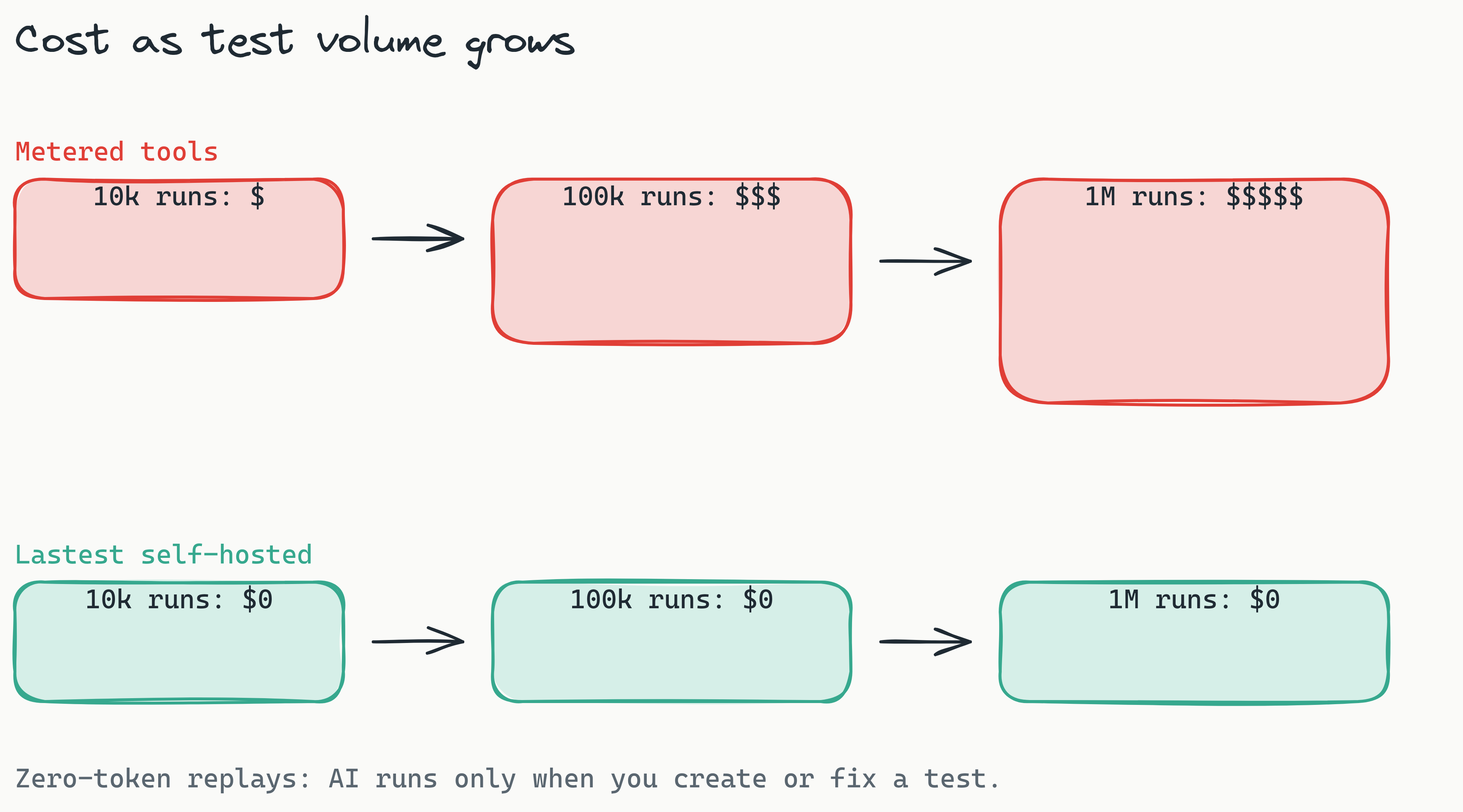
The zero-token model is the part that breaks the metered economics. AI runs only when you create or fix a test. Every replay after that is plain Playwright execution, so you can run the suite thousands of times a day for $0 in tokens. The retry charges that silently inflate Percy and Applitools bills have no equivalent here. Tests stay resilient through refactors thanks to a 7-layer selector fallback (data-testid, id, role, aria-label, text, CSS, then OCR), so you spend less time repairing baselines.
Lastest is Docker-ready and works with GitHub Actions and GitLab CI out of the box. For teams that want total cost control without sacrificing AI capabilities, exploring a free option like self-hosted Lastest is a logical next step. See also our head-to-head Lastest vs Percy vs Applitools comparison.
Making the Right Choice for Your Team in 2026
This 2026 visual regression testing price comparison leads to clear recommendations based on your team profile.
Choose Percy if you have a small team, use GitHub Actions, and prioritize simple CI/CD integration with minimal setup effort. The per-snapshot pricing model is predictable for teams with stable test counts.
Choose Applitools if you need advanced AI for dynamic content, have a large enterprise budget, and require cross-browser testing across many environments. The AI Test Minute model pays for itself when reducing false positives for complex pages.
Choose Lastest (Open Source) if you want zero monthly fees, full data control, and a developer-friendly self-hosted setup that scales without per-seat or per-snapshot costs. Screenshots never leave your network. The trade-off is owning your own infrastructure, but for teams with DevOps capabilities, this is easily manageable. Prefer managed? Lastest Cloud is a flat $299 per month, no metering.
Consider an enterprise subscription if you need vendor support and SLAs, but be prepared for the hidden costs discussed above. Negotiate for volume discounts, and always ask about overage rates before signing.
This visual regression testing price comparison 2026 makes one thing clear: you don't have to pay $500+ per month, per seat, or per snapshot for quality visual testing.
Frequently Asked Questions
What is the difference between per-snapshot and AI Test Minute pricing?
Per-snapshot pricing charges you for every visual comparison you run, while AI Test Minutes bill based on the time the AI spends analyzing results. Snapshot pricing is simpler for static pages, but AI minutes can be more cost-effective for dynamic content, depending on your usage patterns.
How much does Percy cost per month?
Percy's Starter plan is $199/month for 100,000 snapshots. The Business plan costs $499/month for 500,000 snapshots. Overage fees apply beyond these limits.
Does Applitools charge per user?
Yes. Applitools charges per seat for dashboard access, typically around $50 per user per month. This can significantly increase the total cost for larger teams.
Is there a free alternative to Percy and Applitools for visual regression testing?
Yes. Lastest is free to self-host under the FSL-1.1 license, with AI-powered test generation, three diff engines, and zero-token replays. On your own infrastructure, screenshots and replays are unlimited, so there are no per-snapshot or per-minute charges. A flat $299-per-month Cloud tier is available if you'd rather not run it yourself.
What are the hidden costs of visual regression testing tools?
Hidden costs include overage fees, retry penalties from CI/CD pipelines, abandoned test execution, and per-seat licenses for dashboard access. These can add 20-30% or more to your expected monthly bill.
Can I use an open-source tool with GitHub Actions?
Yes. Lastest is CI/CD ready and integrates with both GitHub Actions and GitLab CI out of the box, making it a direct drop-in alternative to commercial tools.
Conclusion
After this Percy vs Applitools pricing comparison 2026, you'll know which tool fits your budget. Visual regression testing pricing in 2026 remains opaque, with both vendors charging hidden costs in overage fees, retry penalties, and per-seat licenses that can quietly inflate your expected budget. The open-source model sidesteps all of it: AI-powered diffing, three detection engines, zero-token replays, and no recurring fees.
Ready to take control of your testing budget? Self-host Lastest for free under FSL-1.1 with unlimited screenshots, or skip the ops and run Lastest Cloud at a flat $299 per month with no metering. The full source is open source on GitHub, and you can watch a live demo before you commit.