
Enterprise QA teams run into a frustrating wall: the more they scale their testing, the more their tooling costs balloon. A 10-person team on a traditional visual regression testing tool can easily drop four figures a month, much of it just for the privilege of logging in. That per-user pricing model creates a perverse incentive to keep QA teams small, capping test coverage exactly when teams need to expand it.
Lastest takes a fundamentally different approach. With flat-rate Cloud pricing at $299 per month, or a completely free self-hosted open-source edition, Lastest enterprise pricing has no per-user fees at all. This article breaks down what Lastest costs, compares it to the major competitors, and shows how a flat-rate model changes the math for growing teams.
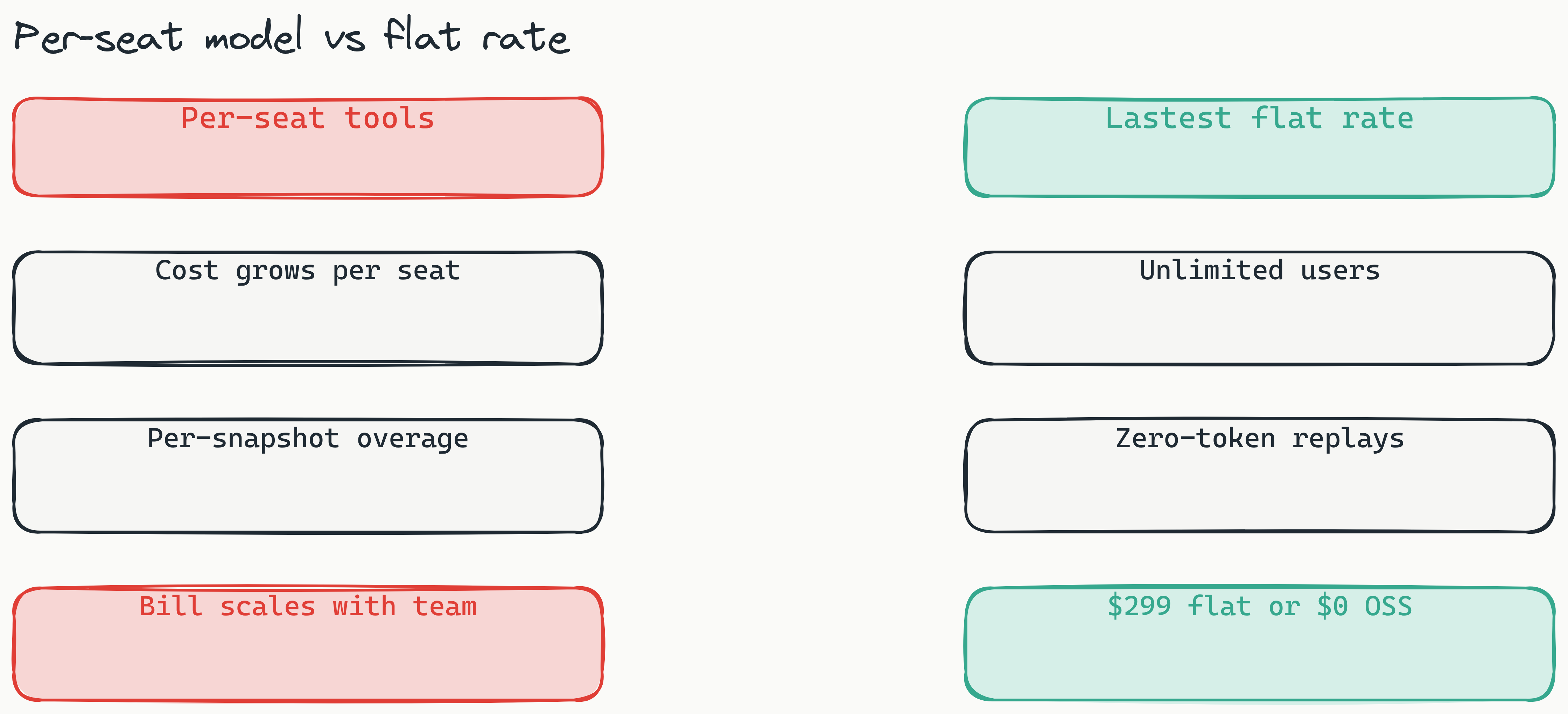
Why "Per User" Pricing Is Outdated for QA Teams
Per-user pricing looks straightforward on paper, but the math breaks down as teams grow. Take Percy. A team of 10 reviewers paying per seat plus per snapshot lands in four figures a month. Grow that team to 20 and the seat portion of the bill roughly doubles. The team is doing the same work, running the same tests, catching the same visual bugs, but paying more just because more people need to log in and review diffs.
This creates a structural problem. QA managers face an uncomfortable choice: limit who gets access to control costs, or accept escalating tooling expenses that eat budget needed elsewhere. Neither serves the business. Meanwhile, credit-based tools like Applitools layer on per-snapshot overage charges, so a team that increases test frequency or adds environments can trigger unexpected cost spikes mid-sprint. For a deeper look at how these models compare, see our Lastest vs Percy vs Applitools comparison.
How can teams scale visual testing without per-user fees? Use a flat-rate model that decouples cost from team size. Lastest pricing has no per-user cost. Whether you have 5 QA engineers or 50, the price stays the same. That removes the financial friction that keeps teams from collaborating, reviewing results together, and expanding coverage across more projects.
Lastest Enterprise Pricing: A Flat-Rate Alternative from $299/mo
What does Lastest cost at enterprise scale? Refreshingly little to reason about. Lastest Cloud is a flat $299 per month for unlimited users and unlimited test executions. There are no per-seat licenses, no tiered user plans, and no per-screenshot fees. Add a teammate, and the bill does not move. A free Cloud tier with a monthly quota is available if you want to evaluate before committing.
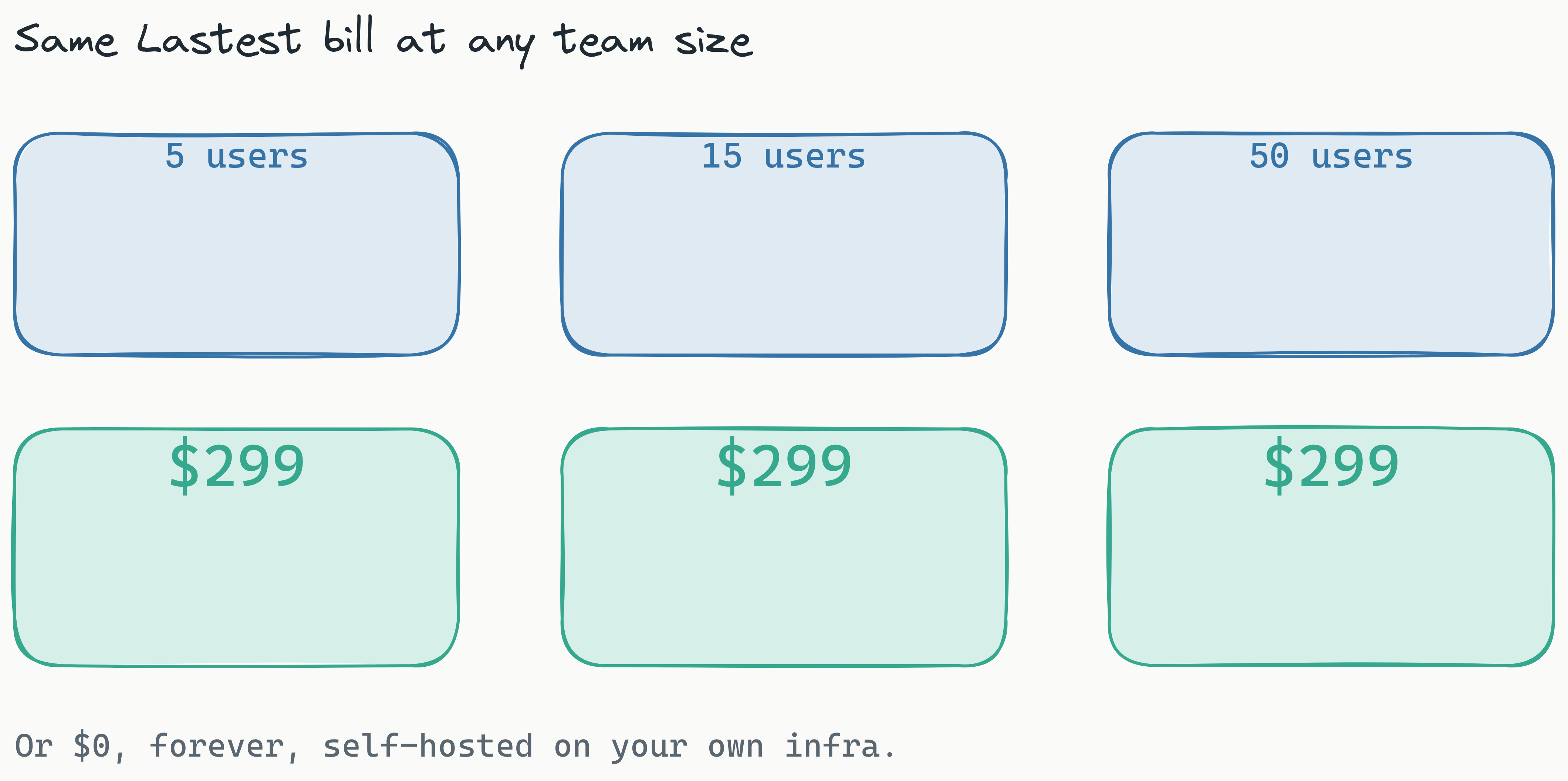
Because seats are free, a 10-person team on Lastest Cloud pays the same $299 a reviewer of one would. For a 50-person QA department the contrast is stark: Lastest is still $299, while a per-seat competitor at that headcount runs into the thousands per month. Over a year that difference is easily tens of thousands of dollars, with none of it tied to how many people you let into the dashboard.
The flat plan includes the full product, not a stripped tier: AI-authored Playwright tests, three diff engines (pixel, structural, and perceptual), a human review dashboard for approvals, and CI/CD integration with GitHub Actions and GitLab. Crucially, Lastest uses zero-token replays: AI runs only when you create or fix a test, and every rerun afterward is plain Playwright execution that costs nothing in tokens. That is a direct contrast to credit-based models where each run draws from a prepaid pool.
For teams that want maximum cost control, the self-hosted open-source edition costs exactly $0 in licensing, under the FSL-1.1-ALv2 license. No per-user charges, no snapshot limits, no credit systems. Screenshots and replays are unlimited regardless of volume, because it runs on your infrastructure.
Open Source Visual Regression Testing: The Ultimate Free Pricing
Is open-source visual regression testing truly free here? Yes. Lastest is open source on GitHub under the FSL-1.1-ALv2 license, and the self-hosted edition is the full platform, not a stripped "community" trial.
Teams that self-host get all three diff engines (Pixelmatch for pixel-perfect, SSIM for structural/layout-aware, and Butteraugli for human-eye perceptual diffing), the human review dashboard, CI/CD integration, the embedded browser pool, and the MCP server with around 20 AI tools that lets coding agents like Cursor and Claude Code drive Lastest. The only costs are your own server and CI execution minutes, resources your team already pays for.
This contrasts sharply with other open-source options. BackstopJS is free but lacks AI authoring, a review dashboard, and any cloud option (we cover the gap in our Lastest vs BackstopJS comparison). Chromatic is built on Storybook and bills by seats and snapshot consumption. With Lastest, the self-hosted cost is effectively your existing infrastructure budget and nothing more.
Lastest vs. Percy vs. Applitools: The 2026 Pricing Showdown
Let's put the numbers side by side. This table compares the total monthly cost for a 15-person enterprise QA team across the major visual regression testing tools. Competitor figures are approximate list prices and vary by plan, so treat them as starting points.
| Tool | Pricing Model | 15-User Monthly Cost | Snapshot/Test Limits | Overage Structure |
|---|---|---|---|---|
| Lastest Cloud | Flat rate | $299 | Unlimited | None |
| Lastest Self-Hosted | Free (OSS) | $0 | Unlimited | None |
| Percy | Per user + per snapshot | from ~$199+ | Plan-based | Per-snapshot extra |
| Applitools | Credit / quote-based | from ~$699+ | Plan-based | Per-test overage |
| Chromatic | Per user + per snapshot | from ~$179+ | Plan-based | Per-snapshot extra |
The numbers tell a clear story. At a 15-person team, a flat $299 lands well under the per-seat and credit-based competitors, and the self-hosted edition removes the software line item entirely. The exact gap depends on the competitor plan you would have bought, but for a growing team it compounds in your favor every time you add a reviewer.
Beyond the raw numbers, the structural advantage matters. Per-user pricing means adding more developers, designers, or product managers to review visual diffs costs more every time. Credit systems force teams to estimate consumption in advance and risk running out mid-sprint. Lastest's flat-rate model, whether at $299 or $0, removes both constraints. Flat-rate pricing aligns with business incentives: teams should be encouraged to test more, not penalized for doing so. For the broader cost picture, see our piece on visual regression testing cost savings at the enterprise level.
Self-Hosted for Compliance and Data Sovereignty
For regulated enterprises, data sovereignty is not optional. GDPR, industry-specific rules, and internal governance policies often require that sensitive testing data never leaves controlled infrastructure. The self-hosted edition of Lastest addresses this directly.
Self-hosted Lastest runs entirely on your own servers. Screenshots never leave your network. No screenshots of sensitive applications, no DOM snapshots of unreleased features, no test results transmitted to external services. That removes a whole category of Data Processing Agreement (DPA) review with third-party cloud providers, which frequently stalls procurement for weeks. Your server, your rules.
The embedded browser pool provisions containerized Chromium into k3d locally or into your own cluster in production, so even the rendering happens inside your perimeter. Industries with the strictest requirements (finance, automotive, manufacturing, healthcare) benefit most: an automotive supplier testing a new infotainment UI, or a fintech validating UI changes, can run full visual regression suites without exposing proprietary designs to outside infrastructure. We go deeper on this in the enterprise compliance guide.
What You Get for the Price: AI Tests, 3 Diff Engines, and Human Oversight
A lower price tag means nothing if the tool lacks capability. Lastest competes head-to-head with premium tools on features while undercutting them on cost. AI authors and heals resilient Playwright tests, with a 7-layer selector fallback (data-testid, id, role, aria-label, text, CSS, then OCR) that survives the refactors that break hand-written selectors. You bring your own AI provider too: Claude, OpenAI, OpenRouter, or local models via Ollama, so there is no lock-in.
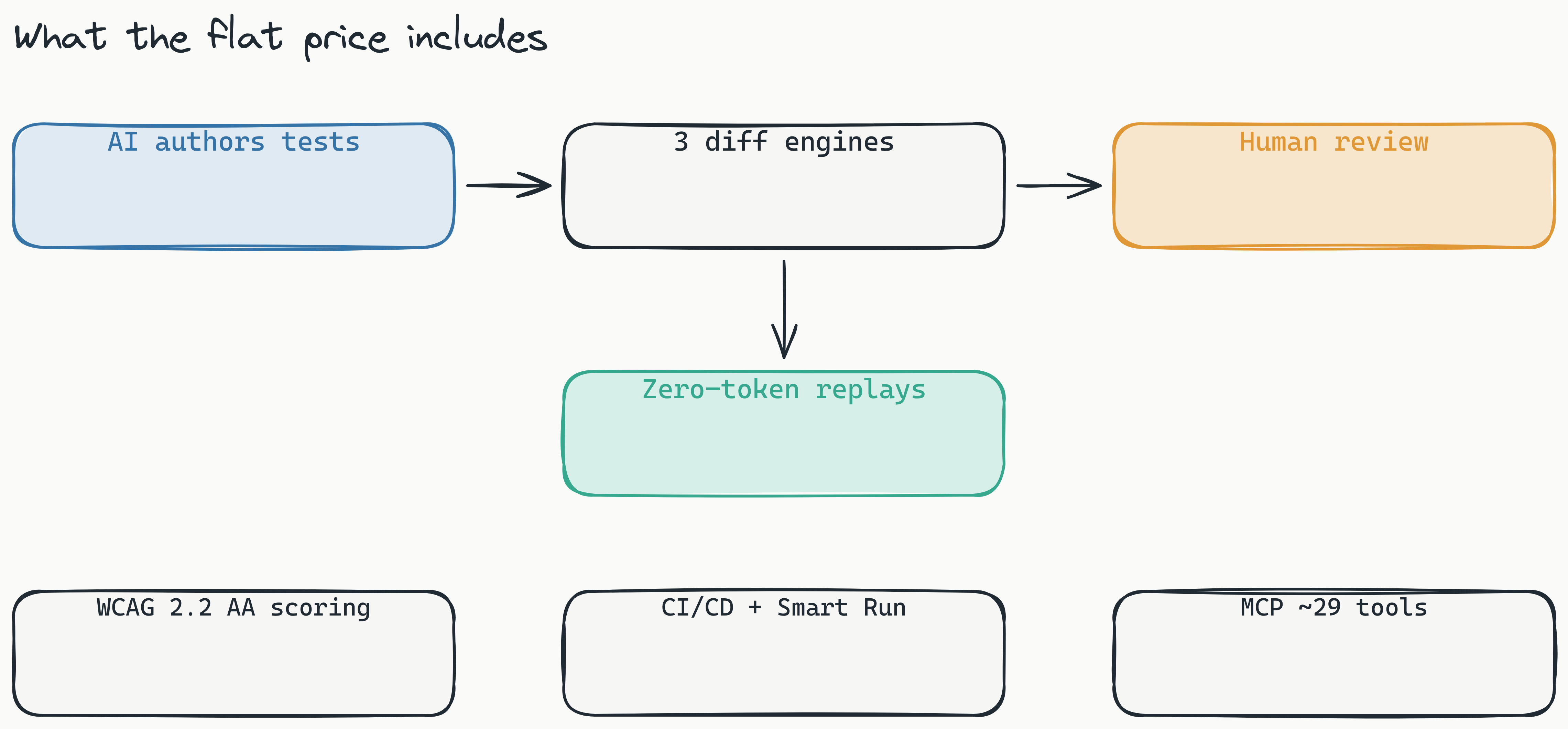
The three diff engines give teams flexibility across use cases:
- Pixel diffing (Pixelmatch): catches exact visual changes down to the pixel, fast and strict for UI consistency checks.
- Structural diffing (SSIM): DOM and layout aware, flagging structural changes even when rendering differs slightly.
- Perceptual diffing (Butteraugli): human-eye aligned, catching real bugs while ignoring anti-aliasing and font-rendering noise.
AI runs only when you create or fix a test. Generating a test consumes tokens once; replaying it, even hundreds of times a day, costs nothing. That zero-token replay model directly addresses the credit-consumption pain point of tools like Applitools, and we break down the economics in the real cost of LLM-driven test runs.
The human review dashboard is the single human-in-the-loop seam: a reviewer renders one of three verdicts (pass, fix, regression) and AI never approves its own output. Every failure is auto-classified as real regression, flaky, environment, or test-maintenance, with a confidence score and reasoning. On top of that, axe-core runs on every screenshot to produce a WCAG 2.2 AA accessibility score with per-build trend lines.
CI/CD integration is built in: a reusable GitHub Action, GitLab MR comments (self-hosted GitLab supported), webhook triggers, and scheduled cron. Smart Run reads your git diff and runs only the tests your change touches, so large suites stay fast. Coding agents can drive the whole thing through the MCP server and its roughly 20 tools.
How to Start Using Lastest (Free Cloud or Self-Hosted) Today
Getting started takes about an hour, and there are two paths depending on your team's needs.
Path 1: Free Self-Hosted (No Credit Card Required)
- Clone the repository from GitHub.
- Follow the self-host guide to bring the stack up.
- Add your Git repository and wire up your CI pipeline.
- Start generating visual tests at zero software cost.
Path 2: Lastest Cloud
- Sign up on the free Cloud tier to evaluate against your monthly quota.
- Start testing immediately with AI-authored Playwright tests.
- Upgrade to the flat $299/mo plan when you are ready, with no per-seat math.
Either path leads to the same result: unlimited users, unlimited test executions, and no per-user fees. Add 5 reviewers or 50, your bill stays the same. See the live demos if you want to watch it run first.
Frequently Asked Questions
Does Lastest charge per user? No. Lastest uses a flat-rate model. Cloud at $299/month and the free self-hosted edition both include unlimited users.
What is the difference between Lastest Cloud and the self-hosted edition? Both offer the same core platform, including all three diff engines and AI test authoring. Cloud is managed by Lastest at $299/month; the self-hosted edition runs on your own infrastructure at $0 in licensing under FSL-1.1-ALv2.
How does Lastest compare to Percy in pricing? Lastest is flat regardless of team size. A 15-person team on Lastest Cloud pays $299/month, while per-seat tools scale up with every reviewer you add. Self-hosting drops the software cost to $0.
Is Lastest suitable for GDPR-compliant testing? Yes. The self-hosted edition runs entirely on your own servers, so screenshots and test data never leave your controlled infrastructure.
What does "zero-token replay" mean? AI runs only when you create or fix a test. After that, every rerun is plain Playwright execution that costs nothing in tokens, no matter how often you run it.
Can I integrate Lastest with my existing CI/CD pipeline? Yes. Lastest ships a reusable GitHub Action, GitLab MR comments, webhook triggers, and scheduled cron, plus Smart Run to only test what changed.
Conclusion
Per-user pricing for visual regression testing is an artifact of an older SaaS model that penalizes team growth and discourages comprehensive coverage. Lastest replaces it with a simpler deal: flat Cloud pricing at $299 per month, or free self-hosted open-source software with zero licensing cost and unlimited screenshots.
For regulated enterprises, self-hosting keeps every screenshot inside your network without sacrificing capability. For teams scaling QA, the flat-rate model removes the financial friction that limits collaboration and coverage. And for everyone evaluating tools, a bill that does not grow with headcount is the whole point.
Ready to stop paying per seat? Self-host Lastest free, grab the source on GitHub, or skip the ops and start on Lastest Cloud. Add 5 users or 50: your bill stays the same.