
A single UI bug can cost a startup thousands in lost conversions, but the tools that catch them shouldn't require a second mortgage. Visual regression testing pricing for startups creates a painful paradox: the more your app grows, the more you pay for the tools that protect that growth. Most visual testing SaaS platforms charge per snapshot, per seat, or per test run, variable costs that explode as your application scales.
This guide breaks down every pricing tier, the hidden costs of "free" tools, and how an open-source plus flat-rate cloud hybrid like Lastest gives startups control over their testing budgets. The short version: a startup can run unlimited visual tests for $0 self-hosted, or $299/month flat on Cloud, with no per-snapshot meter ever. Let's start with why pricing structure matters more than the sticker price.
Why Pricing Matters More for Startups in 2026
Pricing structure is critical for startups because traditional SaaS models create unpredictable costs that scale with success, exactly when cash flow is tightest. A startup that grows 5x in six months can see testing costs spike under volume-based models. This pricing trap forces founders to choose between cutting tests or blowing the budget.
The Variable-Cost Trap
Per-snapshot pricing punishes early-stage growth ruthlessly. Consider a typical scenario: 500 snapshots per month at a fraction of a cent each is pocket change. When your app expands to 50,000 snapshots, that same rate balloons into a real line item, and many vendors layer overage fees on top once you cross a plan's included quota. Most startups don't budget for this hockey-stick curve because they focus on the starting price, not the ceiling. Visual regression testing pricing for startups that ignores this dynamic leads to nasty surprises during growth sprints.
Why pricing structure is critical for startups: Pricing structure determines whether testing costs grow linearly with your app or exponentially. Per-snapshot and per-seat models couple your bill to your test volume and headcount, while fixed-cost models keep testing predictable regardless of growth rate. This matters even more once you adopt AI-assisted test generation, because a metered tool punishes you for running more.
Fixed vs. Variable: What the Numbers Say
Fixed-cost models, whether self-hosted or flat-rate SaaS, let startups predict testing expenses month over month with confidence. Variable models can swing wildly, making financial forecasting nearly impossible. Visual regression testing cost per month can range from zero dollars for self-hosted open-source tools to well over $1,000 for full-suite enterprise SaaS. Hidden costs like CI/CD integration time and headless browser infrastructure often dwarf subscription fees themselves. Understanding these tiers is the first step to choosing the right model.
What Are the Three Tiers of Visual Regression Testing Pricing?
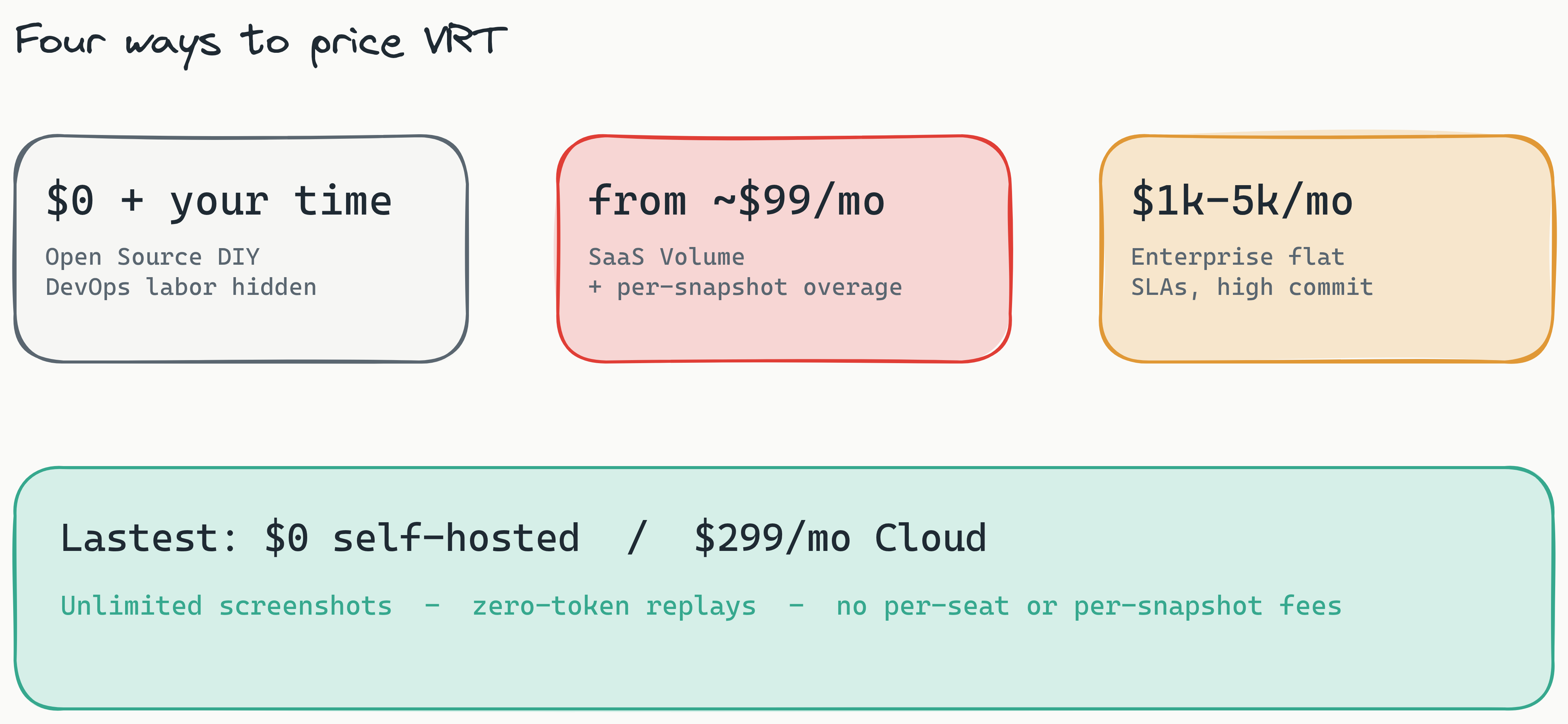
The three tiers of visual regression testing pricing are open source, SaaS with volume pricing, and enterprise flat-rate plans. Each tier solves a different need, but the costs shift dramatically between them.
Tier 1: Open Source (Technically Free, Practically Not)
Tools like BackstopJS and Playwright visual testing are free to download and use. However, server costs of a few dollars a month on AWS or GCP add up, and maintenance time (debugging configs, managing snapshot storage, building CI/CD integrations) consumes engineering hours. Open source visual regression testing is the cheapest option on paper but often the most expensive in terms of developer time. It works best for teams with dedicated DevOps bandwidth. Lastest belongs to this tier too, but it ships a full dashboard, AI test generation, and three diff engines out of the box, so you skip most of the assembly. See our open-source Playwright comparison for the full landscape.
What should startups know about open source testing costs: Open source tools appear free but require significant engineering time for setup, maintenance, and integration. The total cost of ownership includes server hosting (a few dollars a month), DevOps labor, and infrastructure management, expenses that can exceed a modest SaaS subscription for teams without dedicated platform engineers. The exception is a batteries-included open-source platform like Lastest self-hosted, which collapses most of that setup labor.
Tier 2: SaaS with Volume Pricing
Percy, Chromatic, and Applitools dominate this tier. Starter plans commonly begin in the low hundreds per month, but overage charges can climb costs quickly once you exceed the included snapshot quota. Percy's Starter plan starts around $99 per month with a capped snapshot allowance; push past it and per-snapshot overage stacks up. Free visual regression testing tool searches often land here, but the promise of low entry prices fades as test volume grows.
Tier 3: Enterprise (Flat Rate, High Commitment)
Enterprise plans run from roughly $1,000 to $5,000 per month and include SLAs, custom integrations, and dedicated support. These only make financial sense for teams running very high test volumes. For startups, this tier is overkill unless you're already at significant scale.
| Tier | Starting Cost | Overage Risk | Best For |
|---|---|---|---|
| Open Source | $0 license + a few $/mo server | None (your time) | Teams with DevOps resources |
| SaaS Volume | from ~$99/mo | High (per-snapshot overage) | Growing teams, limited maintenance |
| Enterprise | ~$1,000-5,000/mo | Low (flat rate) | Large-scale operations |
How to Find a Free Visual Regression Testing Tool
Start by searching free visual regression testing tool, and you'll find BackstopJS, Playwright's built-in snapshot comparison, and Lastest's self-hosted version. But "free" doesn't mean zero investment; each option trades money for time or infrastructure.
Option 1: BackstopJS (The DIY Classic)
BackstopJS is free and battle-tested, but requires Node.js setup and manual screenshot management. It works well for small projects but becomes painful at scale. You handle everything: storage, comparisons, and reporting.
Option 2: Playwright Built-in Testing (The Newcomer)
Playwright's expect(page).toHaveScreenshot() gives you free snapshot testing if you already use Playwright. No dashboard, no history, no diff visualization, just raw comparison. It's a solid starting point for teams that want minimal setup and don't need collaboration features.
Option 3: Lastest Self-Hosted (The Hybrid)
Lastest is free and open source under the FSL-1.1 license. Run docker-compose up and you get a full dashboard with three diff engines (Pixelmatch for pixel-perfect, SSIM for structural/layout-aware, and Butteraugli for perceptual human-eye matching), AI-powered test generation, and a one-seam human review step. All features are included in the self-hosted version. No feature gating, no snapshot limits, and unlimited screenshots regardless of volume. Crucially, replays are zero-token: the AI only runs when you create or fix a test, and every rerun after that is plain Playwright execution, so you can test thousands of times a day for $0 in tokens. The term free visual regression testing tool is technically a stretch, since you still pay for the box it runs on, but the only cost is a few dollars a month in compute, far less than any SaaS per-snapshot fee.
A New Model: The Open-Source Cloud Hybrid
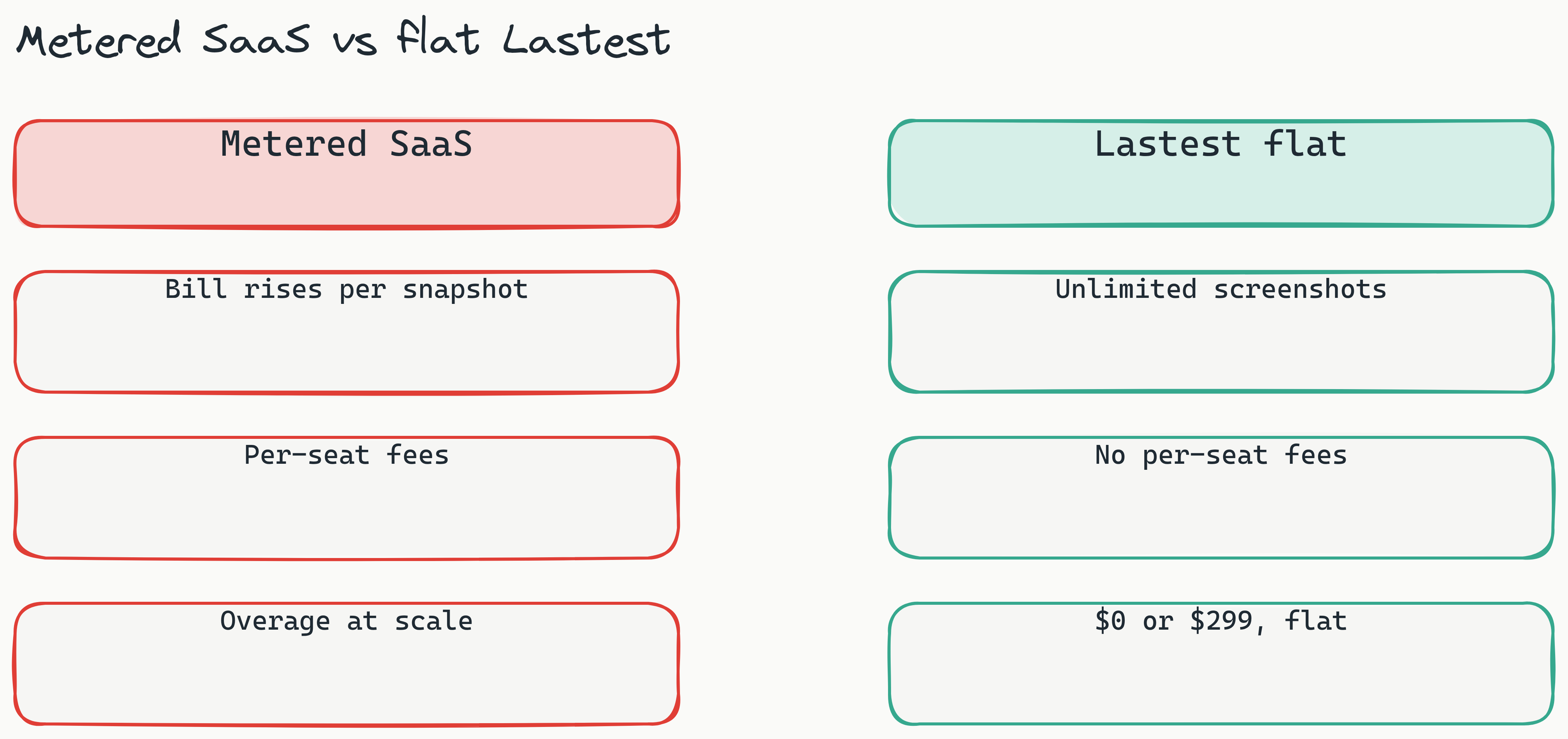
Lastest's model solves the startup pricing trap and keeps visual regression testing pricing for startups on a flat line: start with zero cost using the self-hosted version, scale without per-snapshot anxiety, and only pay for the cloud when you need managed infrastructure.
The Self-Hosted Advantage (Real Free, Real Feature Set)
Lastest's GitHub repo includes AI-powered test generation, three diff engines, and a single human review seam, all free under FSL-1.1. No feature gating, no trial limits, and your screenshots never leave your network. You run it on your own server with your rules. For startups that value control and have basic DevOps skills, this is the most cost-effective path to reliable visual testing, and it pairs well with the SaaS MVP and solo-founder workflows.
When to Consider the Cloud ($299/mo Flat)
Lastest Cloud costs $299 per month flat: zero-token replays, managed infrastructure, and no overage charges regardless of test volume. There are no per-seat fees and no per-screenshot fees, so the number on your invoice is the number you budgeted. Compare that to the metered model: a starter plan around $99 per month sounds cheap until per-snapshot overage stacks up, and enterprise visual-testing suites commonly land several hundred dollars a month higher than Lastest Cloud once you account for checkpoints and seats. This flat-rate model is exactly what visual regression testing pricing for startups should look like: predictable, scalable, and affordable.
Quick Guide: How to Set Up Self-Hosted Visual Testing for Free
How to set up visual regression testing for free takes only a couple of commands. Clone the Lastest repo and run docker-compose up for full visual testing, ready to go. Full instructions live in the docs.
- Clone the repository:
git clone https://github.com/las-team/lastest.git - Start the services:
docker-compose upin the project root - Access the dashboard: Navigate to
http://localhost:3000, connect your CI/CD pipeline (GitHub Actions or GitLab CI), and run your first test
System requirements are minimal: Docker and a couple of GB of RAM. The whole setup runs on any modern machine or a low-cost cloud droplet. A few commands to get your first test running, that's the promise of how to set up visual regression testing for free with Lastest. From there you can wire it into CI, drive it from your editor through the MCP server, or let the Play Agent author tests autonomously.
Making the Choice: Self-Hosted vs. Cloud
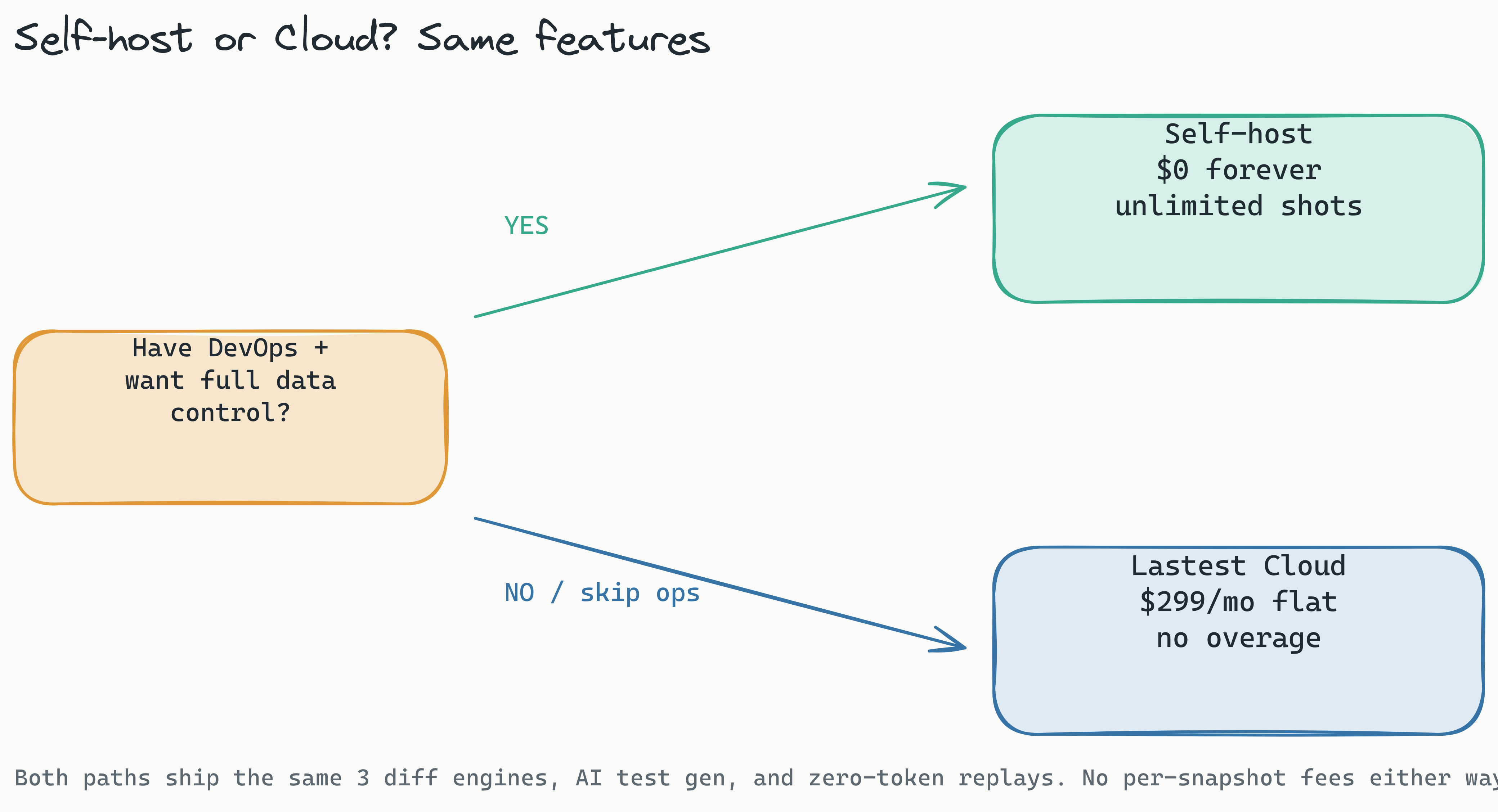
Should you go self-hosted or cloud? It depends entirely on your team's DevOps bandwidth, test volume, and tolerance for maintenance. The real question isn't Percy vs Applitools for startups, it's self-hosted vs. cloud, and Lastest is the only option that offers both paths without feature gating.
Comparison Table: Lastest vs. Percy vs. Applitools vs. Chromatic
| Tool | Starting Cost | Overage Risk | Self-Hosted | Diff Engines | AI Test Gen |
|---|---|---|---|---|---|
| Lastest Self-Hosted | $0 | None | Yes | 3 (pixel/structural/perceptual) | Yes |
| Lastest Cloud | $299/mo | None | No | 3 | Yes |
| Percy | from ~$99/mo | High (per-snapshot overage) | No | 1 (pixel) | No |
| Applitools | from ~$699/mo | Medium (per-checkpoint) | Enterprise only | AI visual | Yes |
| Chromatic | from ~$179/mo | Medium (per-snapshot) | No | 1 (pixel) | No |
For deeper head-to-head breakdowns, see Lastest vs Percy vs Applitools and Chromatic vs Lastest.
When to Go Self-Hosted
Choose self-hosted if you have a DevOps person on the team and want complete control over your data. Lastest's GitHub repo gives you all the features without any cost beyond your server bill, and screenshots never leave your network.
When to Go Cloud
Choose cloud if you lack DevOps capacity or simply want to skip ops entirely. Lastest Cloud at $299 per month flat is far more predictable than any per-snapshot model, and the bill does not move when your test volume does. Percy vs Applitools for startups misses the point; the real comparison is whether you want variable or fixed costs.
Frequently Asked Questions
What is the cheapest way to start visual regression testing for a startup? The cheapest way is to use a self-hosted open-source tool like Lastest. You pay only for server hosting (a few dollars a month on AWS or a low-cost droplet) and get full features including AI-powered test generation, three diff engines, and a human review step, with no per-snapshot fees and zero-token replays.
How much does visual regression testing cost per month for a growing startup? Costs vary widely: open-source self-hosted tools cost a few dollars a month in compute (plus engineering time), SaaS volume plans start in the low hundreds and rise with snapshot count, and flat-rate cloud options like Lastest Cloud cost $299/month with no overage charges.
Are there truly free visual regression testing tools available? Yes, several tools are free to use: BackstopJS, Playwright's built-in snapshot testing, and Lastest's self-hosted version. However, "free" means you handle hosting, storage, and maintenance yourself. Lastest's self-hosted version is the most feature-rich free option, including AI test generation, three diff engines, and unlimited screenshots.
Which is better for startups, Percy or Applitools? Neither is ideal for most startups due to variable pricing. Percy charges per snapshot with high overage risk, while Applitools is more capable but starts considerably higher (commonly cited from around $699/month) with checkpoint limits. Both can become expensive as test volume grows. A flat-rate hybrid like Lastest Cloud ($299/month, unlimited) or Lastest self-hosted (free) is more startup-friendly.
Can I use visual regression testing for free with CI/CD integration? Yes. Lastest's self-hosted version integrates with GitHub Actions and GitLab CI out of the box, all for free (minus your server cost), and Smart Run reads your git diff to run only the tests your change touches. BackstopJS also supports CI/CD integration but requires more manual configuration.
What hidden costs should I watch for in visual regression testing pricing? Hidden costs include server hosting, DevOps labor, overage charges for exceeding snapshot limits, per-seat fees, and infrastructure for headless browsers in CI/CD. Self-hosted tools shift costs to engineering time, while SaaS tools hide overage fees in fine print. Always calculate total cost of ownership, including test volume growth, before committing.
The Bottom Line: Predictable Costs Win for Startups
The core insight for founders is simple: visual regression testing pricing for startups should be predictable, not punitive. Variable per-snapshot and per-seat models from legacy SaaS vendors create financial uncertainty that scales with success, the exact opposite of what growing companies need. A flat or zero-cost model lets teams reallocate budget toward product development instead of monitoring a metered dashboard.
Lastest offers the only model that gives startups both paths: a genuinely free self-hosted version with all features included, and a flat-rate cloud plan at $299/month that eliminates overage anxiety entirely. Whether you start with the GitHub repo and migrate to cloud later, or jump straight to managed infrastructure, your testing costs remain predictable. That's the pricing model startups deserve, and the one that lets you focus on building, not budgeting.
Ready to take control of your visual regression testing budget? Self-host Lastest for free under FSL-1.1, or skip the ops and try the flat-rate Cloud plan at $299/month. No per-snapshot fees, no per-seat fees, no surprises. Star and clone the project on GitHub to get started.