Every testing recipe starts with the same hidden assumption: that you know what correct looks like. You write a spec, you assert against it, and if the assertion passes the system is right. Veeva Vault RIM quietly breaks that assumption, and it is the reason regulatory operations teams end up doing so much of their quality control by eye.
In RIM, correctness is not defined by your spec. It is defined by a validation criteria set published by a health authority, applied to a dossier that you get to submit approximately once. A technical rejection is not a bug report you triage next sprint; it is a delay measured against a regulatory clock, occasionally against an exclusivity window. The oracle lives outside your organization, it changes on the authority's timetable rather than yours, and Vault ships three general releases a year underneath the whole arrangement.
This post is about building a regression suite in that situation: what to assert when the specification is somebody else's, how to survive the eCTD 4.0 transition without doubling your manual QC, and where a visual replay catches things that a validation report structurally cannot. It builds on the auth-bridge and seeded-data groundwork in the Vault CRM testing recipe, which applies unchanged here.
An external oracle changes what you are allowed to assert

This is the philosophical core of RIM testing and it is worth sitting with for a moment, because it dictates the whole design. You cannot write a test that proves a dossier will pass EMA validation. Only EMA validation proves that. What you can do is prove that nothing has changed since the last dossier that did pass, which is a different and much more achievable claim.
That reframing is exactly what a visual regression suite is built for. A baseline is not an assertion about correctness in the abstract; it is a frozen record of a state a human previously confirmed was acceptable. In most applications that framing feels like a limitation. In RIM it is precisely the right epistemology, because "acceptable" was always defined by an external party and confirmed by a human anyway. All you are adding is the machinery to notice when it drifts.
So the design goal is not coverage of the criteria set. It is a high-fidelity record of a known-good publishing run, plus a fast unattended comparison against it after every release, every configuration change, and every criteria update.
eCTD 4.0 means you are running two publishing paths at once
Timing makes this urgent rather than theoretical. Japan's PMDA has mandated eCTD v4.0 for submissions from April 2026, and the EMA opened optional acceptance of eCTD v4.0 for centralized marketing authorization applications from late December 2025. The United States and other regions are on their own timelines. The practical consequence for a global sponsor is a multi-year period in which the same regulatory operations team publishes 3.2.2 dossiers to some regions and 4.0 dossiers to others, from the same RIM instance.
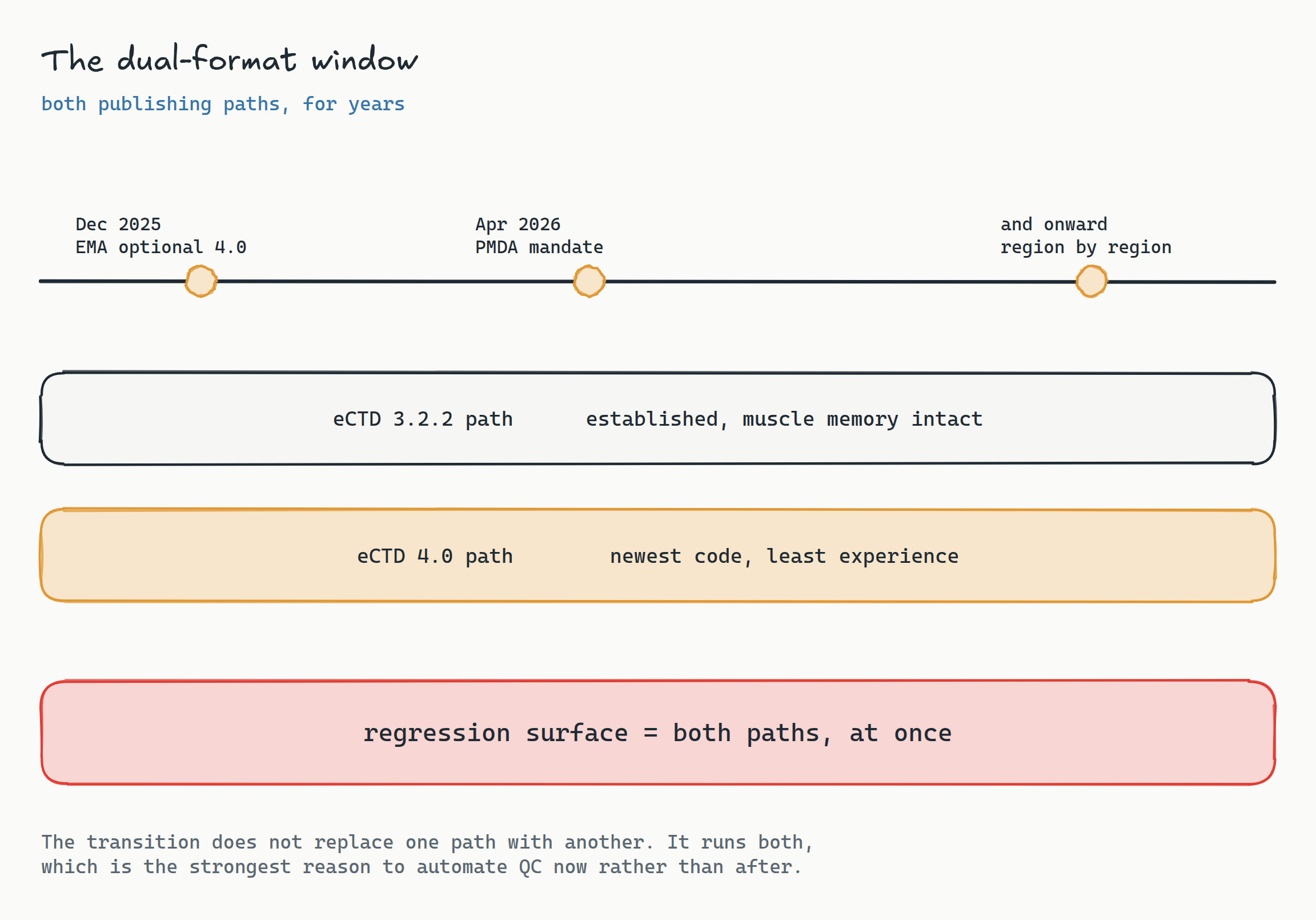
Two publishing paths means double the regression surface, and the newer path is the one with the least institutional muscle memory behind it. That combination is the single strongest argument for automating RIM QC now rather than after the transition settles. Teams that wait will spend the entire transition window doing double manual QC, which is precisely the period when they can least afford it.
Concretely: baseline the same reference submission published to both formats. The dossier contents are identical, the structure and metadata are not, and a diff between consecutive runs of each path is the cheapest early warning you will get that a release changed something in one and not the other.
The validation panel is a user interface, and nobody tests it
Vault Submissions Publishing performs validation continuously as you build, checking against health authority criteria and surfacing errors and warnings for resolution as they appear rather than at the end. This is genuinely good design, and 26R1 improved the tracking and error reporting around the dossier and eCTD publishing processes further.
It is also a screen. A regulatory operations specialist reads that panel and decides, on the basis of what it renders, whether a submission is ready. Which means the panel itself has a failure mode that the validation engine cannot detect: it can be right and still be read wrong.
- A warnings section that collapses by default and hides eleven warnings behind a chevron nobody expands.
- A count that renders correctly and a list that paginates, so items twenty-one through forty are never seen.
- A severity indicator whose colour changed in a release, so an error now reads as a warning at a glance.
- An empty state that renders identically whether there are zero findings or the criteria set failed to load.
That last one deserves its own sentence, because it is the worst bug in this entire category and it is not hypothetical in class: a panel showing no errors because validation did not run looks exactly like a panel showing no errors because there are none. This is what the network verification layer is for. If a call behind that panel returned a 4xx or 5xx, the build fails, regardless of how serenely the empty state renders.
Baselining the validation panel against a reference submission with a known, deliberate set of findings is the highest-value single scenario in a RIM suite. Seed a dossier that produces, say, three errors and five warnings. Baseline the panel. Now any release that changes how findings are counted, grouped, truncated, or coloured produces a diff, and a human looks at it before a submission does.
Dossier structure: what a diff catches that a report does not
The submission hierarchy is the other high-value surface. A dossier is a tree of leaves with lifecycle operations attached: new, replace, append, delete. The relationship between a leaf and the leaf it replaces is what tells the authority how to assemble the current view of your application. Get it wrong and the reviewer sees the wrong document, which is worse than seeing no document.
Lifecycle operations are the kind of thing that is easy to assert on individually and hard to see holistically. A test can confirm that a specific leaf has operation replace and points at the right predecessor. It is far harder to write an assertion that says "the tree as a whole looks the way it looked last time." That is a structural comparison, and it is exactly what a baselined view of the dossier browser gives you for free.
The same logic applies to the hyperlink and bookmark integrity that regulatory QC spends so much time on. Cross-document links inside a dossier are checked by walking them, and walking them is exactly what a replay does well: drive the link, capture the destination, compare it to the baseline destination. A broken cross-reference is a rendering difference on the destination screen, which a pixel comparison sees immediately and a metadata check never will.
The nine-layer verify, tuned for RIM
| Layer | Band | RIM-specific reasoning |
|---|---|---|
| network | ENFORCE | Promoted to the top of the list, unusually. A silent failure behind the validation panel is the worst failure mode in the application. |
| visual | ENFORCE | Perceptual diffing on the validation panel, the dossier browser, and the submission viewer. Mask submission identifiers and timestamps. |
| text | ENFORCE | Promoted out of review-only. Error counts, severity labels, and leaf titles are the regulated content here; a changed word is a finding. |
| url | ENFORCE | Application, sequence, and region context live in the route. Drifting into the wrong sequence is a serious class of error. |
| console | ENFORCE | The dossier browser is a heavy client. Errors in it mean the tree you are reading may be incomplete. |
| dom | LOG | Noisy on large trees, but useful signal when triaging a structural diff. |
| a11y | LOG | Trend it. Regulatory ops staff live in these screens all day. |
| perf | LOG | Large dossiers degrade browser performance measurably. Worth a sparkline. |
| design | DISABLE | Off until a token set exists. |
Two layers get promoted here that stay in the logging band almost everywhere else, and both promotions come from the same source: in RIM, the words and the network calls are the product. Everywhere else they are supporting evidence.
Seeding a submission you can safely break
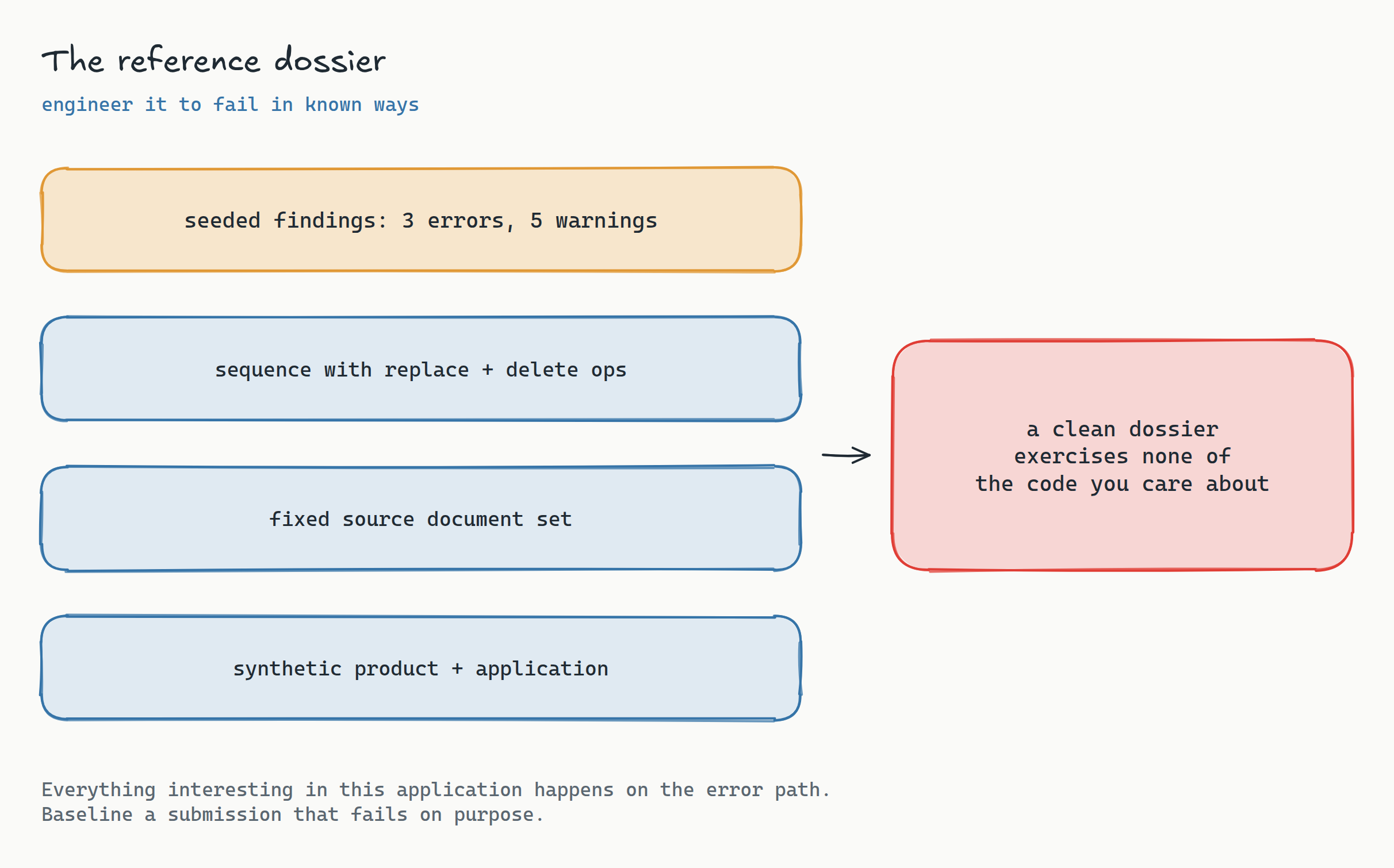
The instinct is to build a perfect reference submission. Resist it. A dossier that passes validation cleanly exercises almost none of the code you care about, because everything interesting in this application happens on the error path.
Build one synthetic application with a small fixed document set, a sequence that includes at least one replace and one delete so lifecycle rendering is exercised, and a deliberately seeded set of findings that produce a known error and warning count. Package it so it reloads identically into any sandbox. That artifact, and the baselines captured against it, is the whole asset. Everything else in the suite is plumbing.
Then freeze the usual suspects before capturing anything: submission and sequence identifiers, publishing timestamps, user names in audit columns, and any dashboard that counts open items. If you skip this step your first run is a wall of red and the team learns to distrust the tool in week one. The stabilization toolkit is covered in reducing false positives in visual regression testing.
When something else is writing into RIM
One more reason to have this suite standing, and it is newer than most RIM testing advice accounts for. Regulatory content is increasingly not typed by a person into a form. AI authoring platforms now generate first drafts of protocols, clinical study reports, and safety documents from upstream source data and push them into RIM directly. AlphaLife Sciences announced a Veeva RIM integration for its AuroraPrime platform in March 2026, connecting AI-orchestrated authoring and quality control to the vault where the submission is assembled.
Whatever you think of that direction, it changes the risk profile of your RIM instance in a specific way: the rate of change to document content goes up, the human proximity to each individual change goes down, and the QC surface becomes the last place a person reliably looks. That is an argument for automating the QC surface, not for slowing the authoring down. We have written separately on what validating a RAG-based authoring system actually requires and on citation drift, the specific failure mode where generated prose stays plausible while its sourcing quietly moves.
The honest prerequisites
- A sandbox vault with RIM Submissions and Submissions Publishing provisioned, plus a password-auth integration user exempt from org SSO and MFA.
- A synthetic reference application and dossier, packaged for repeatable load, containing deliberate lifecycle operations and deliberate findings.
- Network reachability from the browser pool into the vault. Assume private, plan a Remote Runner inside your network, and treat public sandbox access as the exception.
- Agreement from regulatory operations on which screens constitute the QC surface. This is a half-day conversation and it determines the whole scenario set, so have it before authoring rather than after.
The self-hosted deployment matters more here than almost anywhere else in the Vault portfolio, because the screenshots in question are of unsubmitted regulatory content. Running it inside your own network means those images never transit a vendor's infrastructure, which is the answer to the first and hardest question your security review will ask.
Frequently asked
Can this replace regulatory QC review? No. It replaces the repetitive part: confirming that a screen still renders the way it rendered last time. The judgment about whether a dossier is fit to submit stays with a qualified human, and should. What changes is that the human spends their attention on this submission's content rather than on re-verifying that the platform still works.
What happens when a health authority updates its validation criteria? You update the criteria in Vault and rerun the suite against the reference dossier. The diffs show you exactly which findings changed, which is a far better starting point than reading a criteria changelog and guessing at the impact. This is one of the clearest cases where an external oracle changing is something a baseline handles gracefully.
Is a visual diff really the right tool for structured content? For the underlying XML, no, and you should validate that with a validator. For the rendered dossier browser, the validation panel, and the submission viewer, it is the only tool that sees the whole surface at once. Use both. They fail differently, which is the point.
Does this work during the eCTD 4.0 transition or should we wait? The transition is the strongest reason to start. Running two publishing paths in parallel is exactly when a cheap unattended comparison against a known-good run is worth the most, and waiting until the transition settles means paying the manual QC cost for the entire window.
Start here
RIM is the Vault application where a missed regression costs the most and where the test oracle is least under your control, which is a combination that makes stability comparison more valuable than assertion coverage. Book a release-readiness review and we will map your QC surface, size the reference dossier, and hand back a suite structure covering both publishing paths through the transition. Want to see what the output looks like first? Look at a sample diff report, or read the cross-platform release-testing playbook. Everything is open source at github.com/las-team/lastest, and self-hosting is free forever.
The one-line version: you cannot test your way to a passing health authority validation, so stop trying. Freeze a dossier that fails in known ways, baseline the screens your QC team actually reads, and let an unattended replay tell you the moment either one moves.