Here is a regression that will not show up on your dashboard. You upgrade the embedding model behind a retrieval-augmented generation system. Every metric holds. Faithfulness is unchanged. Groundedness is unchanged. Answer relevancy ticks up slightly, which is why you shipped it. Context recall is fine.
And a claim that used to cite the current version of a protocol now cites the superseded one. The generated sentence is identical. The citation label looks right, because both documents have nearly the same title. Nothing failed. The system is, by every measure you are running, working better than before.
We call this citation drift, and it is the most under-tested failure mode in production RAG. It matters in every domain and it matters enormously in regulated ones, where the difference between two versions of a source document is the entire point of having versions.
Why faithfulness structurally cannot see this
The reason citation drift slips through is not that teams are running bad metrics. It is that the standard metrics have a reference frame problem, and it is worth being precise about it because the precision is what makes the fix obvious.

Faithfulness and groundedness measure the relationship between the generated answer and the retrieved context. That is the correct thing to measure for hallucination, which is what those metrics were built for: is the model asserting things its context does not support.
But the reference frame is the retrieved context itself. When retrieval shifts to a different but plausible source, the answer is generated from that new source, and it is perfectly faithful to it. The metric is not wrong. It is answering the question it was asked, which is not the question you now need answered.
The question you need answered is a different one: did retrieval return the same sources it returned when a human last confirmed this was right? That is not a quality metric at all. It is a regression check, and it needs its own instrument.
Five shapes of citation drift
Naming the failure modes makes them testable. In production systems we have seen these five, roughly in order of how often they occur and inversely in order of how easy they are to notice.
| Shape | What happens | Why it slips through |
|---|---|---|
| Anchor drift | Right document, wrong location. Re-chunking moved offsets, so the citation resolves to a neighbouring section. | Document-level assertions pass. The citation label is correct. |
| Version drift | Right document lineage, superseded version. An effective-dated or amended source is retrieved instead of the current one. | Titles are nearly identical. Nothing in the generated prose signals it. |
| Sibling drift | A near-identical document from a different study, product, or market is retrieved instead. | Boilerplate-heavy corpora make siblings embed almost identically. Relevancy scores stay high. |
| Phantom persistence | A withdrawn or deleted source is still served because the index was not rebuilt. | The retrieval layer is technically healthy. Nothing errors. |
| Silent truncation | The interface renders the first N citations and hides the rest behind pagination or a collapsed control. | Purely a rendering failure. No backend metric touches it. |
Note the split. The first four are retrieval-layer failures. The fifth is an interface failure. They require different instruments, and a program that only builds one instrument catches roughly half the category. That is the structure of the rest of this post.
What actually triggers it
Citation drift is not random. It is caused, and the causes are a short and entirely predictable list. Anything on it should trigger the checks below:
- Embedding model change. The most common cause and the most under-appreciated, because upgrading an embedding model is usually framed as a pure improvement.
- Chunking or preprocessing change. Different chunk boundaries mean different offsets, which is anchor drift by construction.
- Index rebuild or migration. Moving vector stores, changing distance metrics, changing index parameters.
- Reranker or top-k change. A reranker swap reorders results, and the top result is the one that gets cited.
- Corpus lifecycle events. New document versions, withdrawals, supersessions, and access-control changes. In a document management system these happen continuously and by design.
- Model swap for generation. Different models select and attribute among the same retrieved chunks differently.
The corpus lifecycle row is the one to sit with if you work in life sciences, because it means citation drift is not only introduced by your engineering changes. It is introduced by your organization doing its job. Every protocol amendment, every label update, every superseded CSR is a chance for retrieval to prefer the wrong member of a lineage.
Instrument one: the retrieval fingerprint
The retrieval-layer instrument is simple enough that its absence is surprising. For a fixed set of queries against a pinned corpus, record the identity of what was retrieved, not just the score. Then assert that identity is stable across changes.
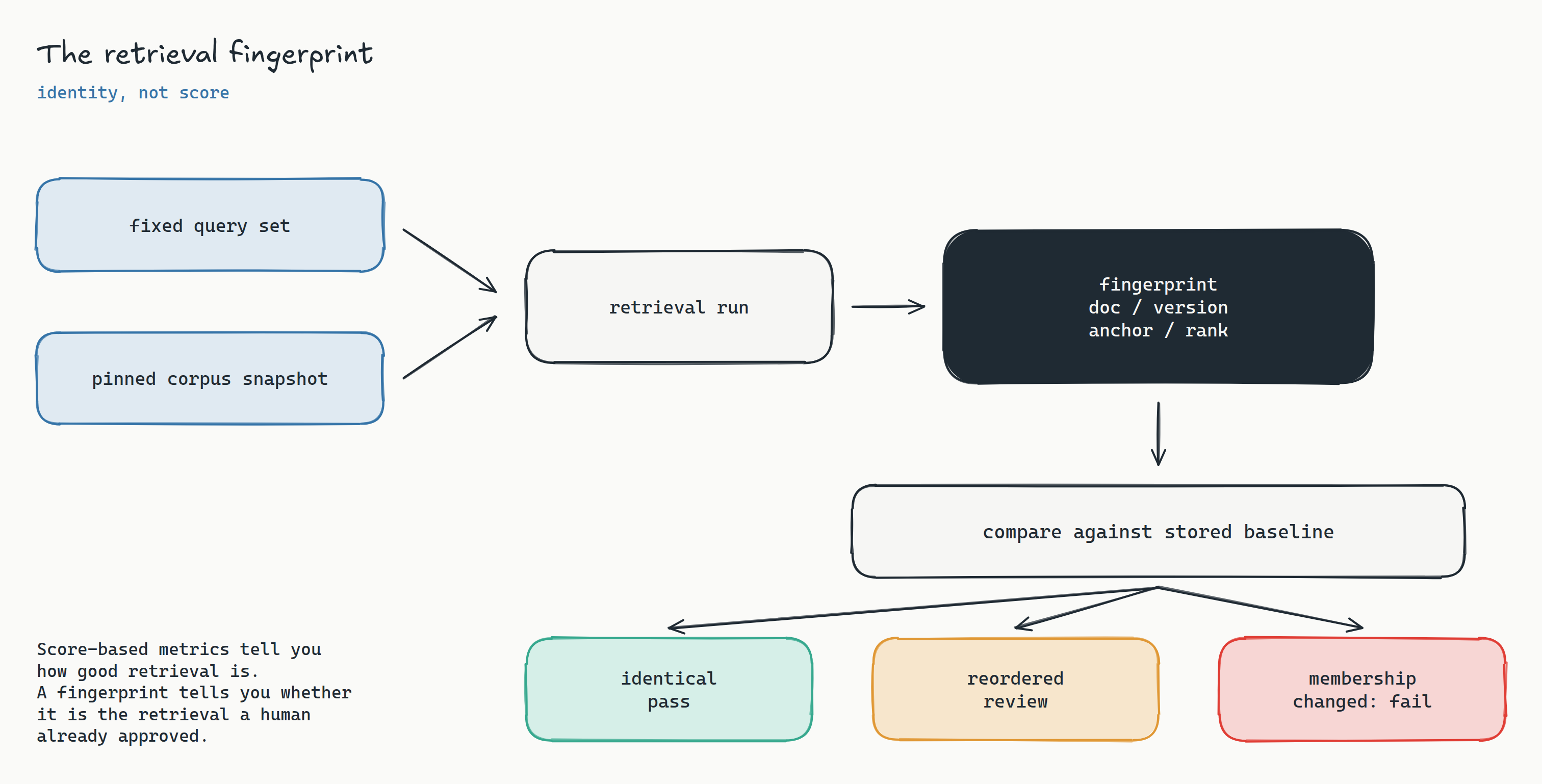
A fingerprint entry is small. For each query, for each result in the top-k, capture the document identifier, the document version, the chunk anchor, and the rank. Something like this:
{
  "query_id": "q-protocol-inclusion-criteria",
  "corpus_snapshot": "2026-08-01",
  "results": [
    { "rank": 1, "doc": "PROT-4471", "version": "3.0", "chunk": "s4.2#0" },
    { "rank": 2, "doc": "PROT-4471", "version": "3.0", "chunk": "s4.2#1" },
    { "rank": 3, "doc": "SAP-4471",  "version": "2.1", "chunk": "s6.1#0" }
  ]
}
Then grade a comparison against the stored baseline on three levels rather than one, because not every change is a failure:
- Identical. Same documents, same versions, same anchors, same order. Pass silently.
- Reordered. Same document and version set, different ranking. Warn and route to review. Usually benign after a reranker change, occasionally the leading indicator of something worse.
- Different membership. A document or version entered or left the top-k. Fail. This is version drift and sibling drift, caught at the only layer where they are cheap to catch.
The pinned corpus snapshot is what makes this work. If the corpus can move underneath the test, every result is ambiguous and the team stops trusting the signal, which is the same seeded-fixture discipline that makes any visual baseline meaningful.
Instrument two: walk the citation
The fingerprint covers the index. It says nothing about what the reviewer sees, and the reviewer is the control. So the second instrument lives in the interface: drive every citation the way a human would, and compare where it lands against where it landed last time.
This is ordinary browser automation applied to a question nobody usually asks it. For each citation rendered in the review pane: click it, wait for the destination to settle, capture the destination view, and compare against the baseline destination captured when a human confirmed the citation was correct. Concretely, that catches:
- Anchor drift, because the destination scrolls to different content and the pixels differ.
- Phantom persistence, because a withdrawn document either fails to load or renders a withdrawal banner, and both are visible.
- Silent truncation, because the count rendered in the pane is compared as text and the collapsed state is compared as pixels.
- Broken links of the plainest kind, because the network layer fails the build on a 4xx or 5xx behind the citation.
Two configuration notes matter. First, promote the text verification layer out of its usual review-only band for these screens. Citation counts, document titles, and version labels are the regulated content in this view, and a changed word is a finding rather than chatter. Second, mask the generated prose region if you are running against live generation, and baseline the surrounding structure. The words are the model's business; the citation apparatus around them is the control, and it is the control you are validating. That decomposition is covered at length in validating a RAG document generator under GxP.
Why this is sharper in life sciences than anywhere else
Every RAG system can drift. Regulated document generation has three properties that turn drift from a quality problem into a compliance problem.
The corpus is versioned by law, not by convention. Superseded protocol versions, amended labels, and prior submission sequences are retained deliberately. A general-purpose retriever sees a dense cluster of near-identical documents and no strong signal about which one is current, which makes version drift the default failure rather than an edge case.
Traceability is the product claim. The whole premise of platforms in this space is that generated content remains traceable to source. AlphaLife Sciences' AuroraPrime grounds output in verified source documents through RAG and records generated content along with user feedback and edit rationales so that claims can be traced back, and its March 2026 Veeva RIM integration carries that trail into the vault where submissions are assembled. That architecture is the right one. It also means the traceability layer is load-bearing: if a citation silently points somewhere new, the primary safeguard has failed while continuing to look like it is working.
The consumer of the citation is time-pressed and pattern-matching. A medical writer reviewing a generated draft checks that a citation exists and looks plausible far more often than they open it and read the cited passage. That is not a criticism, it is how humans review under deadline, and it is exactly the behavior that version drift and sibling drift exploit.
Put those together and the conclusion is uncomfortable but clear: in this domain, the citation apparatus needs automated regression testing precisely because human review is least likely to catch its failures.
What to alert on, and what to leave alone
A drift program that alerts on everything gets muted. Here is a defensible starting policy.
| Signal | Action |
|---|---|
| Top-k membership changed (document or version) | Fail the build. Requires human sign-off to rebaseline. |
| Chunk anchor changed within the same document version | Fail on the first occurrence after a chunking change; expected, but must be reviewed once. |
| Rank order changed, membership stable | Warn. Batch into a weekly review rather than blocking. |
| Citation destination render differs from baseline | Fail. This is the reviewer-visible failure. |
| Citation count rendered differs from citation count returned | Fail. This is silent truncation and it is always a bug. |
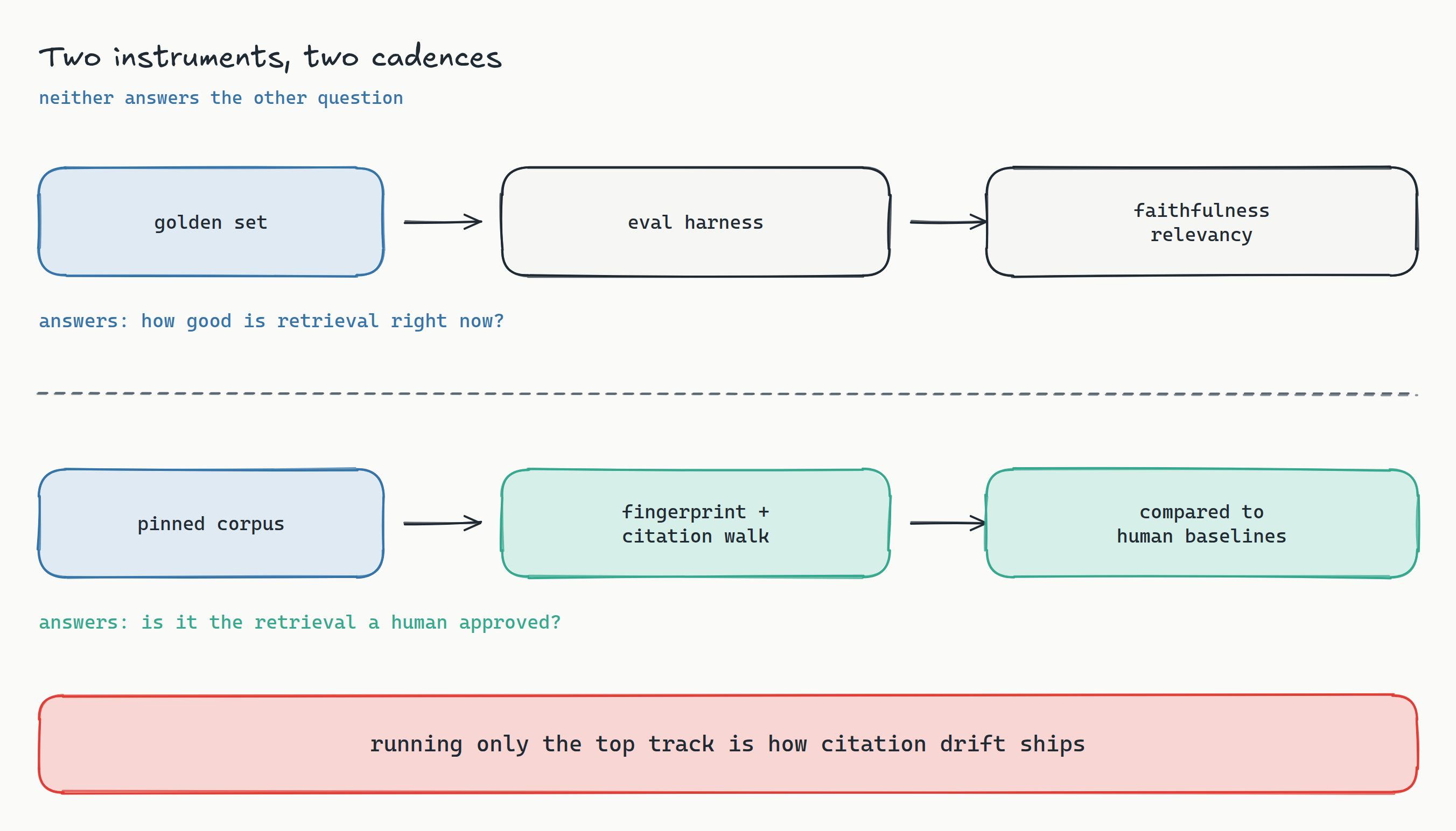
| Faithfulness or relevancy below threshold | Fail, on the eval harness, separately. Different instrument, different cadence. |
Wiring it in
The trigger list from earlier is the CI configuration. Run the fingerprint comparison and the citation walk on every embedding change, chunking change, index rebuild, reranker change, model swap, and vendor release, plus on a schedule to catch corpus lifecycle drift that no commit announces.
The economics make the schedule realistic. Model calls only happen when generation is live; the replay half of this is deterministic browser execution against stored baselines, which costs nothing per run. Running the citation walk nightly against a pinned corpus is not a budget conversation, which is the property that lets you catch corpus-driven drift rather than only change-driven drift. If you are running self-hosted, unlimited replays against unpublished regulatory content stay entirely inside your network.
Frequently asked
Is this not just retrieval evaluation with extra steps? No, and the difference is the reference frame. Retrieval evaluation asks whether the retrieved set is good, scored against relevance judgments. A fingerprint asks whether the retrieved set is the same one that was previously approved. A change can improve the first and still be a regression by the second, and version drift is exactly that case.
Will not the fingerprint fail constantly? It will fail on the first run after any retrieval change, which is correct and is the entire point. What keeps it usable is the three-level grading: reordering warns rather than fails, and rebaselining after a reviewed change is one action, not a rewrite.
How large should the fixed query set be? Smaller than instinct suggests. Thirty to fifty queries covering your real document types and your known-hard cases, especially queries whose correct source has a superseded sibling. A tight set that people actually maintain beats a thousand queries nobody looks at.
Can this catch a citation that points at a real document saying something different? Only by comparison to a human-approved baseline, which is what both instruments do. Neither can tell you a citation is correct in the first place; a qualified reviewer does that once, and the suite then tells you the moment it stops being what they approved. That is the same division of labour we argue for in the human-in-the-loop dev cycle.
Start here
If you run a production RAG system, the fastest way to find out whether you have citation drift is to fingerprint your current retrieval, then diff it against the same query set after your last embedding or chunking change. Teams are usually surprised, and the surprise is the useful part.
The interface half is what Lastest does: deterministic replay of the review surface, baselines that carry a named human's approval, and diffs that are auto-classified as real regression, flaky, environment, or maintenance so triage starts from a sorted list. It is open source at github.com/las-team/lastest, free to self-host forever, and every replay after the first costs nothing in tokens. For the validation-program framing around all of this, read the GxP validation piece; if your generated content lands in Veeva, the Vault RIM testing recipe covers the downstream half. Or look at a sample diff report first.
The one-line version: your metrics measure the answer against the sources, and the sources are the thing that moved.