
Let me coin a term and then defend it: founder mode testing.
It is the QA strategy for a one-person company. It assumes you have forty minutes a week, zero dollars of test budget, and no second pair of eyes before the deploy button. It assumes the blast radius of a bad push is not a sprint retro - it is your MRR.
And it is the exact opposite of how QA gets taught, sold, and tooled today. Solo builders do not need a smaller version of the enterprise playbook. They need a different one. This post is that playbook.
Enterprise QA was designed for a world you do not live in
Walk into any enterprise QA stack and you will find the same fossils. TestRail for case management. A Jira board with a "QA" swimlane. A visual-diff SaaS billed per seat and per screenshot, starting in the hundreds of dollars a month and climbing fast. A regression cycle measured in days, run by humans whose full-time job is to click around.
That stack assumes three things you do not have: a team, a budget, and time.
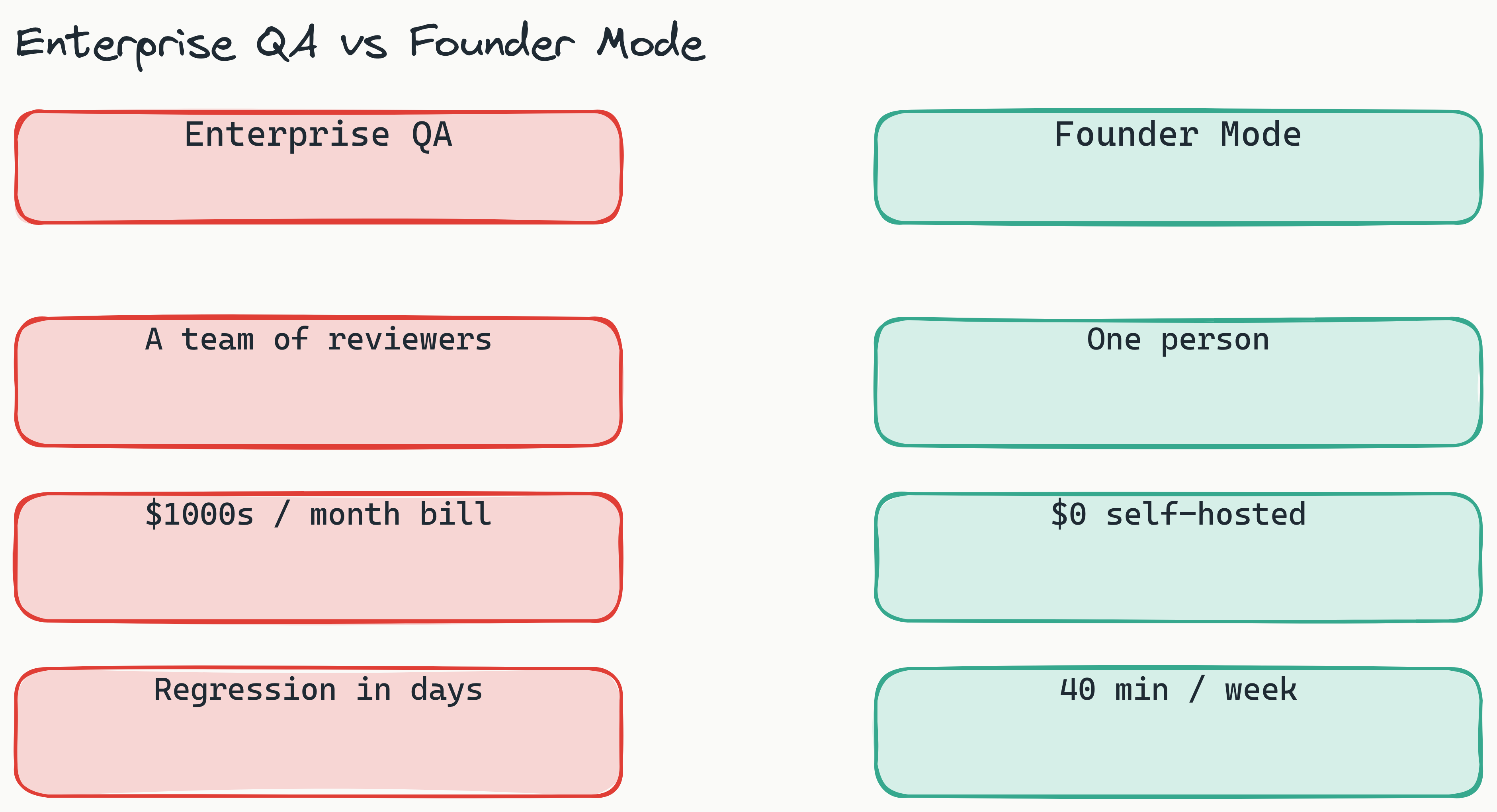
You are one person. Your QA budget is whatever is left after Vercel and Postgres. Your regression cycle is the ten minutes between "ship it" and "first user complaint on Twitter." If you try to bolt enterprise QA onto a solo operation, you will quietly stop testing within a month, ship a regression that nukes checkout, and convince yourself testing is "for later."
Industry surveys put most indie products at more than a month from idea to first shipped MVP, and the ones who do ship are rarely failing because their tests were not thorough. They are failing because the testing rituals they inherited from enterprise teams were designed for a different physics. The fix is not more discipline. It is a strategy shaped like a one-person team.
The three tenets of founder mode testing
If you are going to do this right, you need a philosophy, not a tool list. Here are the three tenets I would die on a hill for.
1. Generate or record, do not hand-write. Your time is the bottleneck.
Writing Playwright by hand is a luxury good. It is fine if you have a QA engineer. You do not.
The "just ask Claude to write the test" crowd keeps rediscovering the catch: industry studies consistently find AI co-authored code carries more defects than human-reviewed code, and agentic test authoring often needs several attempts before a flow lands clean. That is before you count the recurring hours of babysitting that an unsupervised AI suite demands once it is running. Generate-and-pray is not a strategy.
The founder-mode answer is to let AI author the test once and a human review it once, then never pay for the AI again. Lastest gives you three ways to work so you pick per test: AI-Free recording in the browser when you want air-gapped determinism and no API keys, AI-Assisted when you want Claude to propose resilient Playwright and you approve every change, and Full Autonomous via the Play Agent when you want the whole pipeline to plan, generate, run, and fix on its own. Forty seconds of clicking or one supervised prompt, not forty minutes of trial and error. This is exactly what the Lastest solo founder workflow is built around, and we walk through it step by step in how solo founders test a SaaS MVP in five minutes.
The part that makes the math work is what happens after the test exists.
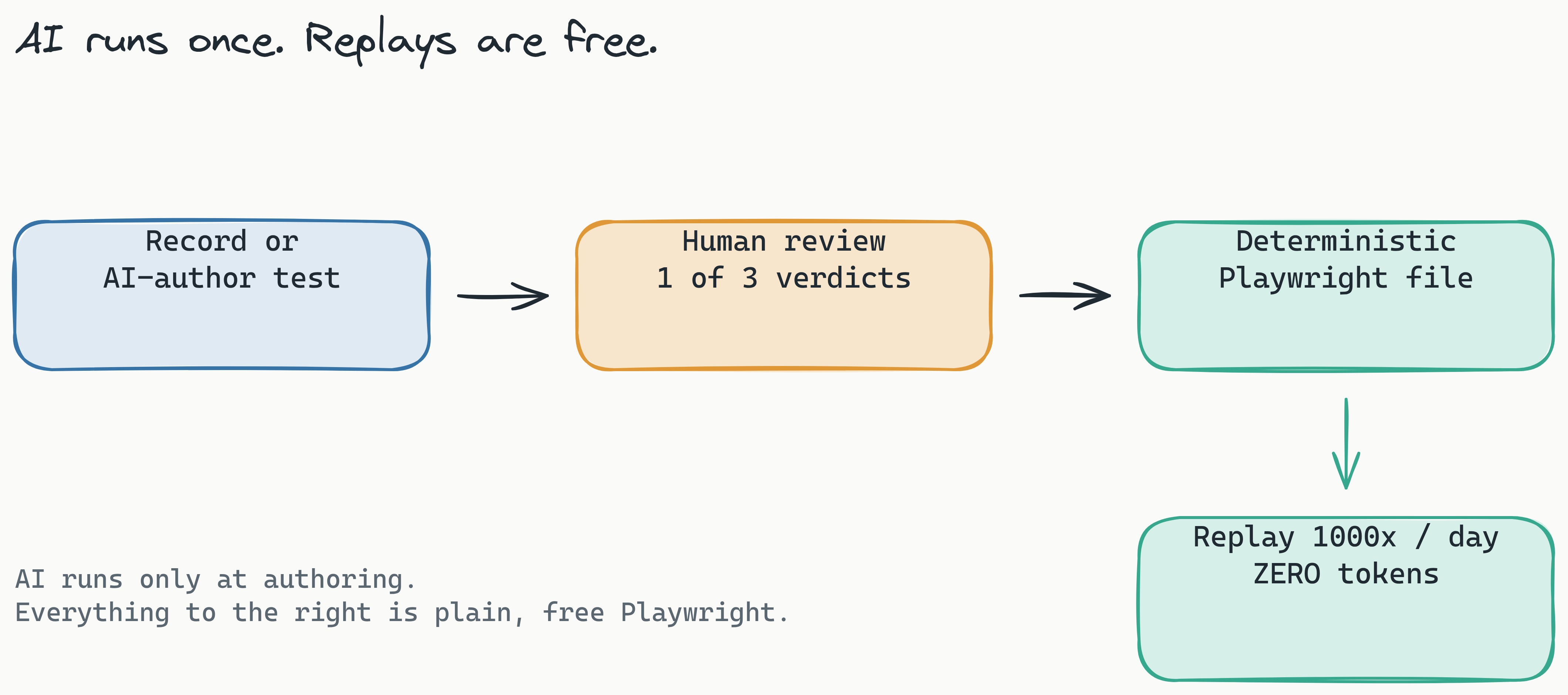
This is the zero-token replay model. AI runs only when you create or fix a test. Every replay after that is plain Playwright execution, so you can run your suite thousands of times a day for nothing. Self-hosted, your screenshots and replays are unlimited regardless of volume. The expensive part of testing happens once; the cheap part happens forever.
2. Visual-first. You cannot grep a paywall that collapsed.
Here is the regression that actually kills indie SaaS: a CSS change pushes the "Upgrade" button below the fold, or a Tailwind purge eats the pricing card, or an AI refactor reflows your hero into a stack of overlapping divs on mobile. None of those break a single assertion. Your unit tests pass. Your API tests pass. Your status page is green. Your conversion rate is zero.
AI-written tests cluster around happy-path API responses because that is what is easy to assert in code. The expensive bugs live in pixels, where assertions never look.
Founder mode testing inverts the pyramid. Pixels first, assertions second. Run a visual diff on every page that touches money. If the screenshot moved, you want to know, even if every selector still resolves. Lastest ships three diff engines so you choose how strict to be: Pixel (Pixelmatch) for fast pixel-perfect comparison, Structural (SSIM) for layout-aware diffs, and Perceptual (Butteraugli) tuned to the human eye so it catches real bugs while ignoring anti-aliasing and font noise. On top of that, every screenshot gets a WCAG 2.2 AA accessibility score from axe-core, and every failure is auto-classified as a real regression, a flake, an environment issue, or test maintenance with a confidence score, so a solo founder is not guessing why something went red.
3. Deterministic and free. Your runway is finite.
If your test suite costs money to run, you will run it less. If it is flaky, you will trust it less. If it is closed-source SaaS, you are one pricing-page edit away from your QA bill eating your margin.
Founder mode means self-hosted, deterministic, and zero marginal cost per test run. A docker-compose up, a recorded flow, a Playwright file you own, and selectors that survive your next refactor. The Lastest source on GitHub is open source under FSL-1.1-ALv2 and free forever to self-host, precisely because the founders building on it should never have to negotiate a per-seat price to test their own product. When you outgrow running your own ops, Lastest Cloud is a flat $299 a month with no per-seat and no per-screenshot fees, so the bill does not grow just because your product did.
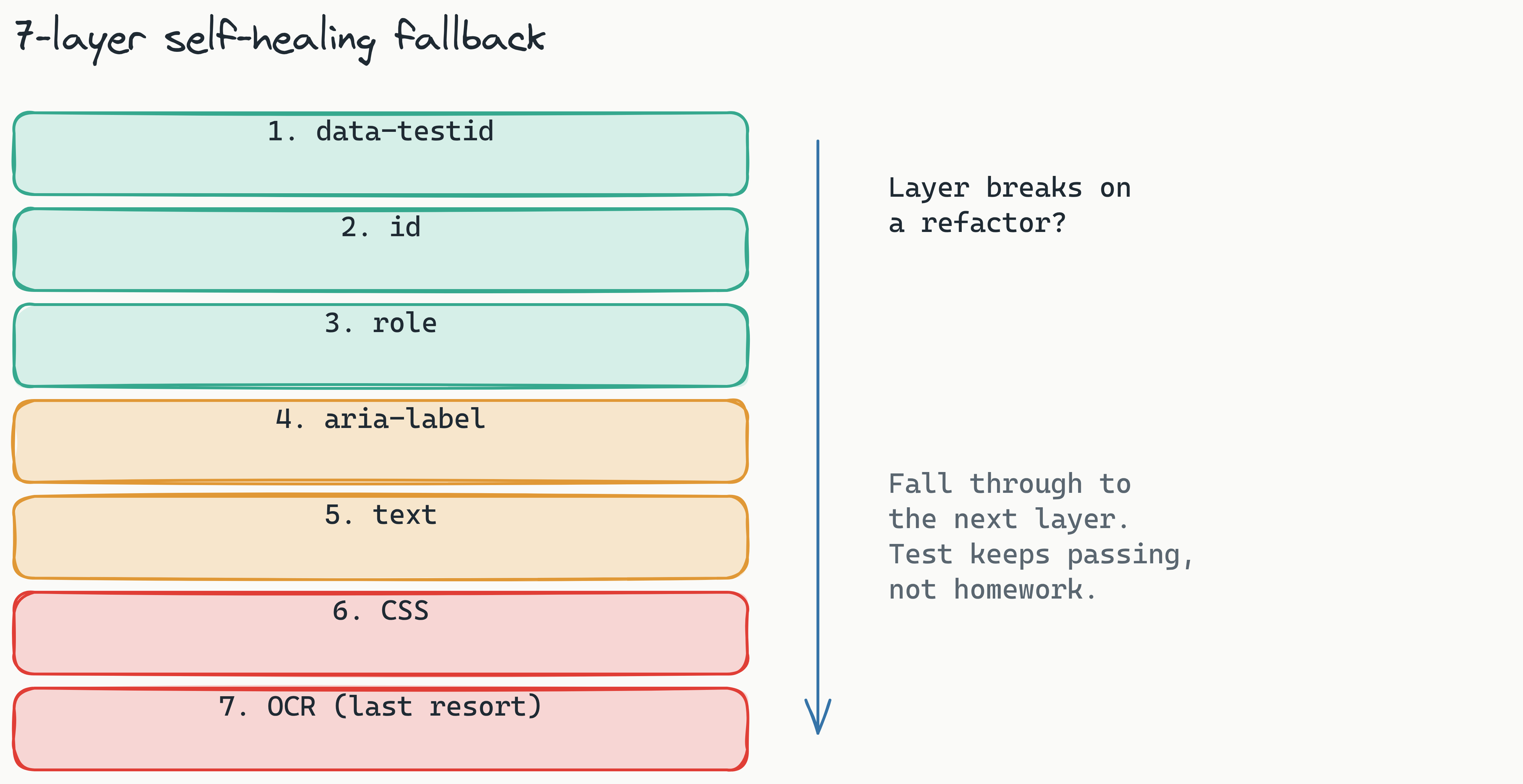
Determinism matters because solo founders cannot afford to debug flakes. A test that fails once a week is worse than no test at all; it teaches you to ignore red. The seven-layer self-healing selector stack (data-testid, then id, then role, then aria-label, then text, then CSS, then OCR) exists because a recorded test should still pass after you rename a div, not turn into homework. The mechanics are detailed in how self-healing selectors actually work.
One human seam, never zero
Founder mode testing is not "just vibe-code it and let Claude check." That is the opposite philosophy: outsourcing judgment to a model that has no idea what your product does, no memory of last week's regression, and a strong incentive to declare victory. AI never approves its own output in Lastest. There is exactly one human review seam where you render one of three verdicts (pass, fix, or regression), and the AI does the expensive grunt work on either side of it. If you are vibe-coding your way to a product, you need that deterministic safety net under the agent more than anyone else.
It is also not "skip testing until you have users." Your first hundred users are the most expensive ones you will ever acquire. Burning them on a checkout regression is not a growth strategy. If you want the line-item math on what skipping QA actually costs a solo team, we ran the numbers in what manual QA actually costs a solo SaaS founder.
Make the suite run itself
The last piece of founder mode is that the suite should not need you to remember it. Smart Run reads your git diff and runs only the tests your change actually touches, so a one-line copy edit does not trigger a full regression sweep. The reusable GitHub Action wires the whole thing into CI, and the MCP server exposes roughly 20 AI tools so your coding agent (Cursor, Claude Code, and friends) can drive Lastest directly from the editor. You can also bring your own AI: Claude CLI, Anthropic API, OpenRouter, OpenAI, or local Ollama models, with no lock-in and no surprise per-token bill. See the full feature set or the tool list if you want the inventory.
The Chesky connection
Paul Graham wrote about founder mode as a management philosophy: the observation that the advice founders get from professional managers ("hire good people and give them room to do their job") quietly destroys the things that made the company work in the first place. Brian Chesky's version of running Airbnb looks nothing like the MBA playbook, and that is the point.
Founder mode testing is the same idea applied to reliability. The advice you will get from QA professionals (write a test plan, build a regression suite, stand up a staging environment, run a UAT cycle) is correct for the company they came from. It is wrong for yours. Not because quality does not matter, but because the shape of the team is different, and the rituals have to match the shape.
One person. Forty minutes a week. Zero budget. MRR on the line.
Record or generate the flow. Diff the pixels. Own the source. Ship on Friday anyway.
That is founder mode testing. The tool built around exactly this strategy is free and self-hosted at github.com/las-team/lastest, and if you would rather skip the ops, Lastest Cloud is a flat $299 a month with the same FSL license underneath. The solo founders page is where to start. Stop running enterprise QA on a one-person company; the physics do not work, and the rituals will quietly bankrupt your weekend.