
You are a solo founder. You hit $10k MRR last quarter. About 500 paying users on a Next.js + Supabase + Stripe stack. Every Friday afternoon, before you push, you open the app and click through the same flows: signup, checkout, dashboard, settings, the one weird Stripe webhook edge case that broke last month.
You tell yourself it only takes a few minutes. It does not. This post is a line-by-line look at what manual QA actually costs a solo SaaS founder - in dollars, in churn, and in weekends - and what the cheapest credible alternative looks like. Let's run the numbers.
The hidden line item on your P&L
Here is the uncomfortable thing about being solo: your time is the most expensive resource in the company, and it is the one resource that never shows up on a Stripe invoice. So you ignore it.
Let's not ignore it. At $10k MRR with one operator, your effective opportunity cost per hour sits somewhere between $150 and $250/hr - that is what one hour of your focus would generate if you spent it on the next feature, the next ad test, or the next sales call. Pick the middle: $200/hr.
Now measure honestly. Most solo founders shipping weekly spend 1.5 to 2 hours per week on manual pre-release clicking. That is 6 to 8 hours per month. At $200/hr, you are spending $1,200 to $1,600/month on QA labor that you never invoiced, never tracked, and never optimized.
And that is the optimistic version - the version where nothing breaks.
The cost of one bad push
Now factor in the version where something does break. Independent research on AI-co-authored code suggests it ships with a meaningfully higher rate of significant issues than human-only code. If you are using Cursor, Claude Code, v0, Bolt, or Lovable to move fast - and you are - you are also inheriting that defect rate.
A typical solo founder takes 2 to 3 hours to detect a production regression (you find out from a support email or a Sentry alert that finally crosses your noise threshold). During that window, the affected cohort is hitting a broken signup, a broken checkout, or a broken billing portal.
Industry data on broken-flow churn puts the spike at roughly 10 to 15% of the impacted cohort. If a bad push affects even 50 users in that detection window, and your average LTV is $240 (2-year average for a $20/mo plan with typical solo SaaS retention), you are looking at:
50 affected users x 12% churn spike x $240 LTV = $1,440 in vaporized lifetime revenue from a single bad push.
And solo founders, on average, ship one regression-grade bug every 4-6 weeks. Annualize it. That is roughly $12,000 to $18,000/year in churn cost from undetected pushes alone.
Table 1: The cost of doing nothing
| Line item | Monthly cost | Annual cost |
|---|---|---|
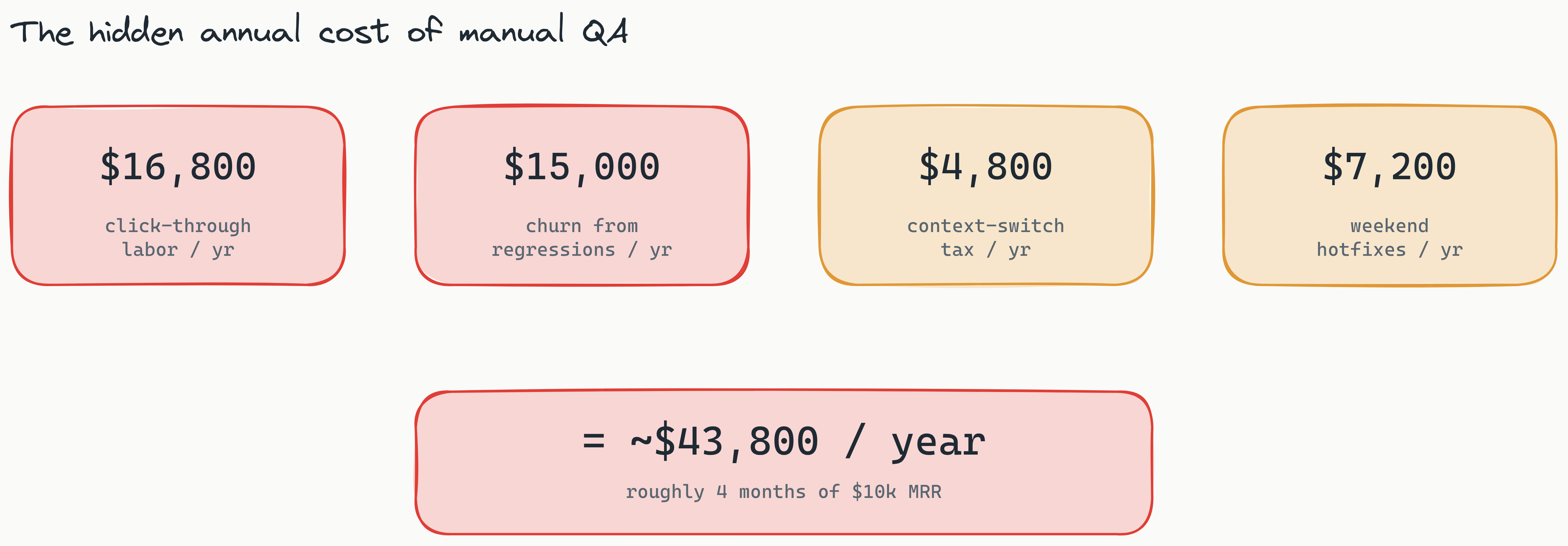
| Manual click-through QA (7 hrs/mo @ $200/hr) | $1,400 | $16,800 |
| Churn from undetected regressions (avg) | $1,250 | $15,000 |
| Context-switch tax (Friday afternoon focus loss) | $400 | $4,800 |
| Weekend hotfixes (1 per month avg, 3 hrs) | $600 | $7,200 |
| Total cost of "I'll just click through it" | $3,650 | $43,800 |
Forty-three thousand dollars. That is roughly 4 months of your MRR, evaporating annually into a problem you have convinced yourself is "just part of the job."
So why don't solo founders fix this?
Because the conventional fixes are also expensive - and they were not built for someone running solo. Let's look at the menu.
Option A: Hosted visual testing (Percy, Applitools, Chromatic)
These tools are good. They are also priced for funded teams. Percy starts from around $199/mo and climbs with overages. Applitools is gated behind sales calls, with public anchors starting at roughly $699/mo. Chromatic starts from around $179/mo. Add per-snapshot or per-seat overages and the bill only goes up. (For a deeper teardown, see Lastest vs Percy vs Applitools.)
None of these write the tests for you. You still need to author Playwright or Cypress specs by hand - and that is the part that breaks solo founders. Hand-written selectors snap the moment your DOM shifts, so the real recurring cost is not the subscription, it is the hours per month of "test maintenance" tax spent un-breaking specs you already wrote.
Option B: Outsource to a QA contractor
Upwork rates for E2E-capable QA freelancers run $30 to $60/hr. For solo SaaS coverage, you need at least 10 hours/month - call it $300 to $600/mo. But the real cost is coordination: writing test plans, reviewing reports, walking them through your stack, dealing with timezone gaps, re-explaining the Stripe webhook quirk every six weeks.
Add another 2-3 hours/month of your time at $200/hr and the true cost lands around $700 to $1,200/mo. Plus the contractor cannot push hotfixes for you on a Saturday.
Option C: Self-host Lastest
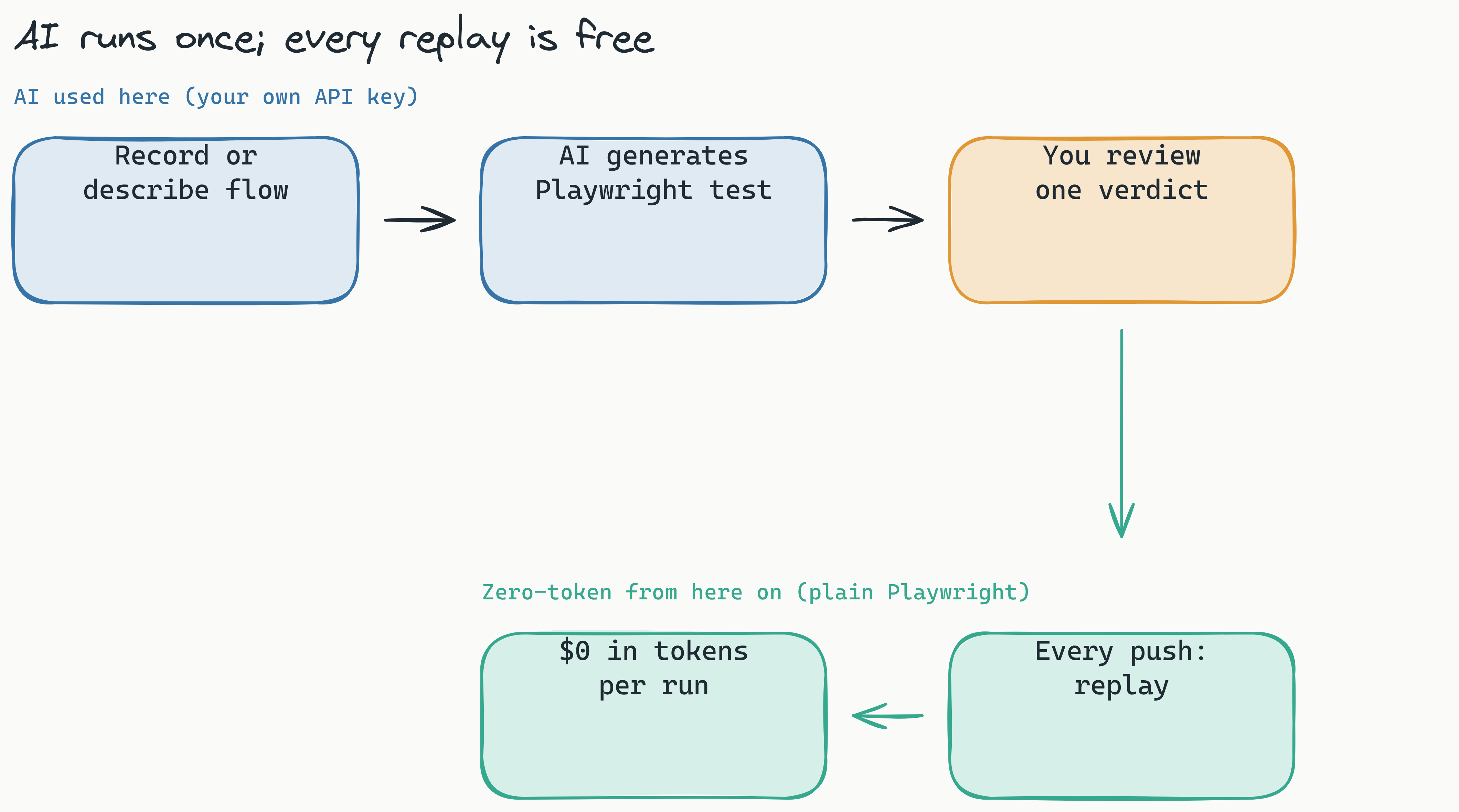
This is where the math breaks in your favor. Lastest is free to self-host, source-available (FSL-1.1-ALv2), and runs via docker-compose on a $5/mo VPS. You describe or record a flow once, AI generates a deterministic Playwright test, and a 7-layer self-healing selector fallback (data-testid → id → role → aria-label → text → CSS → OCR) keeps it running when your DOM shifts. Crucially, replays are zero-token: AI runs only when you create or fix a test, every replay is plain Playwright execution, so each run costs $0 and self-hosted screenshots are unlimited regardless of volume.
Test generation uses your own AI provider (Claude CLI, Anthropic API, OpenAI, OpenRouter, or a local Ollama model - no lock-in). For a solo SaaS authoring a handful of new tests per month and re-recording occasionally, that is a few dollars in tokens. Total all-in: roughly $15/mo. Prefer to skip the ops entirely? Lastest Cloud is $299/mo flat - no per-seat fees, no per-screenshot fees - with a free evaluation tier to start.
Table 2: The cost of each solution
| Solution | Monthly cost | Writes tests for you? | Self-healing? | Per-run cost |
|---|---|---|---|---|
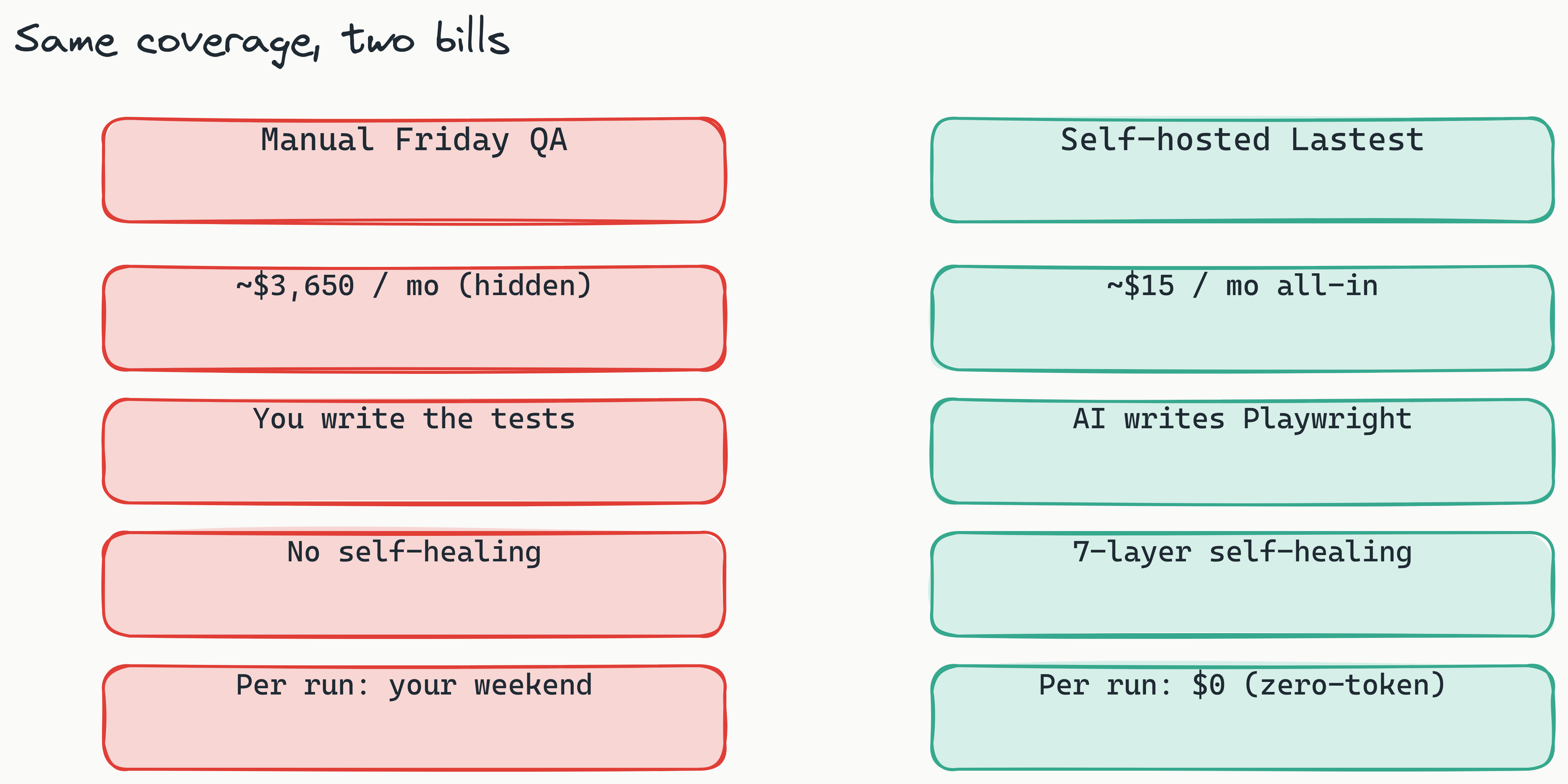
| Status quo (manual clicking) | $3,650 (hidden) | No | N/A | Your weekend |
| Percy / Chromatic | from $179-199 | No | Partial | Per snapshot overage |
| Applitools | from $699 | No | Yes (visual AI) | Per check overage |
| Upwork QA contractor | $700-1,200 (with coordination) | Sort of | No | Per hour |
| Lastest (self-hosted) | ~$15 | Yes (record-to-Playwright) | Yes (7-layer) | $0 |
How the cheap path actually runs
The reason the per-run cost collapses to $0 is the split between authoring and replay. AI touches the test exactly once - when you create or heal it - then every push after that is plain Playwright. Here is the loop end to end.
The delta is not just dollars
Pull back from the spreadsheet for a second. The gap between $3,650/mo and $15/mo is real, but it is not the whole story.
The thing the table cannot show you is cognitive overhead. The Friday afternoon dread. The "should I push this or wait until Monday?" flinch. The Saturday morning Slack ping that ruins brunch. The slow drift where you stop shipping bold changes because the QA tax on each push is too high. The founders who keep shipping fast after launch tend to be the ones who automate that friction, not the ones who power through it.
You did not become a solo founder to spend 8 hours a month being a human regression suite. You became a solo founder to ship.
What to actually do this week
- Time yourself for one week. Track every minute spent clicking through your app pre-release. Multiply by $200. Sit with the number.
- Spin up a $5 VPS. Pull github.com/las-team/lastest and run docker-compose up. It takes about 10 minutes.
- Record your three most-broken flows: signup, checkout, and the one billing edge case that bit you last month.
- Wire the generated Playwright tests into your existing CI (or just run them locally before each push).
- Reclaim your Friday afternoons.
The pitch is simple: stop paying yourself $200/hr to do work a $5 VPS can do for free. If you want the longer breakdown of how Lastest fits the solo founder workflow specifically, the solo founder page walks through the full setup, and this five-minute walkthrough shows a real flow going from record to green. Otherwise, self-host it free or grab the repo: github.com/las-team/lastest. Free, self-hosted, no credit card, no sales call. Or if you would rather skip ops, Lastest Cloud is $299/mo flat with a free tier to evaluate.
Your weekends are worth more than $43,800/year. Go get them back.