
For most of the history of visual regression testing, "diffing" has meant exactly one thing: take two PNGs, walk every pixel, light up the ones that changed. That model is simple, framework-agnostic, and ruthlessly literal - and it has run the field for fifteen years for a reason. It also has a ceiling. Every team that ships a visual regression suite eventually slams into the same wall: pixel diffs flag everything that looks different, including thousands of things no human cares about, and they tell you nothing about why the page looks different.
DOM diffing replaces the substrate. Instead of comparing two bitmaps, you compare two snapshots of the live document - a tree of nodes, attributes, and computed styles. The math underneath is no longer "is pixel (412, 88) the same color in both screenshots?" It's "did the node at main > section.hero > button.primary change, and if so, which property?" Same goal, completely different question.
What pixel diffs can and can't say
A pixel diff produces exactly one output: a mask. For every coordinate in the image, either the color matched within tolerance or it didn't. That output is honest but flat. It can tell you a region of the page is different. It cannot tell you:
- Whether the change is a layout shift, a color change, a font swap, or a new element entirely.
- Which DOM node owns the change - or whether one node moving caused a hundred others to also move.
- Whether the change is something a user would notice or sub-pixel rendering noise from a Chromium point release.
- Whether the change is intentional (a designer updated the spacing) or accidental (a Tailwind class got deleted).
You can paper over each of those with heuristics - ignore regions, anti-alias tolerances, perceptual color spaces, ROI cropping. We have shipped all of them, and they are why Lastest runs several false-positive reducers on top of raw pixels. They help, and they all have the same ceiling: the diff engine is reasoning about pixels and trying to recover semantic meaning that was thrown away the moment the page was rasterized.
What DOM diffing actually compares
DOM diffing skips the rasterization step entirely. Before (and after) the screenshot is taken, the engine snapshots the rendered document as structured data: the tree of elements, their attributes, their textual content, and their computed styles - the styles the browser actually applied after cascade, inheritance, and media queries resolved.
Comparison then runs against two trees. The output is no longer a pixel mask; it's a list of structural edits in the language the browser already speaks:
- Node added / removed. A new
<button>appeared inside.toolbar; an<img>disappeared fromarticle.card. - Attribute changed.
aria-expandedflipped from"false"to"true";hrefon the primary CTA changed. - Computed style changed.
display: flexbecamedisplay: gridon the dashboard wrapper;coloron a heading shifted from#0f172ato#1e293b. - Geometry changed. The bounding box of
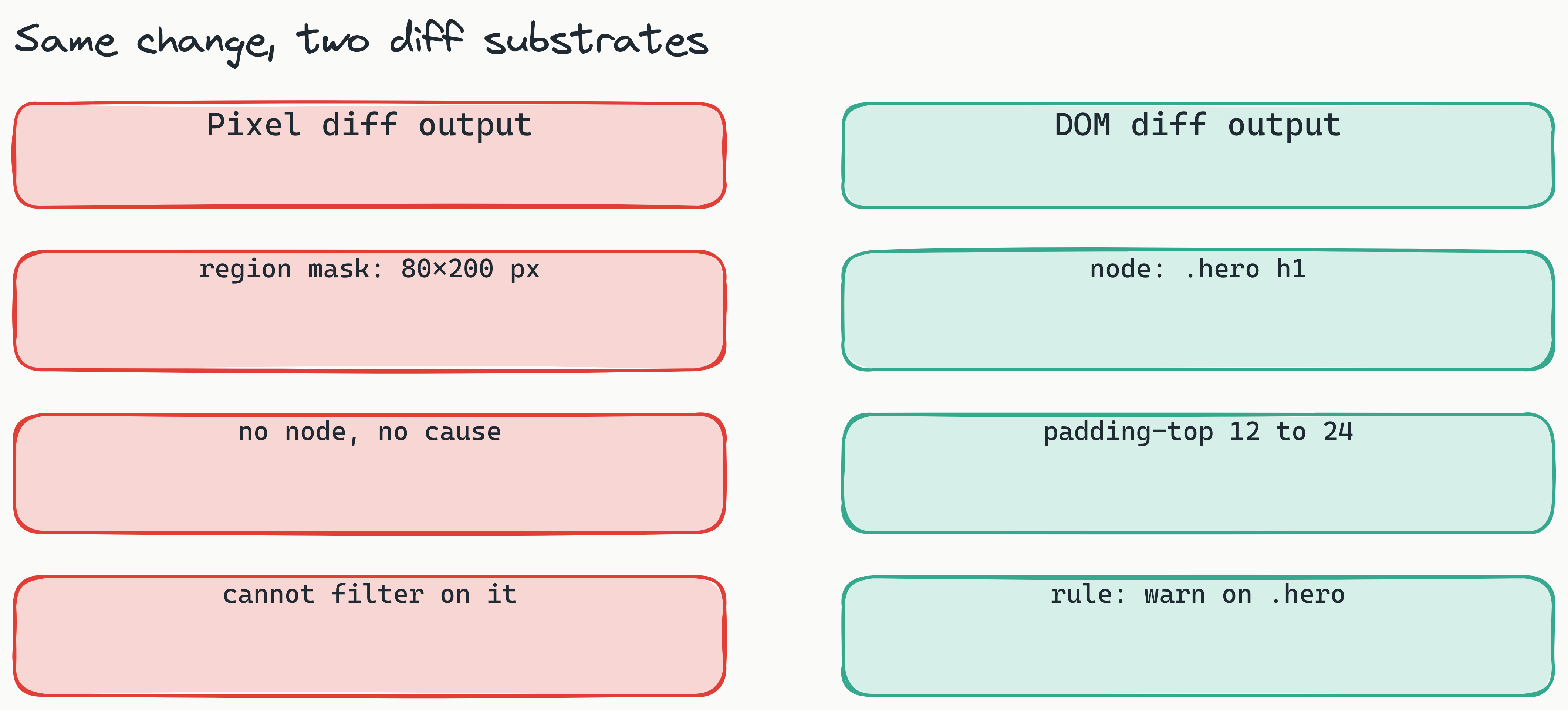
.hero h1moved 12px down because its parent gained a 12pxpadding-top. - Text content changed. The plan card's price label changed from
"$19/mo"to"$24/mo".
Each edit is attributed to a specific node, identified by a stable selector or path. The diff is no longer "this 80×200 region looks different." It's "this node, this property, this value, this delta." That's a different artefact entirely - one a human reviewer can scan in a fraction of the time, and one a downstream system can actually filter on.
What this changes about how comparison is done
The substrate switch - pixels to tree - has knock-on effects across the whole comparison pipeline. None of them are subtle.
1. Noise that used to dominate becomes invisible
Sub-pixel font rendering, anti-aliasing variations between Chromium builds, GPU compositing differences between machines, scrollbar widths between operating systems - the entire long tail of "pixels changed but nothing meaningful changed" disappears. The DOM doesn't have anti-aliasing. The computed style for font-size is 16px on every machine that runs the test. Two trees that describe the same page produce zero diffs, even when the rasterized PNGs differ at thousands of pixels.
This is the single biggest reason teams adopt DOM diffing: it kills the false-positive engine that makes pixel-only suites untrustable in CI.
2. One change is reported as one change
Pixel diffs have no notion of cause and effect. If you change flex-direction on a parent, every child reflows, and the diff lights up dozens of disconnected regions. A reviewer has to re-derive that "they're all the same change." DOM diffing reports the actual edit at the parent node, and optionally the cascade of geometry changes underneath it. One diff entry, one root cause. The signal-to-noise ratio collapses by an order of magnitude.
3. Diffs become filterable, not just reviewable
Once every change is a structured edit, you can write rules over them. Ignore data-testid attribute changes. Ignore text-content changes inside time elements. Fail loudly on color changes inside .btn--primary but warn-only on color changes inside .muted. None of those rules are expressible against a pixel mask. All of them are expressible against a tree of computed-style edits, and they let teams encode their actual review policy instead of eyeballing every flag.
4. Selectors, not coordinates, become the unit of approval
When a reviewer accepts a change in a pixel-diff system, they're saying "this region of pixels is the new truth." The next time the page renders one pixel differently in that region, the system has nothing to compare against beyond the new bitmap. With a DOM-anchored baseline, approval is attached to a node selector and a property: "padding-top on .hero is now 24px, approved." A baseline composed of selector-keyed facts ages dramatically better than a baseline composed of frozen PNGs - the page can be re-rendered, re-themed, even re-skinned, and the approved facts still resolve to something meaningful.
5. The diff explains itself in code-level terms
A pixel diff hands a developer a screenshot. A DOM diff hands a developer something they can grep for: a selector, a property name, a before-and-after value. The path from "the test failed" to "the offending CSS rule" stops being a visual hunt and becomes a lookup. For a team running an AI agent that writes the code in the first place, this matters even more - the agent can read the diff, locate the rule in its own diff, and propose a fix without anyone screenshotting anything.
What DOM diffing won't catch
It would be irresponsible to leave the impression that DOM diffing replaces pixel diffing. It does not. The DOM is a description of intent - "render this node with this style." Rasterization is what the user actually sees. There are real bugs that live entirely in the gap:
- Image and canvas regressions. An
<img>whosesrcdidn't change but whose underlying asset got swapped will look identical to a DOM diff and very different to a user. - Renderer bugs. A browser version that decides to anti-alias a font slightly differently, or a GPU driver that botches a backdrop-filter, will leave the DOM untouched and rewrite the pixels.
- SVG and complex graphical content. The DOM tree of a complex SVG tells you almost nothing useful; the rasterized output tells you everything.
- Fonts that fall back silently. A web font that fails to load and falls back to a system font keeps its
font-familydeclaration intact - the DOM diff is clean, the screenshot is wrong.
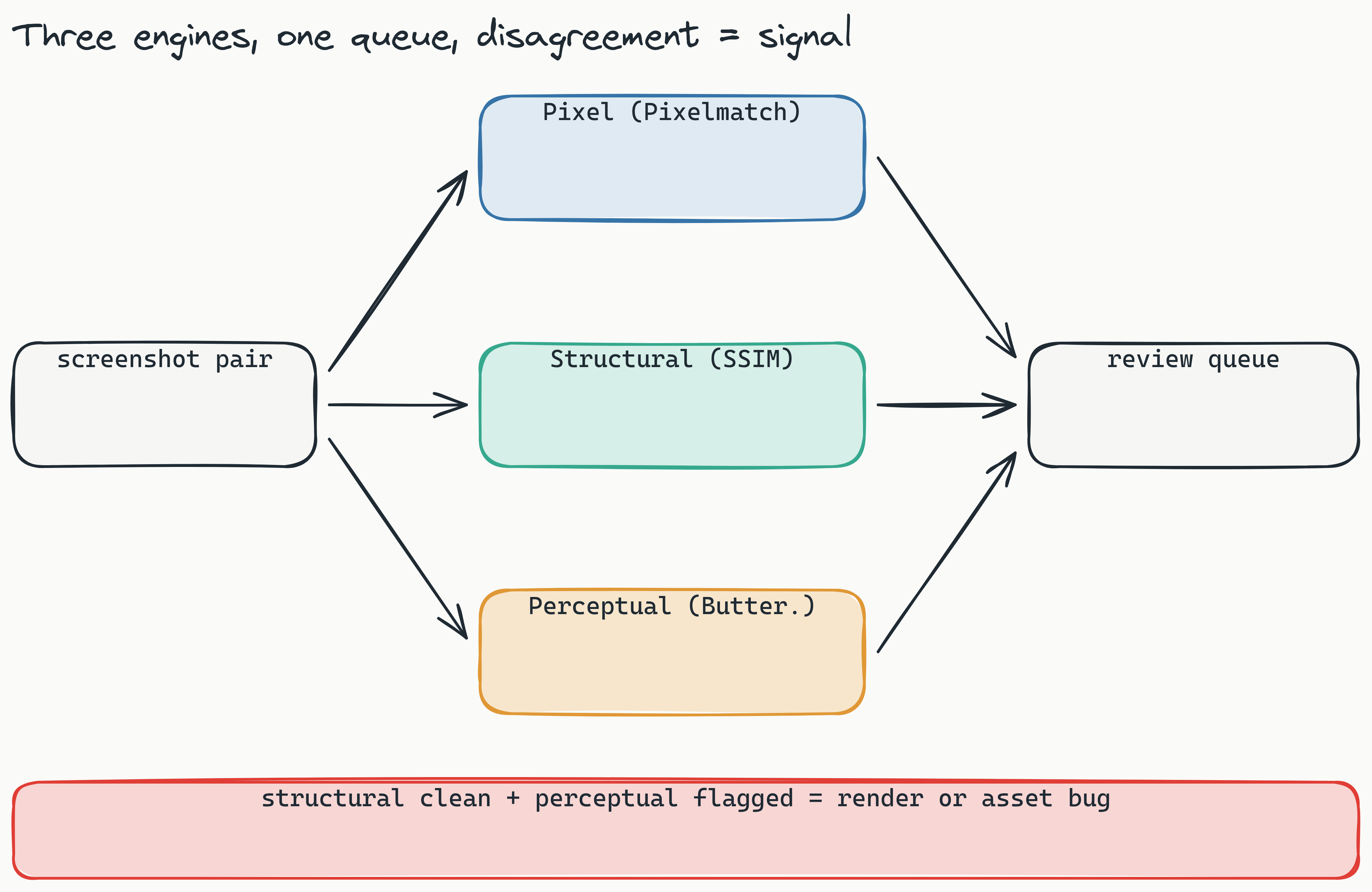
The right answer is the obvious one: run more than one engine. Lastest ships three and runs them side by side: Pixel (Pixelmatch, pixel-perfect and fast but noisy), Structural (SSIM, DOM and layout aware), and Perceptual (Butteraugli, aligned to the human eye, so it ignores anti-aliasing and font noise but still catches real rendering bugs). Use the structural and DOM-aware signal as your primary read because that's where most of the regressions you actually care about live, and keep the perceptual and pixel engines as the backstop for the categories above. The engines disagreeing is itself a useful signal - a clean structural diff with a flagged perceptual diff almost always indicates a rendering or asset bug, which is exactly the bug a structure-only system would miss.
Where this lands in practice
The dashboard clip above is a DOM-anchored comparison running against a baseline. The thing to notice in the UI isn't the colors or the layout - it's that every flagged change resolves to a node in the tree, with the property that changed and the value it changed to. A reviewer looking at that screen is making decisions about elements, not about regions. That changes the cognitive load enough that approval-per-test stops being the bottleneck it usually is.
If you want the long version of the architecture - how we run pixel, structural, and perceptual diff engines together and let them disagree on purpose - the validation frontier piece covers it, and our guide to diffing React components shows the same idea applied component by component. Lastest's diff engines are part of a larger story: zero-token replays (the AI runs only when you create or fix a test, every rerun after that is plain Playwright at $0 in tokens), self-healing selectors, AI failure classification, and WCAG 2.2 AA scoring on every screenshot.
Stop asking the diff engine to recover meaning from pixels. Hand it the tree the browser already had. Lastest is open source under FSL-1.1 and free to self-host forever on your own infra with unlimited screenshots, or you can skip the ops and run Lastest Cloud at a flat $299/month with no per-seat or per-screenshot fees. The full source lives on GitHub.