Three years ago the hard part of shipping software with an AI agent was getting the agent to produce something that compiled. Two years ago it was getting it to produce something that ran. One year ago it was getting it to produce something that passed a unit test. Today, all of those problems are mostly solved - an agent will happily generate a working, tested, deploy-ready feature in an afternoon.
And yet shipping is still slow. The reason is that the bottleneck has quietly moved. The new hard part isn't generating a candidate change. It's deciding whether the candidate change is the one you actually wanted. That decision - cheap, repeatable, trustable validation - is the frontier of AI development. Everything before it has been industrialised. Everything after it is downstream of getting validation right. This post is about why validation is the last unsolved stage, and what a validation layer has to look like to actually clear it.

Validation has to answer two questions, not one
This is the part most teams get wrong on the first try, and it is the reason their first attempt at “just have CI run a screenshot diff” quietly underperforms. Validation is not one check. It is two distinct checks, and the agent can fail either of them independently:
- Nothing is broken. Whatever was working before the change is still working after the change. No layout regressions, no contrast collapses, no missing icons, no silently dead buttons. This is the regression-safety question, and it is asked against the previously approved baseline.
- What was built matches what was expected. The change actually does the thing the spec, the ticket, the Figma, or the prompt asked for. The agent didn't hallucinate a different feature, didn't silently re-interpret the brief, didn't ship something that “looks reasonable” but isn't the asked-for design. This is the intent-conformance question, and it is asked against the spec or the design.
Both questions can fail green-but-wrong. A change can be a perfect implementation of the wrong intent and break nothing - the regression check passes, but the work is junk. A change can also nail the brief and incidentally break something three pages over - the intent check passes, but a regression shipped. Either failure mode loses you a day; both failure modes together lose you a sprint. You need both checks, and you need them in the same loop.
The good news is that the substrate is the same. Visual diffs against the previously approved baseline answer the regression-safety question. Visual diffs against an uploaded design or an expected screenshot answer the intent-conformance question. Same diff engines, same review surface, same human-approves-once seam - just two different references being compared.
The three-stage AI dev loop, and why two of the three are commodities
If you squint, every AI-driven development workflow looks the same. There are three stages:
- Generate. An agent writes a change - new code, a refactor, a config bump, a test.
- Validate. Something decides whether that change is acceptable to ship.
- Replay. The accepted artefact runs forever, deterministically, on every PR and every deploy.
Two of those three stages are now commodities.
Generation is a commodity because there are a dozen agents that will one-shot a feature, and the marginal cost of asking another one is roughly free. Replay is a commodity because the moment you have a deterministic artefact - a Playwright script, a recorded HTTP trace, a baseline screenshot - rerunning it costs essentially nothing. CI minutes are not the constraint they used to be.
The constraint is in the middle. Validation is where the loop stalls, and it stalls in the most expensive way possible: with a human staring at a diff trying to decide if a 3-pixel font shift is a regression or a Tuesday.
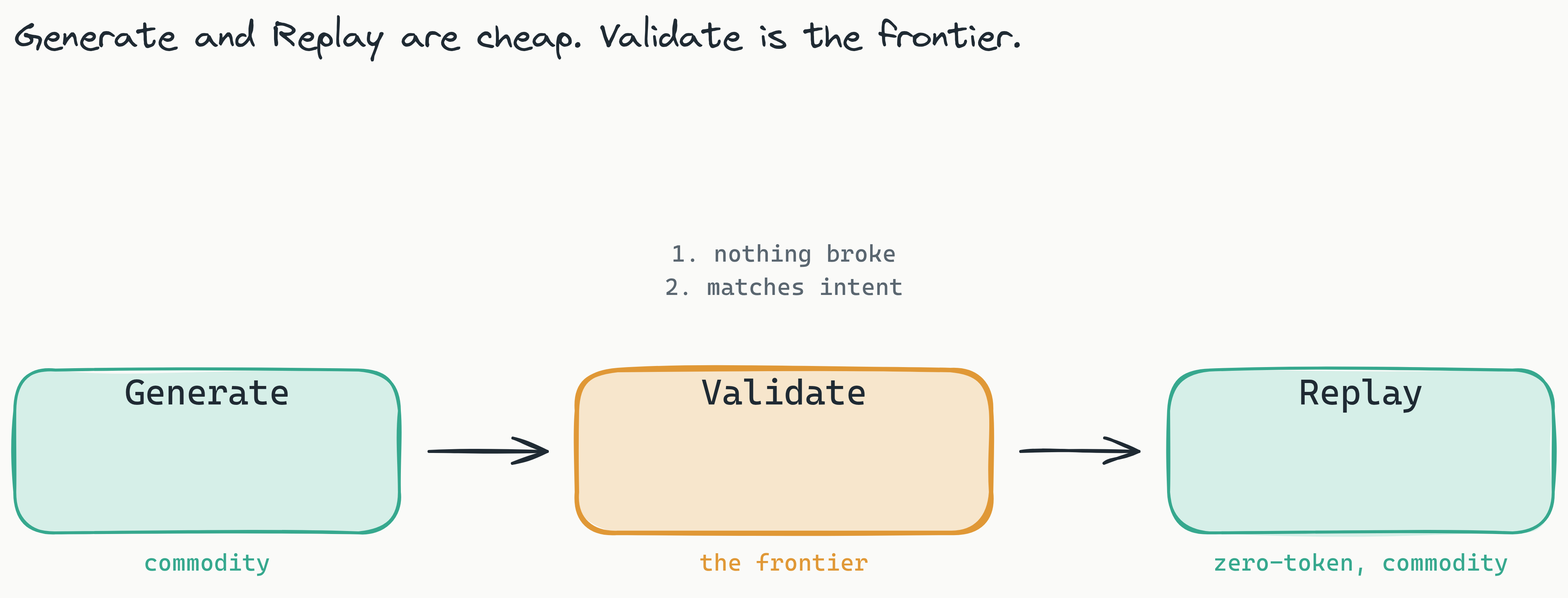
Zero-token replays make this lopsidedness even sharper. With Lastest, the AI runs only when you create or fix a test; every replay after that is plain Playwright execution at no token cost, so you can rerun a suite thousands of times a day for nothing. When replay is free and generation is near-free, validation is the entire cost of the loop.
Why the easy validation strategies don't reach the frontier
Engineers reach for the validation tools they already own. None of them go all the way.
Type checks
Type checks catch one specific category of bug: "you passed a thing of the wrong shape to a function." That is a real category. It is also a vanishingly small fraction of the bugs an agent can introduce. A perfectly typed function can return the wrong number, render the wrong layout, lose user data, or silently swap the meaning of a UI element. The compiler will sign off on all of it.
Unit tests
Unit tests are excellent at locking in pure-function behavior. They are bad at catching everything that isn't a pure function. The most common AI-introduced bug we see - a "fixed" component that quietly mis-renders an entire dashboard region - will sail through every unit test in the repo because the unit test was written against the function, not against the rendered DOM, and certainly not against the rendered pixels.
Scripted E2E
Scripted Playwright/Cypress tests are closer, but they have two structural problems. First, they only check what they were told to check - "click login, expect dashboard." If the dashboard renders entirely white because a Tailwind class was deleted, the assertion expect(page).toHaveURL('/dashboard') still passes. Second, the cost of writing and maintaining them grows with the surface area of the app. The same agent that generates features at 10x will generate broken selectors at 10x, and now you are debugging tests instead of code. (Resilient selectors help: Lastest uses a 7-layer selector fallback - data-testid, id, role, aria-label, text, CSS, then OCR - so a refactor that moves a button doesn't silently break the test. But selector resilience is a generation problem, not the validation problem this post is about.)
LLM-as-judge
"Just have another LLM look at the change" is the most seductive answer and the most dangerous one. It works on the demo. It does not work in a tight loop where you ship dozens of changes a day. The judge hallucinates approvals, anchors on the agent's own framing, and produces no audit trail a human will actually trust at 4pm on a Friday before a release. It is fine as a triage layer. It is not validation.
What the frontier actually looks like
The validation strategy that actually clears the frontier has four properties. We landed on these the hard way, by trying every weaker approach first.
1. The diff is visual, and it runs against two references
The cheapest signal that something is wrong with an AI-generated change is also the most direct: the page looks different. Not “a function returned a different value.” Not “a test assertion failed.” A visual diff catches every category of regression that ends in a user noticing - layout shifts, color regressions, missing icons, broken responsive breakpoints, mis-rendered components, dropped translations - in one signal.
The frontier-clearing trick is that the diff runs against two references, not one. Against the previously approved baseline, the diff answers “did anything that was working break?” Against the uploaded spec or design, the diff answers “did the thing we asked for actually get built?” Same engine, same review surface, two different reference frames. A change that flips both red is the agent confidently shipping the wrong feature in a way that also breaks something else - rare, but exactly the failure mode that LLM-as-judge will rubber-stamp.
Crucially, neither diff requires you to know in advance what to assert on. Which is the only validation strategy that scales when an agent is making 50 small changes a day.
2. There are multiple diff engines, and they disagree on purpose
Pixel, structural, and perceptual diffing catch different things, and Lastest ships all three: Pixelmatch (pixel-perfect, fast, noisy), SSIM (structural, DOM and layout aware), and Butteraugli (perceptual, aligned to the human eye). Pixel diff catches everything - including 1-pixel anti-aliasing noise. Structural diff catches layout shifts but ignores font-rendering jitter. Perceptual diff models human vision and ignores everything a human wouldn't notice.
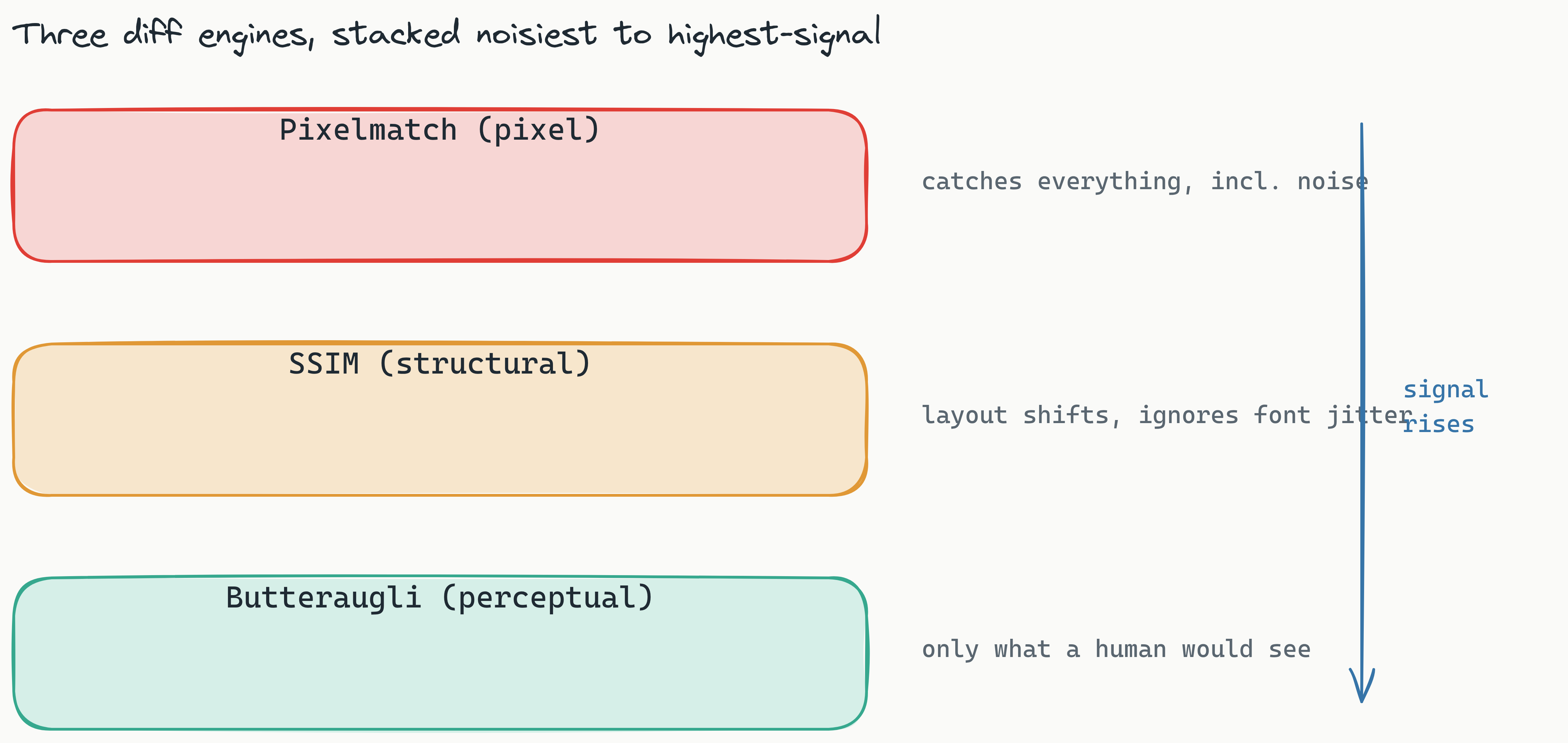
You want all three because they fail in different directions. A change that flips pixel diff red but leaves structural and perceptual green is almost always cosmetic noise. A change that flips structural red is almost always a real layout regression. A change that flips perceptual red - the rarest signal - is a "your user will absolutely see this" alarm. Three engines, one verdict, made cheap to compute. On top of the raw diff, every failure is auto-classified as real regression, flaky, environment, or test-maintenance with a confidence score, so the human is not the one sorting noise from signal.
3. There is a human in the loop, but only at the seam
"Human in the loop" is one of those phrases that has been worn smooth by overuse. The version that actually matters is narrower: a human approves the change, exactly once, at the moment the new behavior is established as canonical.
That is it. The human does not run the test. The human does not write the assertion. The human does not babysit the agent. The human looks at a baseline-vs-current diff, decides "yes, that's the new truth" or "no, the agent broke something," and clicks one button. Every replay forever after that point happens with zero further human attention.
This is the only point in the loop where human judgment is irreplaceable, and it is also the only point where it scales - because the human only sees changes that the diff engines flagged as worth seeing. Concretely, the reviewer renders one of three verdicts (pass, fix, or regression) and the AI never approves its own output. We unpack why that single seam is the thing that survives rollout in the human-in-the-loop verification seam, and why most teams stall trying to engineer it away in the 2026 AI testing scale gap.
4. There is an audit trail, because trust requires receipts
The dirty secret of AI development is that nobody trusts the agent yet, and nobody should. The validation layer has to leave receipts: who approved which baseline, when, against which diff engine, with which screenshot. Not because regulators ask - though, increasingly, they do - but because three weeks from now somebody will ask "when did this change land?" and you will need an answer that doesn't depend on the agent's memory.
This is the part that LLM-as-judge can't do. An audit trail of "another model approved it" is not an audit trail at all. It is a confidence trick.
What this means for the next year of agentic development
The teams that are shipping fastest with agents right now are not the ones with the best agents. They are the ones with the best validation. They have made the diff cheap, the human-in-the-loop seam clean, and the audit trail automatic. They use the agent to generate, the diff engines to validate, and the deterministic replay to lock in. The agent never approves its own work. A human approves it, once, and the system remembers.
The teams shipping slowly with agents are the ones that have nailed generation and assumed validation will sort itself out. It will not. The thing about a frontier is that you cannot get past it by being faster on the well-mapped side of the line.
Where Lastest sits in this picture
We built Lastest to be exactly the validation layer described above, because we hit the wall ourselves. The Play Agent is an 11-step pipeline of specialised sub-agents (orchestrator, planner, scout, diver, generator, healer, and more) that plan, generate, run, and fix Playwright tests by exploring a target app - and you can pause, approve, or skip any step. The three diff engines (Pixelmatch, SSIM, Butteraugli) make sure the right kind of regression flags the right alarm. A reviewer dashboard exists for one purpose: make the human approval seam fast and obvious, with one of three verdicts per change. WCAG 2.2 AA scoring runs axe-core on every screenshot, and an audit trail gives every approved baseline an owner and a timestamp. You bring your own AI (Claude, OpenAI, OpenRouter, or local Ollama), and an MCP server with roughly 20 tools lets coding agents like Cursor and Claude Code drive the whole thing.
That is the frontier. That is where every team using agents to write features is going to end up sitting in the next twelve months, whether they build it themselves or use something off the shelf. We made ours open source on GitHub because validation infrastructure is too important to be the thing that locks you into a vendor.
Two ways to start. Self-host Lastest for free, forever - open source under FSL-1.1, your infra, unlimited screenshots and replays, screenshots that never leave your network. Or skip the ops and run Lastest Cloud at a flat $299/month: no per-seat fees, no per-screenshot fees, and replays stay zero-token regardless of how many times a day you run them. If you are a vibe coder shipping agent-generated features, this is the layer that lets you trust what just got built. Either way, the point is the same: stop optimising the part of the loop that's already cheap, and go put your effort where the bottleneck actually is.