
A visual bug that reaches production is the cheapest defect to introduce and one of the most expensive to live with: it erodes user trust on the exact surface where credibility is formed. For QA managers the squeeze is structural. Modern apps ship multiple times a day across dozens of browser and device combinations, and traditional pixel-diff tools answer that velocity by drowning teams in false positives, stalling pipelines and burning out engineers while the regressions you actually care about still slip through.
This guide compares the visual testing tools for QA managers use in 2026 across the three dimensions that decide whether the tool helps or hurts: cost predictability, CI/CD automation, and AI diff intelligence. Whether you lead a three-person startup team or an enterprise QA org, the goal is the same, turning visual testing from a bottleneck into a release accelerant. We will use Lastest, an open-source platform you can self-host for free, as the worked example throughout.
Why QA Managers Need a New Approach to Visual Testing in 2026
The scaling problem is simple but painful. A typical e-commerce application might have 500 components, each rendered across Chrome, Firefox, Safari, and mobile viewports. With traditional pixel-diff tools, that means 2,000 baseline snapshots per test run. When a single CSS change triggers 150 false positives because of sub-pixel rendering differences, the CI pipeline grinds to a halt.
Most teams start on a commercial free tier, a few hundred snapshots a month, one seat, limited history. As the team grows to five engineers running 20 builds a day, that free tier quietly becomes a subscription line item that scales with every commit. The "freemium trap" is real: tools that cost nothing to try get prohibitively expensive at scale, and switching costs lock teams into vendor relationships they never meant to form.
The deeper problem is technical. Pixel-based comparisons cannot tell a meaningful layout shift apart from a harmless anti-aliasing difference. Modern UIs lean on animations, lazy-loaded images, custom fonts, and dynamic content that all trip simple diff engines. QA managers need a tool that understands structure and human perception, not just raw color values.
Why do traditional pixel-diff tools fail in modern CI/CD pipelines?
Traditional pixel-diff tools compare images pixel-by-pixel, which generates excessive false positives from harmless changes like sub-pixel rendering, anti-aliasing differences, and dynamic content. AI-powered tools that combine structural and perceptual diff engines are necessary to eliminate noise and maintain pipeline velocity.
For visual testing tools for QA managers evaluating their options in 2026, the ideal solution balances three things: predictable pricing that scales with the team, seamless CI/CD integration that eliminates manual bottlenecks, and AI intelligence that reduces noise to zero.
How Much Do Visual Regression Testing Tools Actually Cost?
Visual regression tooling ranges from $0 (self-hosted open source) to four figures a month for enterprise SaaS plans. Understanding the underlying pricing model matters more than any single sticker price, because the model is what decides whether your bill grows with your test coverage.
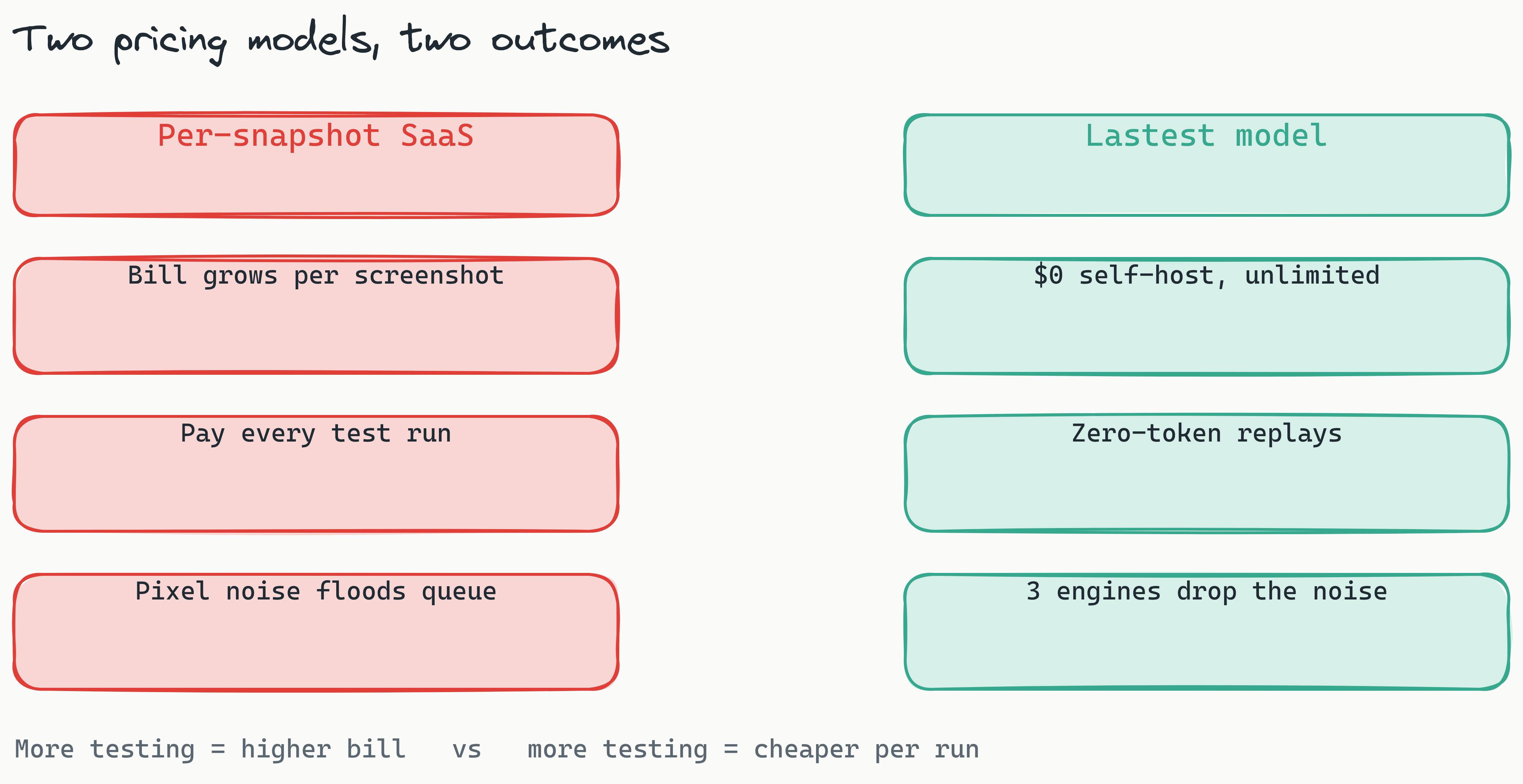
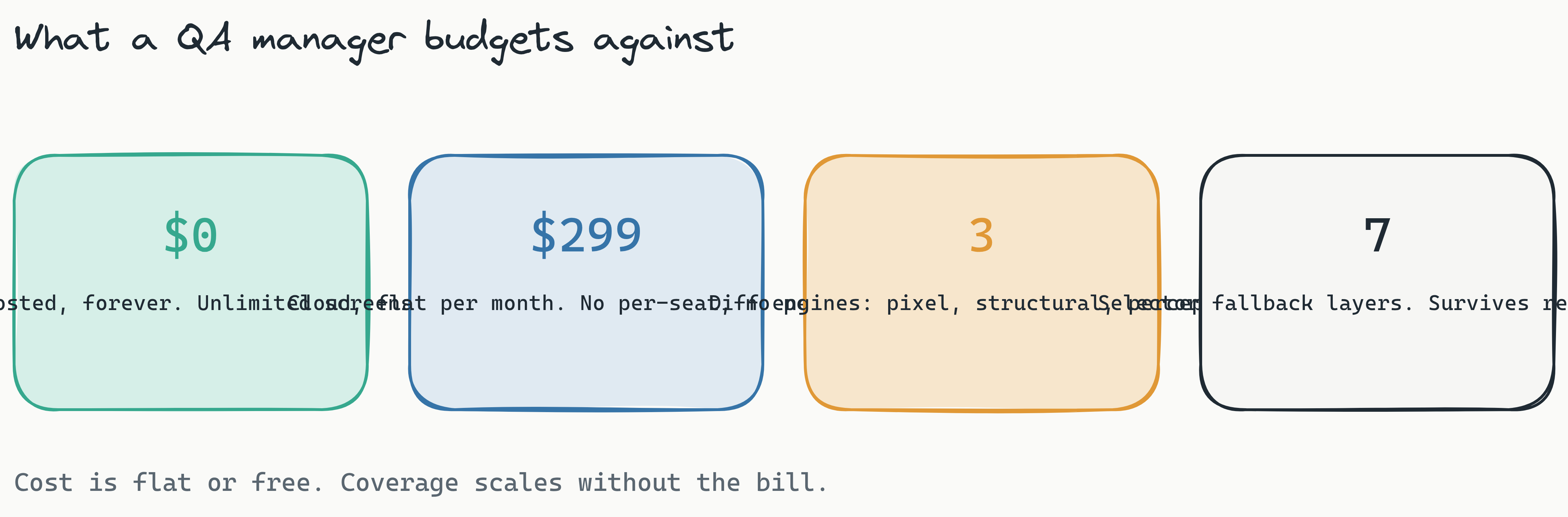
Two model shapes dominate. Per-snapshot tools like Percy (BrowserStack, from around $199/mo) and Chromatic (from around $179/mo) bill against the number of screenshots you capture, so the bill climbs every time you add a component or a viewport. Per-test-run tools like Applitools (from around $699/mo) bill against execution volume. Both punish the teams that iterate most. Lastest breaks the pattern: self-hosted is $0 forever with unlimited screenshots and replays, and Lastest Cloud is a flat $299/month, no per-seat and no per-screenshot fees.
Here is a direct comparison for a team of 10 engineers running 500 builds per month. Competitor numbers are entry-tier list prices and grow with usage; treat them as "starting at":
| Tool | Starting Price (Cloud) | Self-Hosted Option | AI Diffs Included? | Estimated Monthly Cost (Team of 10) |
|---|---|---|---|---|
| Percy (BrowserStack) | from ~$199/mo | No | Limited | Scales with snapshots & seats |
| Applitools Eyes | from ~$699/mo | Enterprise only | Yes | Scales with test runs |
| Chromatic (Storybook) | from ~$179/mo | No | Basic | Scales with snapshots & seats |
| Lastest | $299/mo (flat) or $0 self-hosted | Yes (free, FSL-1.1) | Yes (3 engines) | $299 flat (Cloud) or $0 (self-hosted) |
Percy and Applitools offer strong features, but their pricing escalates quickly for teams running hundreds of builds a day. The per-snapshot and per-run models both penalize frequent iteration, and enterprise plans often add annual contracts and minimum seat commitments on top. For a deeper teardown see our Lastest vs Percy vs Applitools comparison.
What is the most cost-effective visual testing pricing model for growing teams?
The most cost-effective model decouples cost from execution volume. Lastest runs AI only when you create or fix a test; every replay afterward is plain Playwright execution that consumes zero tokens. Self-hosted, screenshots and replays are unlimited at any volume. So the per-run cost trends toward zero as usage grows, the opposite of per-snapshot models that get more expensive the more you test.
The mechanism behind fewer false positives is concrete, not a vague promise. Combining structural and perceptual diffing with pixel diffing lets the engines ignore anti-aliasing and font-rendering noise that single-engine pixel tools flag as failures, so reviewers spend their time on real regressions instead of triaging sub-pixel jitter. See how to reduce visual-testing false positives for the full method.
How to Automate Visual Testing in Your CI/CD Pipeline
Automation is the core value proposition of visual regression testing. A tool that requires manual review of every snapshot defeats the purpose. The goal is to integrate visual checks directly into the existing CI/CD pipeline with zero friction.
For Lastest, setup is straightforward because the tool is Docker-ready. A single docker-compose up command starts the entire infrastructure-the web dashboard, the AI diff engines, and the result storage. Here's a minimal GitHub Actions workflow that runs visual tests on every push:
name: Visual Regression Tests
on: [push]
jobs:
  visual-diff:
    runs-on: ubuntu-latest
    steps:
      - uses: actions/checkout@v4
      - name: Run Lastest
        run: |
          docker-compose up -d
          npx playwright test
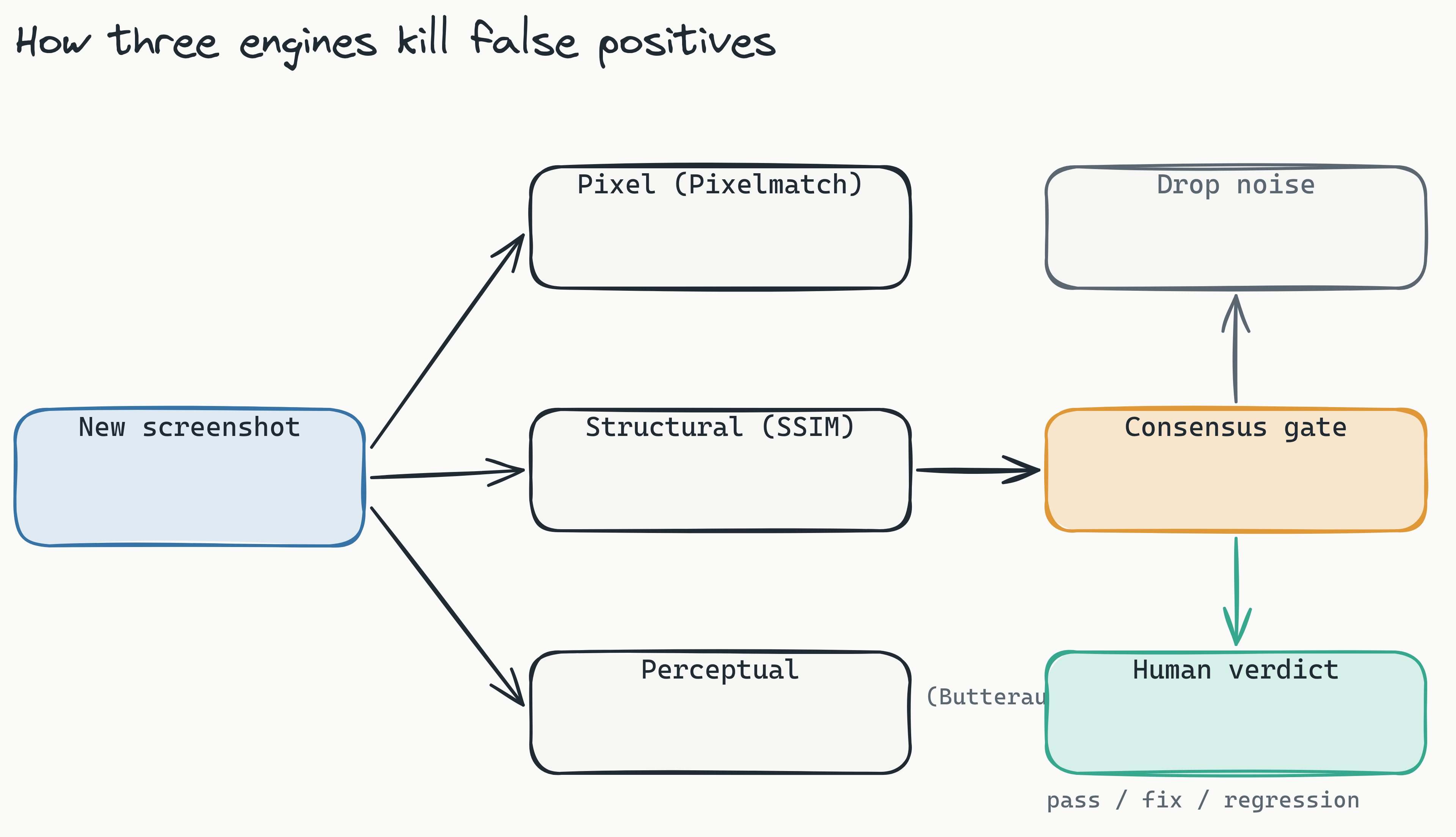
The key innovation is the three-diff-engine architecture. When Lastest compares a baseline to a new screenshot, it can run three separate engines, each tuned for a different failure mode:
- Pixel (Pixelmatch): fast, pixel-perfect comparison. Catches exact mismatches but is noisy on rendering differences.
- Structural (SSIM): structural-similarity scoring that is layout-aware, so it weights real geometric shifts over flat color noise.
- Perceptual (Butteraugli): a human-eye-aligned metric that catches changes a person would actually notice while ignoring anti-aliasing and font-rendering noise.
When the structural and perceptual engines agree a change is insignificant, the noisy pixel result stops mattering. That is what kills the false positives that plague single-engine tools. Stabilization helpers (OCR-aware text-region diffing, timestamp freezing, network-idle and font-load waits, auto-masking of dynamic content) keep screenshots consistent across machines so the comparison is fair in the first place. Only genuine failures, a missing button, a broken layout, a shifted nav, reach the human reviewer.
And because AI runs only when a test is created or fixed, every subsequent replay consumes zero tokens. Teams can run visual checks on every commit without ever watching a per-run meter.
How does the three-diff-engine approach eliminate false positives?
The three engines, pixel (Pixelmatch), structural (SSIM), and perceptual (Butteraugli), each judge a different kind of change. Pixel catches exact mismatches, structural weights real layout shifts, and perceptual mirrors what a human eye would notice. When the structural and perceptual engines agree a difference is harmless, the noisy pixel result is discounted, so anti-aliasing and dynamic-content jitter stop reaching the review queue.
Can Open Source Visual Regression Testing Compete with Enterprise SaaS?
Yes-open source visual regression testing tools like Lastest now offer enterprise-grade features without the enterprise vendor lock-in. The traditional objection is that open source lacks polish, support, and advanced AI capabilities. That objection no longer holds.
The trade-offs are clear. Enterprise SaaS tools like Percy and Applitools provide managed infrastructure, automatic scaling, and dedicated support. In exchange, teams surrender control over their data, commit to recurring monthly costs, and accept that feature development follows the vendor's roadmap.
Self-hosted open source tools offer the opposite value proposition: total control over data and infrastructure, zero recurring cost, and the freedom to customize every part of the pipeline. Lastest ships under an FSL-1.1 license that converts to Apache 2.0 over time, with the full source on GitHub. For teams in GDPR-heavy jurisdictions, self-hosting is not just a cost-saver, it is a data-residency answer: screenshots never leave your network.
That matters because UI screenshots can contain customer data, internal tooling, and pre-release features. A self-hosted AI-powered visual testing tool keeps all of that inside your own perimeter instead of shipping it to a vendor cloud, which is a recurring requirement for European enterprises and regulated industries.
The practical trade-off is infrastructure management. Enterprise SaaS handles uptime, backups, and scaling for you. Self-hosting asks for some DevOps ownership of the containers and storage, though Lastest is designed to keep that light. For a team that already runs a CI/CD pipeline and is comfortable with Docker, the trade-off strongly favors self-hosting.
When should teams choose self-hosted open source over enterprise SaaS for visual testing?
Teams should choose self-hosted open source when they prioritize data sovereignty, cost control, and customization over managed infrastructure. Self-hosting is especially valuable for European teams subject to GDPR, teams with existing DevOps expertise who can maintain Docker containers, and organizations that need unlimited scalability without per-snapshot pricing.
Why Small Teams and Startups Are Switching to Lastest
For startups and small teams, the visual testing decision comes down to speed and friction. A team of three engineers cannot afford to spend a week evaluating tools or negotiating contracts. They need something that works within an hour and costs nothing until the product validates.
The free self-hosted version of Lastest meets that need exactly. No credit card, no sales call, no minimum seat count. A single developer can have visual testing running in CI within an afternoon, and SaaS MVP teams and solo founders are exactly who that path is built for.
The token-cost shape is the other advantage. AI runs only when you create or fix a test; the resulting baseline replays as plain Playwright, free, on every commit thereafter. Unlike per-snapshot pricing that bills you for iterating quickly, this aligns cost with value: you pay (in tokens) once when you author or heal a test, not every time it runs. And you bring your own AI provider, Claude, OpenAI, OpenRouter, or local Ollama models, so even the generation cost is yours to control.
For a startup with a fast-moving UI, that shape is transformative. Per-snapshot tools bill more as you add components and builds; self-hosted Lastest stays at $0 of platform cost regardless of volume. You keep comprehensive visual coverage across the whole app without watching a meter climb every sprint.
Which Tool Should Your QA Team Choose in 2026?
The right visual testing tool for your QA team depends on your budget, your infrastructure preferences, and your tolerance for false positives. No single tool works for every organization, but the decision framework is consistent.
Choose Percy or Chromatic if: You're already deeply invested in a vendor ecosystem (BrowserStack or Storybook) and value managed cloud snapshots over cost control. These tools are polished and well-supported, but expensive at scale.
Choose Applitools if: You need the most advanced AI-powered visual testing available and have the budget to pay for it. Applitools' AI is industry-leading, but the pricing model favors larger enterprises.
Choose Lastest if: You want cost control (free self-hosted), data sovereignty (self-hosted or EU cloud), and AI-powered diffs that eliminate false positives. Lastest is the strongest option for teams that value flexibility and predictable pricing over vendor lock-in.
For most QA managers evaluating visual testing tools for QA managers in 2026, the decision comes down to one question: Do you want to pay per snapshot forever, or do you want a tool that gets cheaper as you use it more? The answer should guide your choice.
Frequently Asked Questions
Is visual regression testing worth the investment for small teams?
Yes. Even a single visual bug reaching production can erode user trust and increase support costs. With free self-hosted options available, the investment is minimal and the ROI from preventing regressions is immediate.
How long does it take to set up an AI-powered visual testing tool?
Most Docker-based tools like Lastest can be running with baseline snapshots within 30 minutes. CI/CD integration for GitHub Actions or GitLab CI typically adds another 15–30 minutes.
What is the difference between pixel diff and structural diff?
Pixel diff compares images pixel-by-pixel and flags any color or position change. Structural diff analyzes the DOM tree and element positions, so it can ignore harmless rendering differences like anti-aliasing and focus on meaningful layout shifts.
Can visual testing tools handle dynamic content like animations?
Only tools with perceptual AI engines can reliably handle dynamic content. Perceptual diff uses computer vision to determine whether a human would perceive a change as different, filtering out animated transitions and lazy-loaded images.
Do I need to be an expert in Docker to use self-hosted Lastest?
Basic Docker knowledge is sufficient. The tool provides a docker-compose up command that starts all services automatically. Teams without Docker experience can use the cloud version starting at $299/month.
How does data sovereignty work with self-hosted visual testing?
With self-hosted tools, all screenshots and test data remain on your own servers. This is essential for GDPR compliance in Germany and other European jurisdictions where data residency requirements are strict.
Stop Chasing Pixels, Start Releasing with Confidence
Visual regression testing does not have to be expensive, slow, or noisy. The landscape of visual testing tools for QA managers has shifted: open source, AI, and cost transparency are no longer nice-to-haves-they're essentials.
Three takeaways from this guide are worth remembering. First, reject per-snapshot pricing models that punish iteration. Second, demand CI/CD integration that takes minutes, not days. Third, choose a tool that uses AI to eliminate false positives, not just flag them. The biggest pain point solved is that false positives killed pipeline efficiency-modern tools like Lastest fix that with intelligent diff engines and zero-cost replays.
Ready to test the difference? Self-host Lastest for free and keep every screenshot inside your own network, or skip the ops and start on Lastest Cloud at a flat $299/month with no per-seat or per-screenshot fees. Read the docs to wire it into your pipeline, browse the live demos, then star and fork the source on GitHub. Stop chasing pixels and start releasing with confidence.