
Enterprise visual testing governance policies aren't optional anymore when you're shipping code at scale. Picture this: a critical UI bug slips into production because nobody defined a formal review process. No clear roles, no approval gates, no audit trail. The cost multiplies fast across distributed teams cranking out releases on accelerated timelines.
The real challenge? It's not running visual tests. It's governing their outcomes systematically. This guide covers why enterprise visual testing governance policies matter, how to bake approval workflows into your CI/CD pipelines, and what compliance requirements like GDPR mean for your testing strategy. You'll also get a practical template to start implementing visual testing governance today.
Why Enterprise Visual Testing Needs Formal Governance Policies
Enterprise visual testing governance policies define who approves visual changes, how baselines get managed, and what happens when tests fail - before code ever reaches production. Skip these policies, and your teams hit the same failure modes over and over: nobody owns test baselines, silent failures linger for days unnoticed, and review bottlenecks slow down every deployment.
Here's the distinction that matters. Running tests catches diffs. Governance ensures those diffs get reviewed, classified, and either approved or rejected by the right person at the right time. For small teams, informal processes might scrape by. But at 50 or 100 engineers shipping multiple times daily, governance is what separates controlled releases from chaos. A well-structured visual regression testing policy template that enterprise teams can adapt serves as the foundation for scaling these controls.
What is the core difference between running visual tests and governing them?: Running visual tests detects UI changes (diffs). Governing those diffs involves a structured, auditable process where the right person reviews, classifies, and either approves or rejects the change before it merges. Governance ensures control and accountability at scale.
Key Components of a Visual Testing Governance Framework
A visual testing governance framework rests on four pillars: baseline management, approval workflows, compliance controls, and auditability. To meet enterprise visual regression testing compliance requirements, every component needs documentation and enforcement.
Baseline Ownership and Change Control
Who gets to update baselines? How are changes proposed and reviewed? Best practices for visual testing baseline management include requiring a formal change request workflow for every baseline update. Developers propose changes; QA engineers or leads review and approve them. This stops accidental baseline drift dead in its tracks and ensures intentionality behind every visual change.
Visual Test Coverage Thresholds
Set minimum coverage per component or page type. For critical user flows - login, checkout, payment - aim for 80% or higher. Less critical pages? 50% might be plenty. These thresholds become part of your CI/CD pipeline gate logic.
Role-Based Access and Review Gates
Map roles to review permissions explicitly. Developers can view diffs and mark changes as intended or unexpected. QA engineers review and escalate. Leads or compliance officers approve final changes. Every role has clear boundaries, and the system enforces them automatically.
Visual Testing Approval Workflows for CI/CD Pipelines
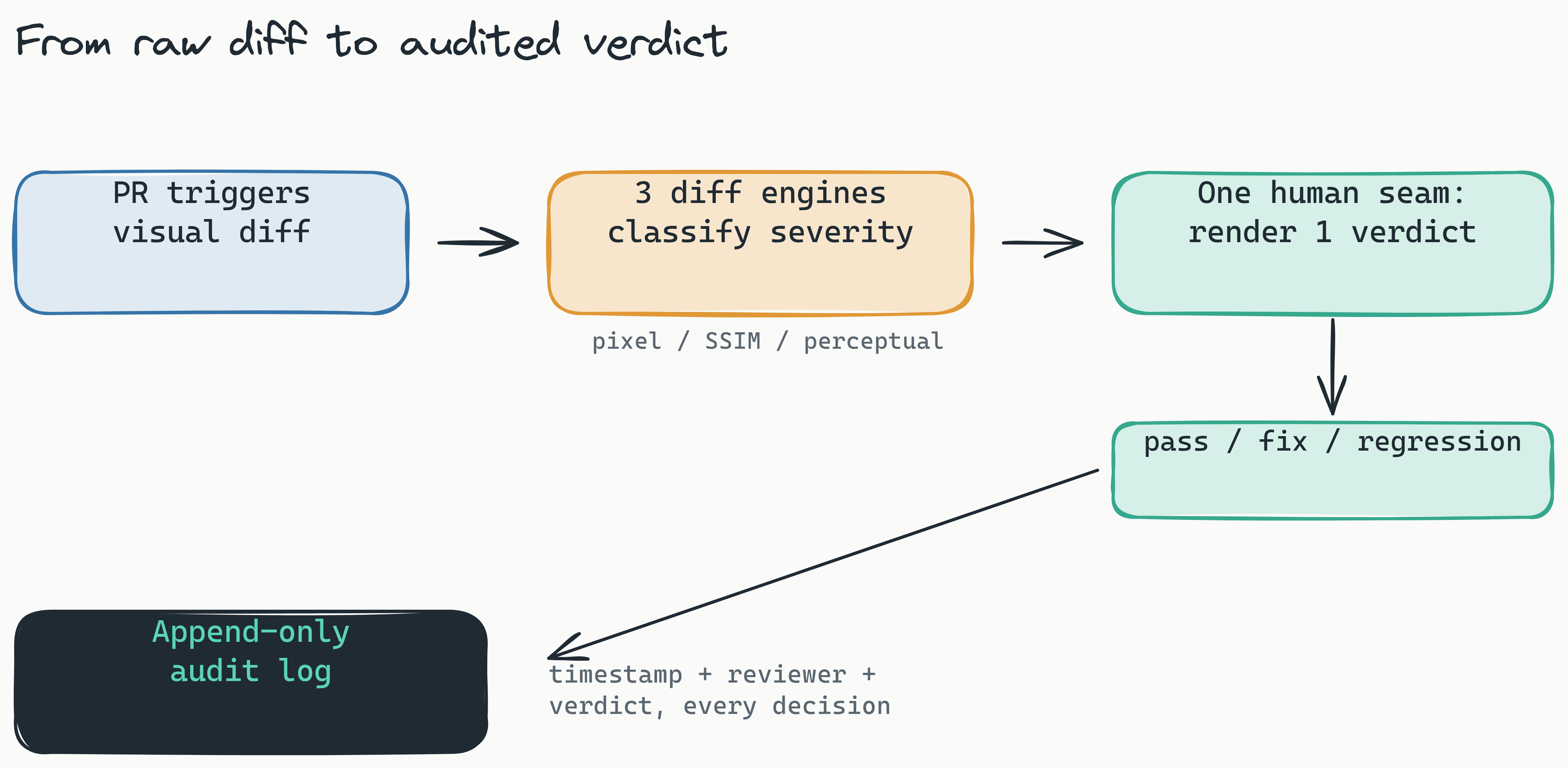
Visual testing approval workflows for CI/CD pipelines automate the decision process: approve, reject, or defer visual changes before they hit production. When a pull request triggers a visual diff, the pipeline checks whether any baseline images changed. If changes exceed a defined threshold, the pipeline pauses and waits for human input.
Here's how the approval loop works. A developer sees the diff in the dashboard, marks it as intended (feature change) or unexpected (regression). A reviewer - assigned automatically by the system or manually by the developer - confirms the classification. Only then does the pipeline proceed. This visual diff approval process eliminates guesswork and creates an auditable trail.
Technically, this integrates via GitHub Actions checks or GitLab MR comments (self-hosted GitLab included). Tools like Lastest use zero-token replays: AI runs only when you create or fix a test, and every replay afterward is plain Playwright execution. Reviewing a diff for the thousandth time costs nothing in tokens, and self-hosted screenshots are unlimited regardless of volume. That removes the friction of per-screenshot and per-seat pricing models that quietly discourage thorough review cycles. A reviewer renders exactly one verdict (pass, fix, or regression); the AI never approves its own output.
Lastest also runs AI failure classification on every failure: each diff is auto-tagged as a real regression, flaky, environment, or test-maintenance issue, with a confidence score and reasoning. That gives your reviewers a triaged queue instead of an undifferentiated pile, which is the single biggest determinant of whether a governance process survives contact with scale, as we cover in the 2026 AI testing scale gap.
Open Source vs Commercial Visual QA Tools: Which Is Right for Your Governance Policy?
The choice between open source vs commercial visual QA tools comes down to your governance requirements around data sovereignty, cost structure, and customization flexibility. Neither category is universally superior - the right fit depends on your compliance needs and team size.
| Criterion | Open Source (e.g., Lastest, BackstopJS) | Commercial (e.g., Percy, Applitools) |
|---|---|---|
| Self-hosting | ✅ Yes | ❌ Cloud-only |
| Data sovereignty | ✅ Full control | ❌ Vendor-managed |
| Upfront cost | ✅ Free, forever (self-hosted) | ❌ Per-seat / per-screenshot |
| Predictable pricing | ✅ $0 self-host, or $299/mo flat Cloud | ❌ From ~$179–$699+/mo, scales with usage |
| Built-in review UI | ✅ Lastest dashboard, one human seam | ✅ Included |
| CI/CD integrations | ✅ GitHub Action, GitLab MR comments, Smart Run | ✅ Native integrations |
| AI features | ✅ AI test gen, 7-layer selector fallback, failure classification (Lastest) | ✅ AI-based (Applitools) |
Commercial tools offer convenience and native integrations. But for governance-focused teams, open source visual regression testing costs aren't just lower, they're predictable. Self-hosted Lastest is free forever under an FSL-1.1 license, and Lastest Cloud is a flat $299 per month with no per-seat or per-screenshot fees. You pay for infrastructure or one flat number, not per test run or per reviewer seat. That matters when scaling governance policies across dozens of services and hundreds of team members, where per-screenshot pricing turns thorough review into a budget line item. Bottom line: commercial tools simplify setup; open source tools give you governance control. See the full enterprise pricing breakdown for the numbers.
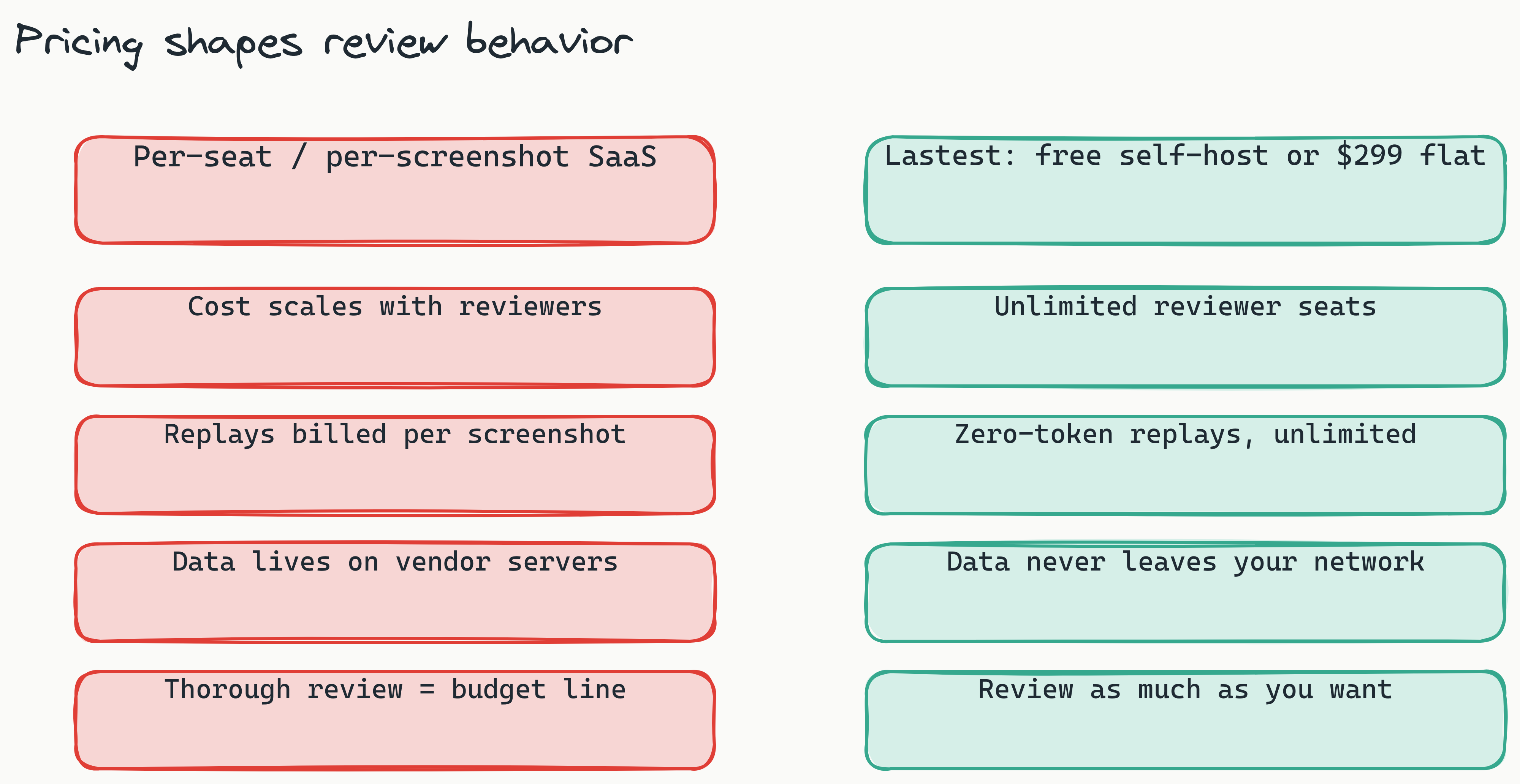
What is the primary advantage of open source visual testing tools for governance?: Open source tools like Lastest and BackstopJS provide full data sovereignty and predictable costs by allowing self-hosting. This gives enterprises complete control over their data, audit trails, and infrastructure, which is often critical for meeting strict compliance requirements.
Automated Visual Testing Review Processes for Distributed Teams
An automated visual testing review process for distributed teams removes manual screenshot comparisons and replaces them with structured, repeatable approval cycles. Without automation, distributed teams fall back on Slack screenshots, email attachments, and "can you look at this?" messages - a recipe for confusion and delays.
Automation changes this fundamentally. Developers trigger visual tests from their local environment or CI/CD pipeline. Diffs get automatically classified by severity using three diff engines - pixel (Pixelmatch), structural (SSIM, layout-aware), and perceptual (Butteraugli, human-eye aligned) - so a font-rendering shimmer doesn't get the same weight as a collapsed layout. The result maps cleanly to governance lanes: ignore (pixel-level noise within tolerance), flag (minor visual shifts requiring review), or block (significant structural changes blocking deployment). Reviewers see only what needs their attention. For deeper background on how the perceptual engine cuts false positives, see reducing false positives in visual testing.
For teams spanning time zones - Berlin and San Francisco, for example - asynchronous review becomes critical. A developer in Berlin pushes code at end of day. Tests run, diffs get flagged, and a reviewer in San Francisco picks them up the next morning. The visual diff approval process completes before the Berlin team arrives. No waiting, no bottlenecks.
GDPR Compliance and Visual Testing: What European Enterprises Must Know
Visual testing GDPR compliance requirements mandate that test screenshots and baseline images get stored with clear data retention policies and access controls. Under GDPR Article 5, data minimization and storage limitation apply to test artifacts just as they apply to production data.
The challenge surfaces when test screenshots capture user interface elements containing personally identifiable information - a user's name on a dashboard, a masked account number in a banking app, or an email address in a form field. These images become data subjects under GDPR. You must define how long they're kept, who can access them, and how they get deleted.
Visual testing baseline management best practices under GDPR include regular audits of baseline images for PII, automated redaction of sensitive data before storage, and strict access controls limited to team members who need them. Self-hosting offers a clear compliance advantage here: data never leaves your infrastructure, and you control retention policies directly. For European enterprises, this eliminates the complexity of data processing agreements with third-party vendors. Consult your legal team for full compliance, but the starting point is clear: know what your test artifacts contain and control how they're stored.
How does self-hosting visual testing help with GDPR compliance?: Self-hosting ensures that test screenshots and baseline images never leave your infrastructure. This gives you full control over data retention policies and access controls, simplifying compliance with data minimization and storage limitation principles without relying on a vendor's data processing agreements.
How to Build Your Visual Testing Governance Policy (Template)
Building a visual regression testing policy template that enterprise teams can use requires defining five elements: scope, roles, baseline rules, review thresholds, and audit procedures. Below is a structured template you can adapt immediately.
Policy Template Structure
Scope
- Which components, pages, or user flows are covered by visual testing
- Critical flows (login, checkout, payment) vs. non-critical flows
- Exclusions (admin pages, internal tools if not necessary)
Roles
- Developer: Runs tests, reviews diffs, marks changes as intended or unexpected
- QA Engineer: Verifies diffs, escalates unclear changes, approves routine updates
- Lead/Approver: Reviews escalated diffs, approves baseline changes, signs off on releases
- Compliance Officer: Audits approval logs, ensures data retention compliance
Baseline Rules
- Only QA engineers or leads can create new baselines
- Baseline updates require a documented change request
- Historical baselines retained for 90 days (or as required by your retention policy)
Review Thresholds
- Auto-approve: Pixel diff less than 5% of total image area, no structural changes
- Flag for review: Pixel diff between 5% and 20%, or any structural change
- Block deployment: Pixel diff exceeding 20%, structural changes to critical flows, or diff on compliance-sensitive pages
Audit Procedures
- All approvals and rejections logged with timestamp and reviewer identity
- Weekly audit of unapproved baseline changes
- Monthly compliance check of data retention policies against stored images
Set visual test coverage thresholds at 80% for critical flows and 50% for standard pages. Adjust based on team maturity and application complexity.
Why Self-Hosted Visual Testing Strengthens Your Governance Posture
Self-hosted visual testing strengthens your governance posture by giving you complete control over data location, retention policies, and access permissions. No third-party server ever sees your UI diffs, baseline images, or approval logs.
This control translates directly into auditability. All test runs, approvals, and baseline changes stay on your infrastructure. You can produce a complete audit trail for any release without depending on a vendor's logging policies. For regulated industries - finance, healthcare, government - this is non-negotiable.
Cost control is another advantage. Instead of per-test-run pricing that scales unpredictably, self-hosting with tools like Docker and GitHub Actions or GitLab CI means fixed infrastructure costs. Take a German fintech, for example. They must keep all test artifacts within EU borders. Self-hosting with a tool like Lastest ensures compliance without vendor dependency. Self-hosted visual testing governance isn't just a technical choice - it's a compliance strategy.
Frequently Asked Questions
What is a visual testing governance policy? A visual testing governance policy is a documented set of rules defining who approves visual UI changes, how test baselines are managed, and how review workflows integrate into your CI/CD pipeline to prevent defects from reaching production.
How do I choose between open-source and commercial visual testing tools? Choose open-source for full data sovereignty, predictable costs, and customization; choose commercial for convenience, built-in integrations, and easier initial setup. The decision often hinges on your compliance needs regarding data retention and access control.
What are the key elements of an enterprise visual regression testing compliance plan? The key elements are baseline ownership, role-based access control (e.g., developer, QA, lead), documented approval workflows, policy on data retention, and regular audit procedures to ensure test artifacts are secure and controlled.
How can I integrate visual testing approval into my CI/CD pipeline? Use a tool that blocks a deployment via a status check (e.g., in GitHub Actions or GitLab CI) when a visual diff exceeds a defined threshold. The pipeline then waits for a human reviewer to approve or reject the change in a dashboard before proceeding.
Why is data sovereignty important for visual testing? Data sovereignty is critical for compliance with regulations like GDPR. Self-hosting your visual testing tool ensures that screenshots and baseline images containing potential PII never leave your infrastructure, giving you full control over storage and access.
Implement Visual Testing Governance with Lastest
Implementing visual testing governance with Lastest means combining open-source self-hosting with AI-authored Playwright tests and a human-in-the-loop review dashboard. Lastest provides a free self-hosted version that teams can stand up with a single docker-compose command. Self-hosting is free, forever, under an FSL-1.1 license, with unlimited screenshots and replays on your own infrastructure.
The platform includes features built for governance, not bolted onto it:
- One human review seam. Reviewers render one of three verdicts (pass, fix, regression). AI never approves its own output, so accountability stays with a named person.
- Zero-token replays. AI runs only when you create or fix a test; every replay is plain Playwright. Unlimited review cycles cost nothing in tokens.
- Three diff engines (pixel/Pixelmatch, structural/SSIM, perceptual/Butteraugli) plus AI failure classification that tags each failure as regression, flaky, environment, or test-maintenance with a confidence score.
- Versioned test history. Every edit, AI-fix, and restore is recorded with a reason, and branch baselines fork on PR open and merge back on PR merge - the audit trail governance demands, by default.
- WCAG 2.2 AA scoring. axe-core runs on every screenshot for a 0–100 accessibility score with per-build trend lines, so compliance is measured, not assumed.
- CI/CD native plus Smart Run. A reusable GitHub Action, GitLab MR comments, webhooks, and scheduled cron enforce approval gates at the pipeline level; Smart Run reads git diffs and runs only the tests your change touches. A ~29-tool MCP server lets coding agents drive Lastest directly, and you can bring your own AI provider (Claude, OpenAI, OpenRouter, or local Ollama) with no lock-in.
For teams that want to skip ops entirely, Lastest Cloud is a flat $299 per month, with no per-seat or per-screenshot fees. Both editions run the same governance controls; the only difference is who manages the infrastructure.
Conclusion
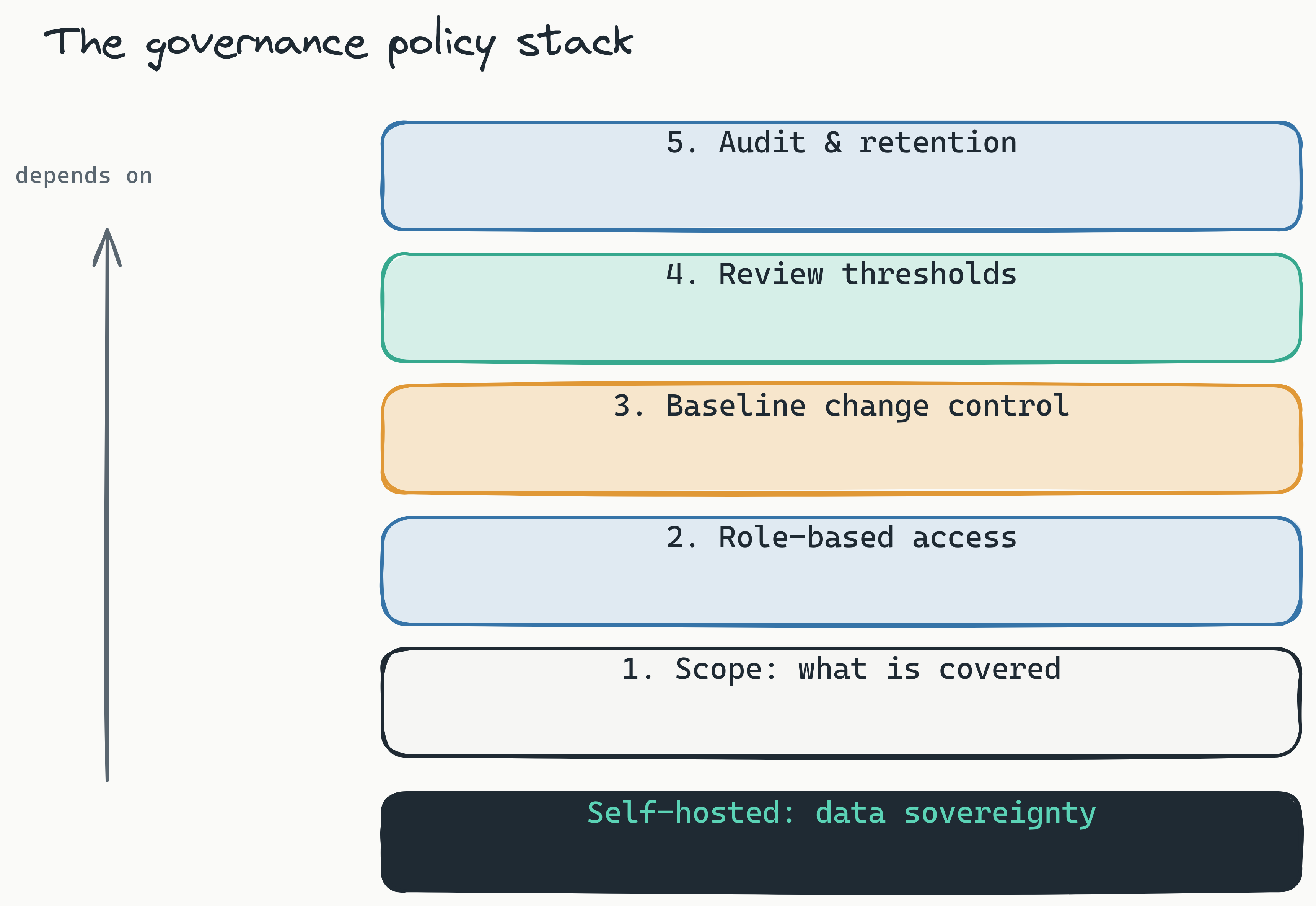
Enterprise visual testing governance policies aren't a one-time document, they're a living framework that evolves with your release cadence and team size. The five pillars - framework definition, CI/CD approval workflows, distributed review processes, GDPR compliance, and a structured policy template - provide a foundation that works for teams of any scale. The tooling you choose directly impacts how much control you have over governance.
Start free: self-host Lastest with a single docker-compose command and keep every screenshot, baseline, and approval log inside your own network - or skip the ops and run Lastest Cloud at a flat $299 per month. Browse the full feature set or read the docs to wire approval gates into your pipeline, and grab the source on GitHub. Whether you self-host or use the cloud, Lastest gives you the audit-ready governance controls enterprise teams need. Start building today.