
It is Sunday night. You are scrolling Hacker News. A build is red in a Slack channel you muted two hours ago. Somewhere in your head a small voice says it: I am the QA team now.
Welcome. You are paying the developer QA tax, and I want to give the thing a name so we can stop pretending it is free.
Naming the developer QA tax
The developer QA tax is the hidden cost every engineering org pays when it disbands (or never builds) a QA function and quietly hands the work to developers. It is not a line item. It does not show up in a budget. Nobody approved it. But it is extracted every sprint, from every person who ships.
The tax is real. It is measurable. And once you see it, you cannot unsee it. (We put hard dollar figures on the broader version of this in The Real Cost of No QA Team.)
I have been watching teams get taxed for a few years now, and I keep seeing the same six collection points. Let me walk you through them.
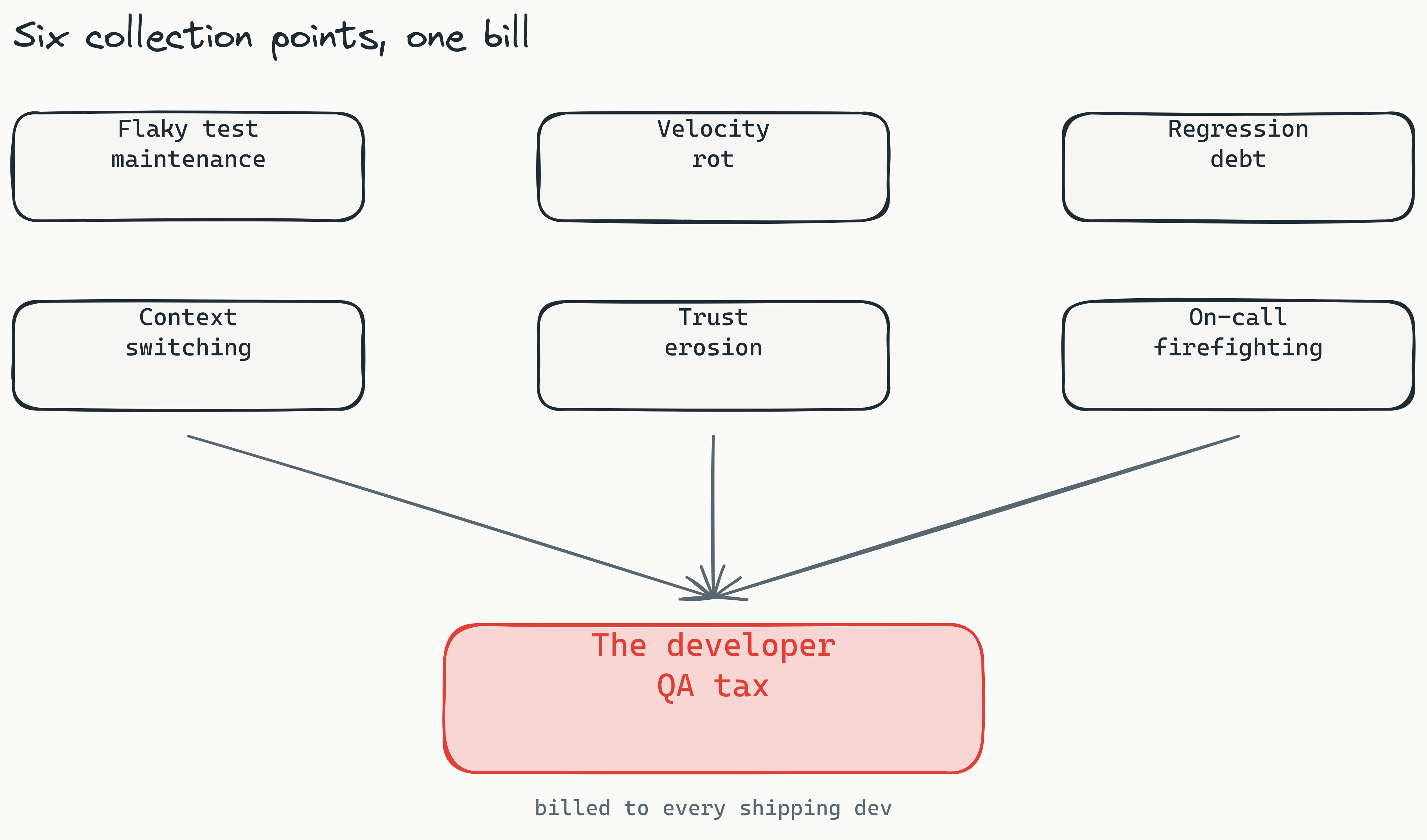
Collection point 1: flaky test maintenance
When we looked at what developers on teams with an end-to-end suite actually spend fixing that suite, the time landed in the range of several hours per developer per month - just on flaky tests and broken selectors. Not writing tests. Not shipping features. Just babysitting. (We dig into the mechanics of this in The Flake Tax.)
Several hours is the better part of a working day. Per person. Every month. At a ten-person team that is most of a senior engineer's week, vaporized into nothing shippable. And the really grim part: the work is invisible. It lives in PR titles like "fix flaky login test (again)" and nobody gets promoted for them.
Collection point 2: velocity rot
When developers own QA, feature velocity does not fall off a cliff. It sags. Stories take twenty percent longer because you are now responsible for thinking about the test matrix you did not design. Rollouts slow because nobody trusts the suite enough to skip manual smoke tests. Refactors get postponed because "we do not really know what that path does."
This is the tax on your roadmap. It does not get billed to a sprint. It gets billed to the quarter, the OKR, the thing you promised your PM three months ago and still have not shipped.
Collection point 3: regression debt
Every time a bug escapes to prod and you do not write a test for it, you take out a loan. The interest is paid in future outages on the same code path. I have watched teams rediscover the same checkout bug three times in a year because nobody had the time, the setup, or the patience to write a proper end-to-end reproduction.
Unit tests do not save you here. Unit tests can prove your function returns the right shape. They cannot prove the button is clickable, the modal opens, the form posts, and the thank-you page renders. That last mile is where regressions actually live - and the last mile is almost always where nobody has tests.
Collection point 4: context-switching tax
Here is the one I think hurts the most, because it is the most invisible.
When a QA engineer reproduces a bug, they stay in bug-finding mode. Their tools are loaded. Their brain is loaded. Their mental model of the edge cases is loaded. When you reproduce a bug, you pause a feature, unload a PR, switch browsers, hunt for the right dataset, re-read a Linear ticket someone wrote in three bullet points, and finally - if you have the stamina - write a reproduction.
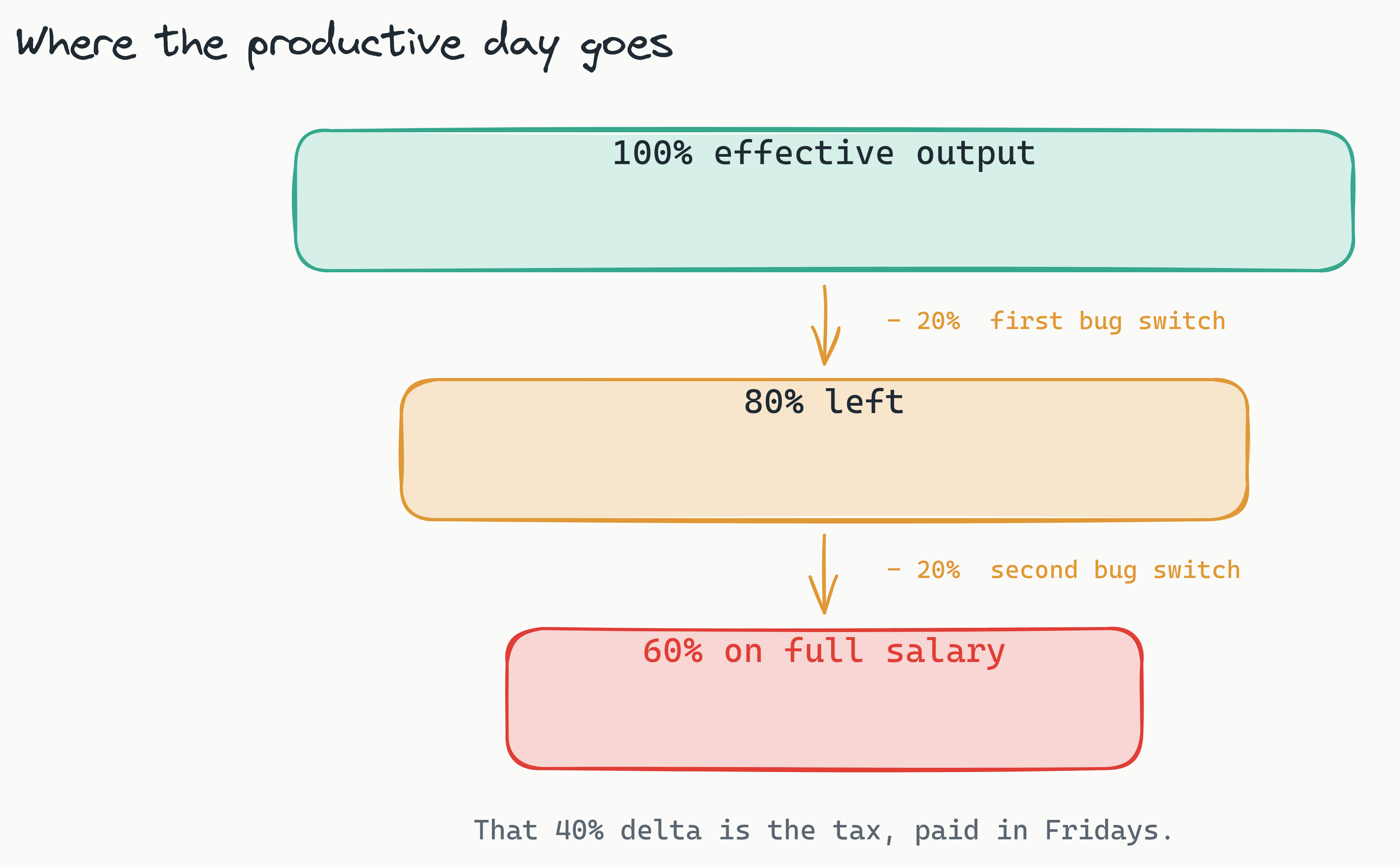
Every bug costs you the feature you were building. Gerald Weinberg famously pegged each context switch as a rough 20% productivity hit. Two of them a day and you are working 60% time on a 100% salary. That delta is the tax, and you pay it in Fridays.
Collection point 5: trust erosion
This is where it gets philosophical. A test suite is a trust machine. It exists so you can deploy on a Friday afternoon without sweating. The moment developers start skipping tests in CI because "that one is flaky, ignore it," the machine breaks. Nobody trusts green. Nobody trusts red. Merges happen on vibes.
Once trust is gone, the suite is worse than useless - it is a liability. It slows CI, it blocks PRs, and it tells you nothing about whether your code is safe to ship. I have seen teams delete entire test directories because the effort of fixing them exceeded the signal they provided. That is the tax compounding.
Collection point 6: on-call firefighting
And then, inevitably, prod catches fire. Because you had no QA, because the suite was rotten, because nobody had ownership of "does the signup flow still work end-to-end", you learn about the regression from a customer. Or PagerDuty. Or both.
On-call firefighting is the tax with interest. You pay it at 2am, in adrenaline, in missed dinners. And the post-mortem always ends with "we should have had a test for that." You know. Everyone knows.
The AI twist nobody wants to talk about
Here is where 2026 makes this worse, not better.
Industry research into AI-assisted coding keeps landing on the same uncomfortable finding: AI co-authored code tends to ship with materially more defects than human-only code. So you are shipping more surface area, faster, with more bugs per line - and you still have no QA team.
And AI is not rescuing your test suite either. When we put coding agents head to head on generating a working end-to-end test for a real app, Cursor took several attempts; Claude got there in fewer. Both tended to write tests where they were easiest, not where regressions hide. A researcher on our team put it better than I can:
LLMs write tests where they are easiest, not where regressions hide.
So the math is ugly. More code, more bugs, fewer humans guarding the gates, and the AI that is meant to help is writing tests for the happy path because the happy path is the path it understood. The tax is going up.
What you can actually do about it
I do not have a silver bullet for you, but I have some vibe-level fixes that work for real teams.
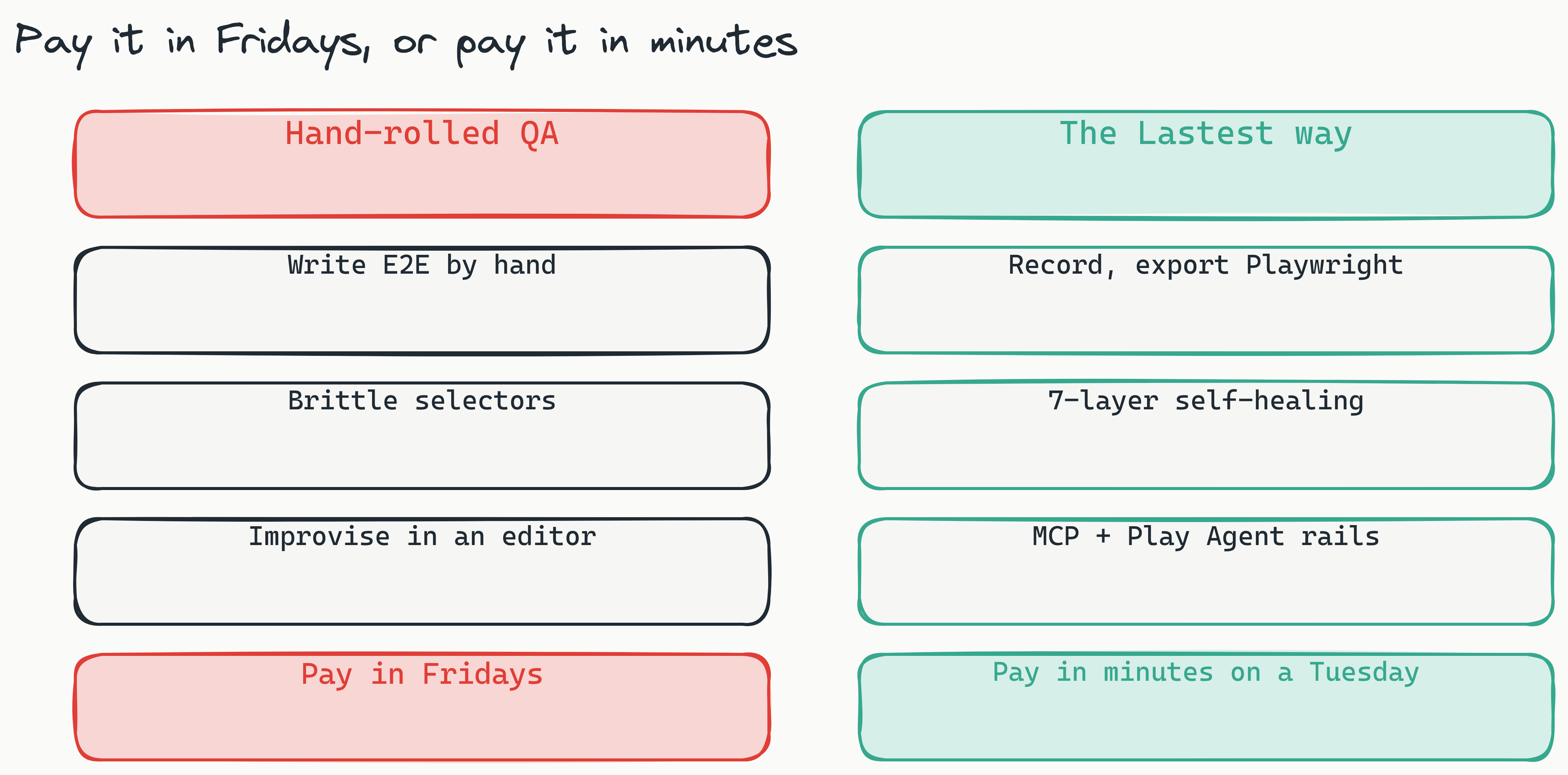
Stop writing end-to-end tests by hand. You are not slow because you are bad. You are slow because writing E2E by hand is a bad shape of work for a developer brain. Record flows, export deterministic Playwright code, edit the parts that matter. And once a test exists, replaying it is plain Playwright execution - zero AI tokens per run, so you can run it thousands of times a day for free. The AI only spends tokens when you create or fix a test. That alone clawed back most of those wasted hours per month for the teams we watched. (Here is how developers without QA ship E2E tests in an afternoon.)
Put selector resilience in the tool, not in the test. If your tests break every time a designer touches a className, the tool is wrong, not your team. You want a runner with a 7-layer selector fallback: data-testid, then id, role, aria-label, text, CSS, and finally OCR before it gives up. When the suite stops lying to you, trust comes back.
Make visual regressions cheap. A pixel diff on every PR catches the class of bug that unit tests literally cannot see - the modal that renders behind another modal, the button that moved off-screen on mobile, the dark-mode text on a dark-mode background. Three diff engines (Pixelmatch for pixel-perfect, SSIM for structural layout, Butteraugli for perceptual human-eye accuracy) catch far more than any one of them alone. Self-host it and the screenshots are unlimited.
Give your agents a real test tool. If you have Cursor or Claude writing tests for you, stop letting them improvise in a text editor. Point them at an MCP server that exposes roughly 20 tools - record, run, diff, heal, classify - so the agent drives the test platform instead of guessing. The 11-step Play Agent pipeline (Orchestrator, Planner, Scout, Diver, Generator, Healer, and more) exists because LLMs need rails, not vibes. Every failure gets auto-classified as real regression, flaky, environment, or test-maintenance, so a human only reviews what matters. (More on that single human seam here.)
The pitch, because I have to
We built Lastest because we got tired of watching our friends pay this tax. Self-hosting is free forever (open source, FSL-1.1-ALv2 license, your infra, unlimited screenshots and replays), and you can have it running in about a minute:
git clone https://github.com/las-team/lastest
cd lastest
docker-compose up -d
Don't want to run the ops? Lastest Cloud is a flat $299/month - no per-seat fees, no per-screenshot metering - with a free evaluation tier to start. Either way the GitHub source is right here: github.com/las-team/lastest.
If you are the developer who got QA dropped in your lap, we wrote a whole page for you at /for/devs-doing-qa. If you are on a specific stack, we have deep dives for Next.js, React, and Vue.
None of this makes the developer QA tax disappear. But it is the difference between paying it in Fridays and paying it in ten minutes on a Tuesday morning. Your call which one feels better.
Now close the laptop. It is still Sunday.