Nobody writes a blog post about baseline management. Nobody gives a conference talk about it. And yet it's the operational problem that determines whether your visual testing suite is trustworthy or chaos.
The Baseline Problems Nobody Warns You About
Problem 1: The Accidental Overwrite
Developer A introduces a bug that shifts a layout by 3 pixels. The visual test catches it. Developer A, in a hurry, approves the new baseline instead of fixing the bug. The bug is now enshrined as the "correct" state. Next week, Developer B fixes the layout (unknowingly fixing A's bug). The test fails again because it no longer matches A's buggy baseline.
Problem 2: The Branch Collision
Feature branch A changes the header. Branch B changes the footer. Both update baselines for pages that include both. When A merges first and then B merges, B's baselines - captured before A's header change - overwrite A's. The baseline shows a state that never existed.
Problem 3: The Orphaned Baseline
A page gets deleted. Its baseline remains. Over months, orphaned baselines accumulate - storage grows, and occasionally a framework picks up a stale baseline and produces confusing failures.
Problem 4: The Environment Baseline
A baseline captured on Mac looks different from one captured on Linux due to font rendering. If developers capture locally on macOS and CI runs on Ubuntu, every test fails.
The Solutions
Branch-Aware Baselines

Every branch maintains its own baseline set, forked from the parent at divergence. Changes on a feature branch only affect that branch's baselines. When the branch merges, its baselines merge with the target, flagging conflicts.
Approval Workflow with Audit Trail
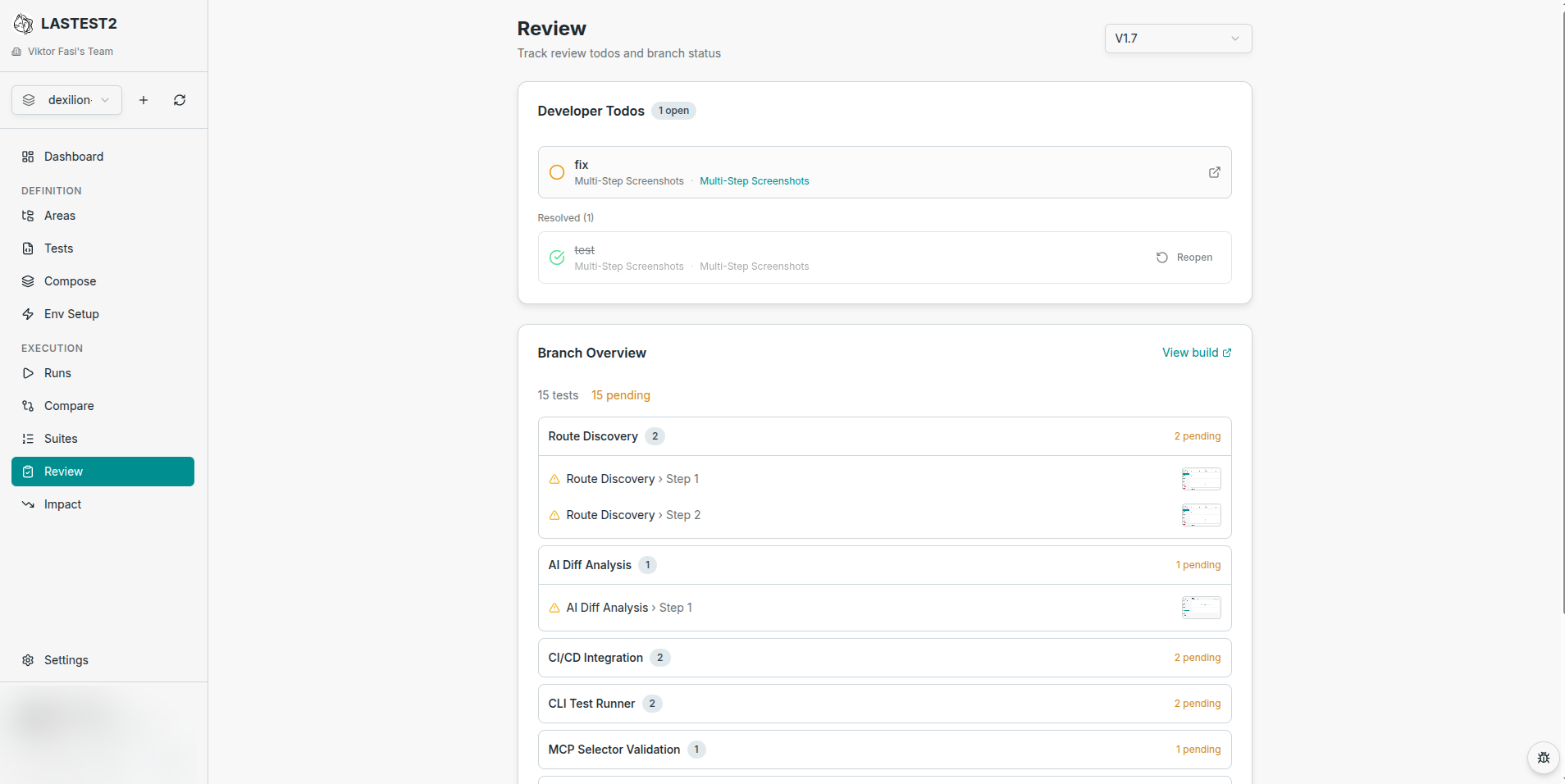
Never allow a baseline update without explicit approval. When a diff is detected: the diff is flagged for review, a reviewer approves or rejects, the approval is recorded with identity and timestamp, and the baseline links back to the diff that created it. This prevents accidental overwrites - approving a buggy baseline is still possible, but it's deliberate with accountability.
SHA256 Hash Fast-Path
Hash raw pixel data with SHA256. If the new screenshot hash matches the baseline hash, the test passes instantly - no diff engine runs. With proper stabilization, the majority of screenshots are byte-identical to their baselines, converting "capture → compare → pass" (seconds) to "capture → hash → pass" (milliseconds).
Baseline Versioning
Every baseline update creates a new version preserving full history: initial baseline, updated after redesign, updated after AI repair, restored to previous version. Each records the change reason, branch, build, and commit reference. Roll back to any previous baseline at any time.

Test Composition with Pinned Versions
For critical builds, pin specific baseline versions rather than using "latest." Cherry-pick tests and pin their versions per build. Running the same composition today and next month produces the same comparison, even if newer baselines have been approved.
Planned Screenshots (Design Comparison)
Upload design files (Figma exports) as "planned" screenshots. The system compares rendered pages against design intent, flagging pixel-level deviations. This turns baseline management into a design QA tool - not just "did it change?" but "does it match the design?"

The teams with reliable visual testing don't have better tests - they have better baselines. That's the unsexy truth nobody talks about.