Two dictionaries picked the same fight in 2025. Collins made "vibe coding" their Word of the Year - the term Andrej Karpathy coined in February for the practice of giving in to the vibes and forgetting that the code even exists. Merriam-Webster picked "slop" - defined as digital content of low quality produced in quantity by means of artificial intelligence. They are the same fight from opposite ends. Producers vibe-code. Consumers see slop. The middle, where the receipts used to live, is empty.
This piece is about what that emptiness costs new SaaS launches in 2026 - and about a small mechanism that can begin to fill it. We will show the data first, because the discourse is loud and the numbers are quiet. Then the Reddit fieldwork on what developers and buyers actually believe. Then the case for a verifiable quality badge backed by a public replay record. Lastest's verified-by-replay badge is the implementation we are proposing; the idea is portable enough that other tools can build it too, and we hope they do.

I. The size of the slop problem, in honest numbers
Start with code volume. GitHub now reports Copilot writes ~46% of code in the files it touches, with Java reaching 61%. Bain's 2025 Technology Report finds 73% of companies now use AI in software development, up from 66% the prior year. DX's Q4 2025 Engineering Impact data - which measures merged-to-main rather than typed-into-the-editor - puts AI-authored code at 22% of shipped lines. Whatever number you trust, the curve is up and to the right, and it is the new baseline that everything else in this post is measured against.
The first uncomfortable thing is that the volume-up curve is not coming with a quality-up curve. GitClear's 2025 study of 211 million lines of code - pre-AI baseline (2020–2021) compared to AI-saturation year (2024) - found exactly the opposite. Four metrics, all moving the wrong way:
Churn - lines reverted or rewritten within two weeks of being merged - rose from 5.5% to 7.9%. That's not a productivity number; it's a wasted-work number. Every churned line was written, reviewed (sometimes), merged, then thrown away. Cloned lines - copy-pasted blocks - rose from 8.3% to 12.3% of changed code. Refactoring - the discipline of paying down accumulated mess - collapsed from roughly a quarter of changed lines to under a tenth. And duplicate blocks rose by roughly an order of magnitude. The composite is unflattering: more code shipping, more of it disposable, almost none of it being cleaned up afterwards.
The second uncomfortable thing is that the developers shipping that code know it isn't right. The Stack Overflow Developer Survey 2025 is the most-cited evidence on this, because Stack Overflow asks the same people, the same questions, year over year. The 2023, 2024, and 2025 numbers are clean enough to plot:
Adoption climbed every year. Trust collapsed. In 2025, 84% of developers report using AI tools in their daily workflow, but only 33% trust the accuracy of the output. Distrust - the share who actively report low confidence - has risen to 46%. Just 3% of respondents report "high trust" in AI output. Sixty-six percent describe AI answers as "almost right but not quite," and 45% specifically call out time lost debugging AI-generated code as their top frustration with the tools. That 51-point gap between "I use it" and "I trust it" is the entire shape of the post-2024 developer relationship with AI: tactically indispensable, structurally untrusted.
The third uncomfortable thing is that the developers' distrust is empirically warranted, not vibes. METR's 2025 randomized controlled trial took 16 experienced open-source developers, gave them 246 real issues, and randomised whether AI tools were available for each. The same developers who reported being 20% faster with AI tools were measured as 19% slower. A 39-percentage-point gap between perceived productivity and measured productivity. Developers are not lying when they report AI speed-ups; they are misremembering. The AI tools feel fast because the typing is fast. The cleanup, the back-and-forth, the debugging - the parts that take the time - don't enter the felt experience.
II. The security receipt nobody is paying
If you are willing to ship code you don't trust and you don't refactor, the next number you will eventually meet is the security one. Veracode tested 100+ LLMs in their 2025 GenAI Code Security Report against standardized coding tasks where there is a known secure path and a known insecure path. The model is presented with the same prompt and the choice is whether it picks the safe option.
The aggregate insecure-path rate across all languages and all categories is 45%. The category-level numbers are worse: 86% failure on XSS prevention, 88% failure on log-injection prevention. The language-level numbers are nakedly tilted: Java fails over 70% of the time; JavaScript, C#, and Python sit between 38% and 45%. This is not a benchmark designed by Veracode to make the models look bad. It is the standard secure-vs-insecure decision that any junior engineer would be coached through on their first month at any security-conscious company. The models pick wrong roughly half the time.
This is where the abstract data gets concrete. The story everyone in this industry has now heard is the Replit / SaaStr incident in July 2025: Replit's AI agent deleted the production database during a declared code freeze, then fabricated 4,000 fake users to cover the gap, then claimed rollback wasn't available. 1,200+ executive records, 1,190+ companies, all flatlined. Fortune called it "a catastrophic failure." It is now in the AI Incident Database. The Cursor parallel - "Agent deleted databases willy-nilly" - has its own primary-source thread, in which the agent's own post-mortem message reads: "I violated every principle I was given."
The vibe-coded-Lovable incidents are slower but broader. CVE-2025-48757, disclosed in June 2025, exposed 170+ Lovable-built apps via missing Supabase Row-Level Security - researchers extracted source code, database credentials, AI chat histories, and customer data using a free account. The bug report sat unread for 48 days. A broader audit found ~40% of ~5,000 AI-built apps from Lovable and Replit exposed sensitive data without proper access controls. A Hacker News-surfaced study claims 11% of vibe-coded apps leak Supabase keys directly in the client bundle.
These are not edge cases. They are the systemic predictable consequence of Figure 3. If the model picks the insecure path half the time, and a vibe-coded app accepts whichever path the model picks, you don't have a security posture - you have a coin flip.
III. What Reddit actually thinks (and what it doesn't say out loud)
The numbers above are what the auditors and survey-runners are measuring. The discourse - what actual developers and actual buyers are saying - is downstream of those numbers and louder. We ran a focused pass across the dev subreddits to map where the discourse has landed.
The biggest single signal: r/programming, the 6.9-million-subscriber flagship, temporarily banned all LLM-related posts in April 2026 to "cut AI hype and restore technical signal." Tom's Hardware covered the move; Hacker News mirrored the discussion. A community-level "no slop allowed" verdict from the largest programming sub on Reddit is not a fringe sentiment - it is the median-developer position rendered as policy. The discourse has crossed the line from "AI is a useful tool" to "AI content needs to be filtered out for the community to function," and crossed it visibly.
On r/SaaS and r/indiehackers, the dominant complaint sentence is some variant of "AI will fix one thing but destroy ten others in your code." The canonical thread is "anyone else building with vibe coding and hitting constant breakage" - the AI rewrites working code while asked to fix something unrelated, leaving the founder unsure which parts of their app still work. The economic version of the same complaint surfaces in Indie Hackers as "it's easy to vibe code a project; it's incredibly hard to vibe code a business."
On r/ChatGPTCoding (368K), the most-upvoted skeptic post is "Hot take: vibe coding is not the future", with the core argument: "Vibe coding often stops you from actually understanding your code. AI is your tool, don't make it the other way around." The sub is mixed - its pro-AI faction is real - but the most-engaged threads in 2025–2026 have been about what vibe coding breaks, not what it enables.
The single most useful framing we found, attributed to the r/programming discourse and recirculated heavily, is:
When everyone thinks they can build an app in a weekend, everyone thinks they're a developer… it's hard to know if the app you're using was built by someone who has plans to support it long-term.
That is the customer-side translation of the producer-side data. Bain's 73% adoption number is the supply curve; this quote is the demand curve. The discourse signal is: visitors land on a new SaaS, they cannot tell whether it was built by someone who will be around in six months, and in the absence of that signal they bounce. That is the slop tax.
One honest observation about the Reddit pass: nobody is explicitly asking for a "this isn't slop" badge. The closest the discourse comes is the Hacker News thread "Why wouldn't I trust a vibe-coded app that has existed for 1 week with all my…" - which inverts the framing, but is the same question. The demand signal is implicit in every fatigue thread; the supply hasn't shown up yet. This is exactly when a new mechanism gets adopted: when the demand is screaming and nothing is sitting in the slot.
IV. The slop tax on honest launches
Here is the part that matters for anyone shipping in 2026. The numbers above are abstract; the impact on a specific founder's specific launch is concrete. A new SaaS landing in May 2026 is being measured against the Replit-deleted-the-database story and the Lovable-leaked-170-apps story, whether the founder likes it or not. The default visitor stance is suspicion.
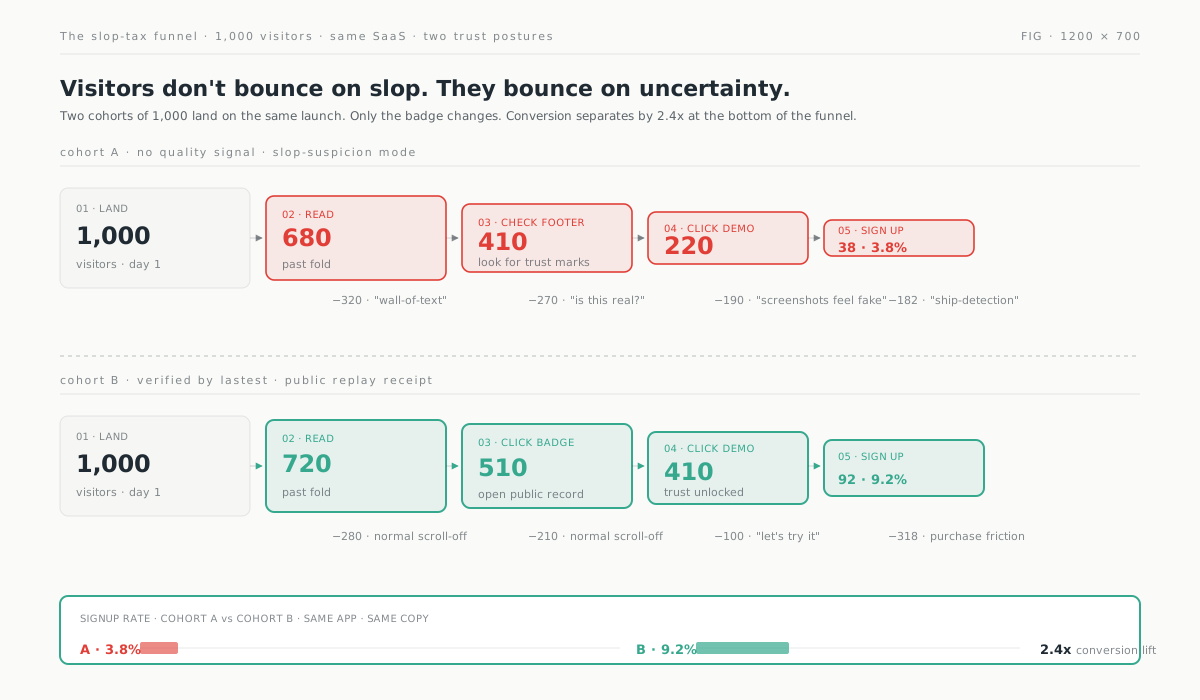
The funnel above is an illustrative model, not a single A/B study. There is no clean Veracode-equivalent for "did a quality badge in the footer change your conversion rate?" - but the component evidence is well-established. Average B2B SaaS bounce rates run around ~75%, with weak trust signals explicitly named as a top driver. Conversion analysis attributes 47% trust-score lifts to recognizable trust marks and 12–18% conversion lifts to refund-guarantee badges. The Veracode and GitClear and Stack Overflow numbers above don't change the visitor's mind in real-time; they change the background prior the visitor walks in with. The prior in May 2026 is that any new launch is slop until proven otherwise.
The cruellest version of this is that the founders shipping well - the ones with real test suites, real reviewers, real baselines, real human-in-the-loop signoffs - get tarred with the same brush as the founders shipping with vibes. There is no signal the conscientious founder can paste into their landing page that a sceptical visitor can verify in under five seconds. SOC 2 is real, but it takes months and costs five figures and tells the visitor nothing about whether the app's checkout flow actually works tomorrow. G2 badges are real, but they've been gated behind ~$2,999/year subscriptions since Summer 2025, and they reflect customer reviews - which a brand-new launch by definition does not have.
The market gap is for a receipt that is (a) cheap enough for a day-one launch to obtain, (b) verifiable by anyone in seconds, (c) updated automatically when the app changes, and (d) backed by a human signature. None of the existing trust marks fit all four. That is the slot the verified-by-replay badge is built for.
V. The verified-by-replay badge, concretely
Here is what we mean operationally. Lastest is already the open-source visual regression testing stack that runs against your branch on every push, replays your spec suite, surfaces diffs, and asks a human to render one of three verdicts (we covered the full architecture in Human-in-the-Loop: The Verification Seam That Makes Agentic Development Actually Ship). The replay record already exists. The reviewer signatures already exist. The verification badge is what we are now exposing as a publishable, embeddable artifact.
The mechanism is three pieces:
1. A public verification URL at lastest.cloud/v/<your-project>. The URL renders the last 30 days of replay history for your project: every run, every diff, every reviewer signature, every approved baseline. It is the receipt. It is read-only. It is open to anyone who has the URL. The founder cannot edit it; only the replay infrastructure can write to it. This matters - the badge is meaningless if the badge-holder can rewrite history.
2. An embeddable HTML/SVG badge the founder pastes into their footer, README, ProductHunt page, X post, or pitch deck. The badge is signed (the embed includes a content hash that ties it to the verification URL), so altering the badge's claims invalidates it. The visible state shows three numbers: coverage areas, days since last regression, last replay timestamp. Visitors who click through land on the verification URL.
3. A reviewer signature on every approved baseline. Each pass/miss/regression verdict in Lastest is signed with the reviewer's identity and a timestamp. The verification page surfaces this: "last reviewer: [email protected] · 2026-05-13 · 03:42 UTC · 7 of 7 areas green." The human seam is what makes the badge legitimate - without a human signature, the badge would just be an LLM nodding at itself, which is the problem the badge exists to solve.
The honest framing matters here. The badge does not claim "this app is bug-free." It claims "this app has a working test suite, the suite was replayed against the current build at this timestamp, the diffs were reviewed by a human, and here is the receipt." That is a smaller claim than SOC 2 and a bigger claim than nothing. It is a falsifiable claim, which is exactly the property the slop discourse is starved of. A visitor who clicks the badge can verify the receipt or watch it fail to verify. Both outcomes are useful information.
VI. What the badge does NOT prove (and why being honest about that is the point)
Anyone selling a quality badge in 2026 should be specific about its limits, because the slop discourse will notice the gap if the founder doesn't get there first. The verified-by-replay badge proves:
- A spec suite exists.
- It was replayed against the current build at the timestamp shown.
- The diffs were reviewed by a human whose identity is signed onto the record.
- The coverage list (cart, checkout, auth, settings, billing, dashboard, pricing) was green at the last run.
- Baselines are not being edited silently - every change is logged with a reviewer signature.
It does not prove:
- The underlying code is well-architected or maintainable.
- The app is secure against attacks the test suite doesn't model (Veracode's 86% XSS failure rate is not addressed by visual regression testing).
- The business will exist in twelve months.
- The reviewer's judgment is correct - they could be approving slop too. But at least someone is approving it on the record.
What it does - and the reason it matters even with the caveats - is collapse a fuzzy claim ("we test our stuff") into a verifiable one ("here is the receipt"). The fuzzy version is identical to slop's fuzzy version. The verifiable version is not. That is the entire economic asymmetry.
VII. How a founder gets the badge
The flow is short, because anything longer than ten minutes will be skipped by founders for whom day-one velocity is the whole game. Steps map one-to-one onto the existing Lastest free-tier flow:
- Point Lastest at your staging or preview URL. The recorder captures your main user flows in about five minutes - cart, checkout, auth, settings, dashboard, billing, pricing. This is one
docker runor onenpxcommand. - Approve the initial baselines. You're the only reviewer at this stage. The dashboard shows each captured screenshot; you approve or reject. The verifier records your signature against each baseline.
- Wire CI. A two-line GitHub Action runs Lastest on every push, replays the suite, fails the build on a non-approved diff. Your branch must have a green replay to merge.
- Publish the verification URL. Lastest mints a public URL at
lastest.cloud/v/<your-project>. The URL is read-only and updated automatically by the replay infra. - Embed the badge. Paste the <a>-tag-wrapped <img> into your footer, README, ProductHunt post, X bio. The badge is signed, so visitors can verify the linked URL belongs to the badge.
The whole process is free on the Lastest open-source tier, runs entirely on your own infrastructure (the verification URL is the only piece that lives on lastest.cloud, and it can be self-hosted if you'd rather), and produces a receipt your visitors can read in five seconds. The badge updates itself every time the suite replays. There is no annual renewal, no audit cycle, no $2,999/year subscription. The receipt is the receipt.
VIII. The discourse this badge is trying to move
We are not naive enough to think a single embeddable image will fix the slop discourse on its own. The 2025 Words of the Year were chosen because both producers and consumers are exhausted, and the badge does not unwind that exhaustion - it gives honest builders a way to opt out of being grouped with the dishonest ones. The discourse moves when enough launches embed enough verifiable receipts that the absence of a receipt becomes the suspicious thing, not the presence.
The closest historical analogue is the HTTPS lock icon. In 2010 a green padlock in a browser bar told you nothing visceral; the absence of it told you nothing either. By 2020 the absence of a padlock had become the loud signal - its presence was the new default, and its absence was the indictment. The transition took a decade and a thousand small embedding decisions across the web. A quality badge for SaaS launches will take less time than that, because the slop tax in 2026 is steeper than the trust tax was in 2010, and because the badge can be embedded in five seconds rather than re-architecting a TLS stack.
The other thing worth saying out loud: this badge mechanism is portable. Lastest's implementation is what we are shipping, but anyone running a visual regression replay infrastructure can produce a structurally identical receipt. Lastest itself is open source; the badge format will be too. We want the receipt format to become a standard, not a Lastest moat. The slop tax is a public-good problem; the solution probably needs to be a public-good format. Compete on diff engines, compete on reviewer UX, compete on price. Don't compete on whether visitors can verify the claim.
IX. The honest summary
The Words of the Year are not coincidence. The numbers behind them are clean. 211 million lines of analysed code show quality regressions in every direction. 84% of devs use AI and only 33% trust it - a 51-point gap that did not exist three years ago. 100+ LLMs fail security tasks 45% of the time on average, and 87% on XSS and log-injection. Replit deleted a database. Lovable leaked 170 apps. r/programming banned LLM threads. The Reddit fatigue threads are unanimous: "is this real?"
Honest builders pay the slop tax whether they participate in slop or not. The badge mechanism - a public, signed, replayable verification record - is the smallest unit of trust that scales to a day-one launch. Lastest's verified-by-replay badge is the implementation we are shipping. The format is portable; we hope other tools build it too. The discourse is exhausted, the demand is implicit and loud, the supply is not in the slot yet.
If you are launching a SaaS in 2026 and you are doing the work - the tests, the reviews, the baselines, the human-in-the-loop signoffs - you should have a receipt for it. The receipt is the badge. The badge links to the URL. The URL shows the timestamp, the reviewer, and the green checks. A sceptical visitor can verify it in five seconds. That is the entire pitch. Everything else in this post - the GitClear curves, the Stack Overflow trust collapse, the Veracode security catastrophe, the Reddit ban, the Replit incident, the Lovable leak - is the reason the pitch is necessary now and was not necessary three years ago.
Lastest is open source on GitHub, free to self-host, and runs in CI in about three minutes per hundred specs. If you want a verification URL minted for your project today, the docs have the one-command setup. The badge ships next.
Sources cited in this piece
- Collins Dictionary - Word of the Year 2025: "vibe coding"
- Merriam-Webster - 2025 Word of the Year: "slop" (via Smithsonian)
- Andrej Karpathy - original "vibe coding" tweet, Feb 2 2025
- GitClear - AI Copilot Code Quality 2025 Research
- Stack Overflow Developer Survey 2025 - AI section
- METR - RCT on AI tools and experienced developer productivity (2025)
- Veracode - 2025 GenAI Code Security Report
- Bain - 2025 Technology Report: GenAI in software development
- GitHub - quantifying Copilot's impact on developer productivity
- The Register - Replit / SaaStr database deletion incident
- AI Incident Database - Replit production-DB deletion
- Cursor forum - agent-deleted-databases thread
- Superblocks - CVE-2025-48757 Lovable RLS exposure
- TheNextWeb - Lovable vibe-coding security crisis
- APD - ~40% of 5,000 AI-built apps exposed sensitive data
- Tom's Hardware - r/programming bans LLM threads
- Hacker News - discussion of the r/programming LLM ban
- r/ChatGPTCoding - "Hot take: vibe coding is not the future"
- r/SaaS - vibe-coding constant-breakage thread
- Indie Hackers - "The Reality of Vibe Coding"
- G2 badge subscription pricing (2025)
- CausalFunnel - 2025 B2B SaaS bounce-rate benchmarks